
Ficinia spiralis

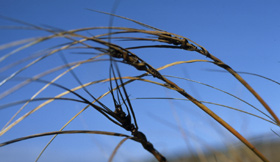

Past favourite plant winner

Past favourite plant finalist
Common names
pīngao, golden sand sedge, pikao
Biostatus
Native – Endemic taxon
Current conservation status
The conservation status of all known New Zealand vascular plant taxa at the rank of species and below were reassessed in 2022-2023 using the New Zealand Threat Classification System (NZTCS) – more information about this can be found on the NZTCS website. This report includes replaces all previous NZTCS lists for vascular plants. Previous assessments can be found here.
- Conservation status of vascular plants in Aotearoa New Zealand, 2023. 2024. Peter J. de Lange, Jane Gosden, Shannel P. Courtney, Alexander J. Fergus, John W. Barkla, Sarah M. Beadel, Paul D. Champion, Rowan Hindmarsh-Walls, Troy Makan and Pascale Michel Department of Conservation. Source: NZTCS and licensed by DOC for reuse under the Creative Commons Attribution 4.0 International licence.
2023 | At Risk – Declining | Qualifiers: CI, PD, RR
Category
Vascular
Structural class
Sedges
Flower colours
White, Yellow
Detailed description
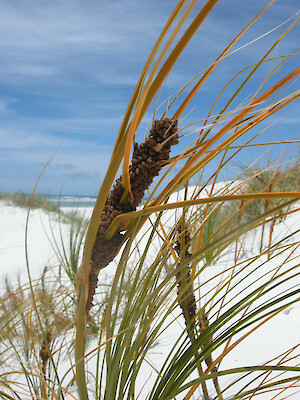
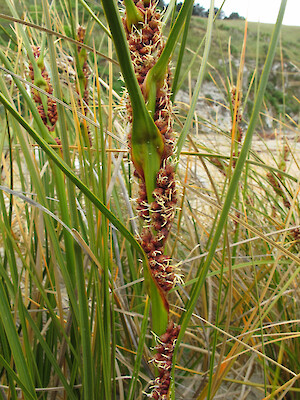
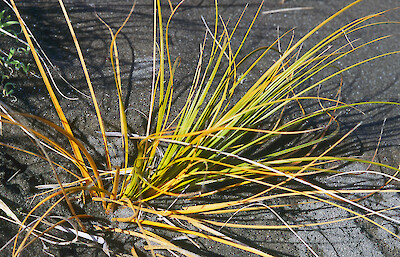
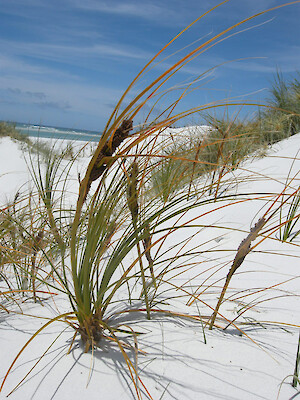
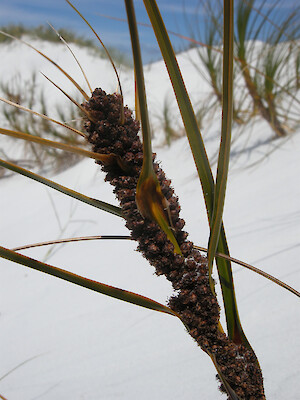
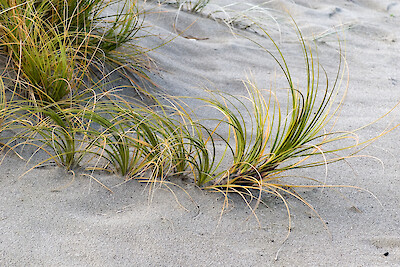
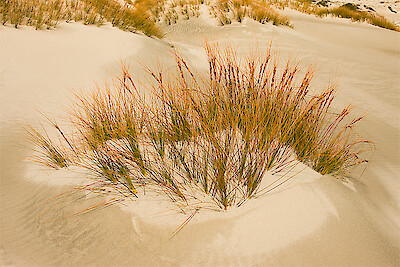
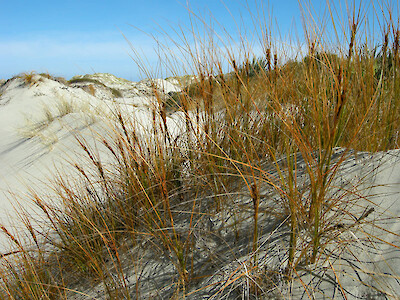
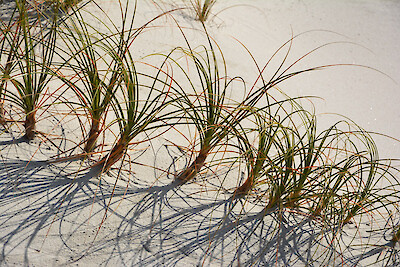
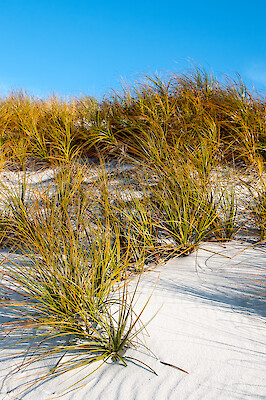
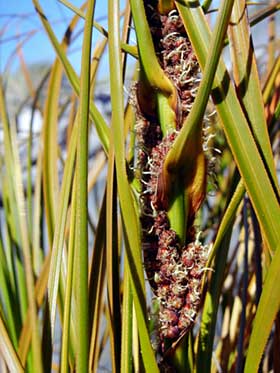
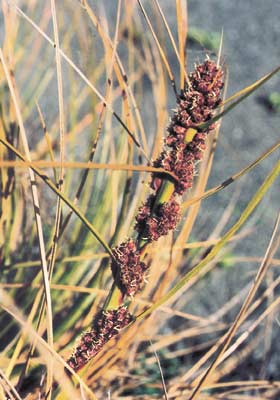
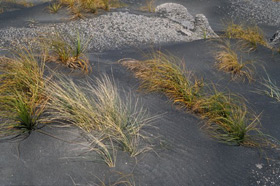
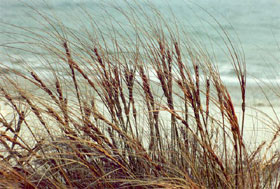
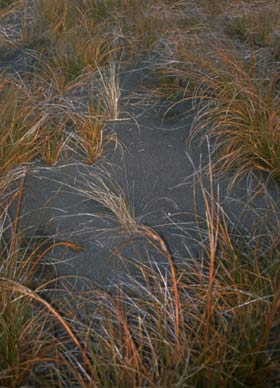
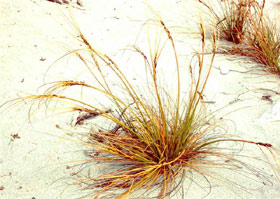
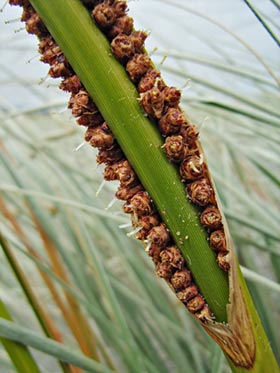
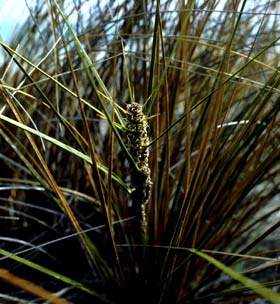
Stout, yellow-green when fresh, golden when dry, shortly creeping plants with stiff culms and very harsh leaves. Rhizome lignaceous, 10–15 mm diameter, shortly creeping, covered by red-brown to brown, fibrous strands left from decaying leaf-sheaths. Culms numerous, 0.3–1.2 m tall, 2–4 mm diameter, erect, obtusely trigonous, very leafy at the base. Leaves numerous, ± = culms, 2–5 mm. wide, stiffly erect or weakly curved, coriaceous, linear, concavo-convex or ± channelled, margins and keel sharply denticulate, narrowed to a long, trigonous tip; sheaths submembranous, much broader than leaves, with numerous, red-brown veins. Inflorescence, paniculate 70–300 mm long, each panicle composed of c. 12 confluent clusters of sessile spikelets, each cluster subtended by a rigid leaf-like bract adnate to the axis and broadening at base to an open sheath, lower bracts much exceeding inflorescence. Spikelets 4–5 mm. long, dark red-brown. Glumes coriaceous, rigid, broadly ovate, obtuse, distinctly nerved, finely mucronulate, the lower ones ± keeled. Nut 2.5–4.0 × 2.0–2.5 mm, broadly obovoid, concavo-convex, compressed, obtuse, dark brown, smooth and shining.
Similar taxa
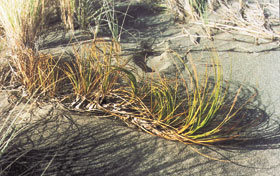
None. Easily recognised by the widely spreading rhizomatous growth habit, distinctive overall orange colouring of the plant, paniculate spiral seed heads, and by the possession of a gynophore (see taxonomic notes).
Distribution
Endemic. New Zealand: North, South, Stewart and Chatham Islands.
Habitat
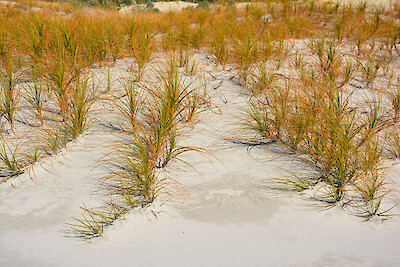
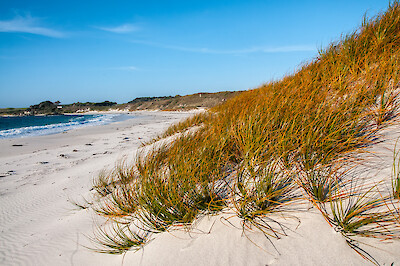
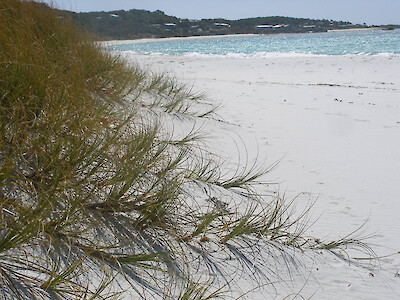
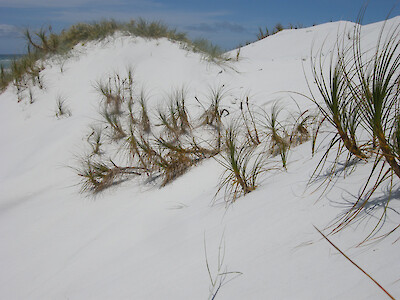
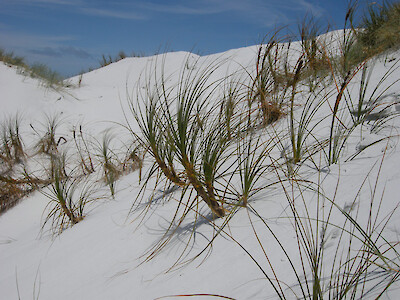
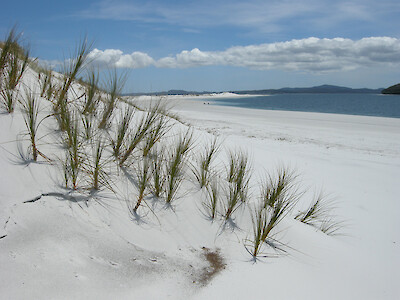
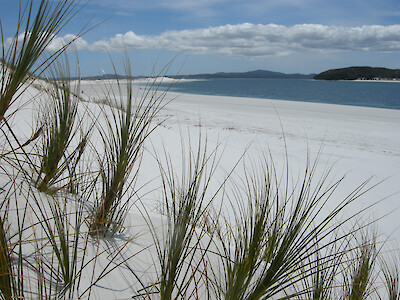
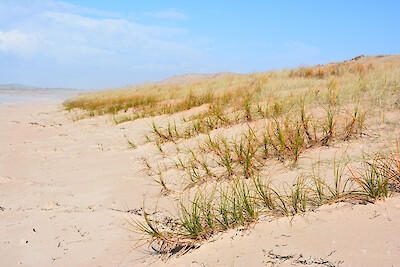
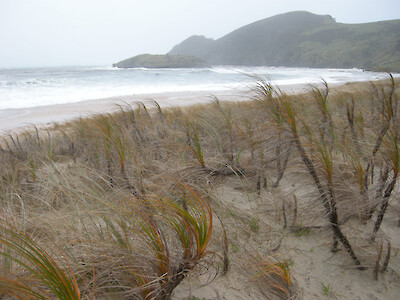
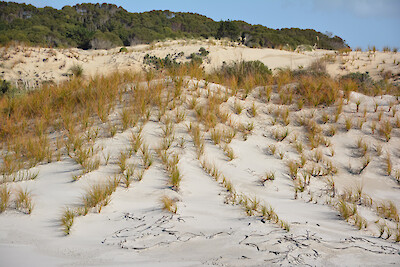
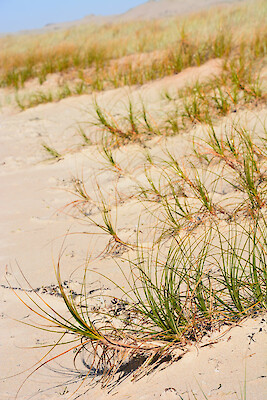
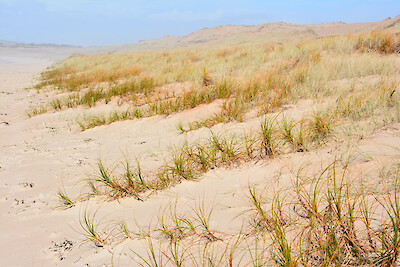
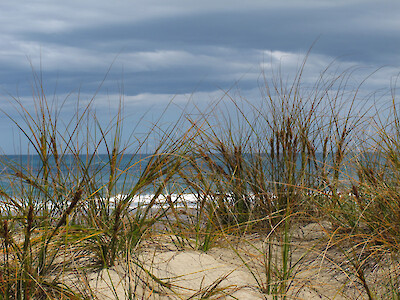
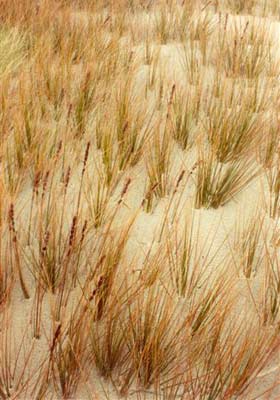
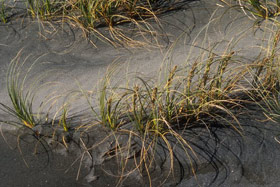
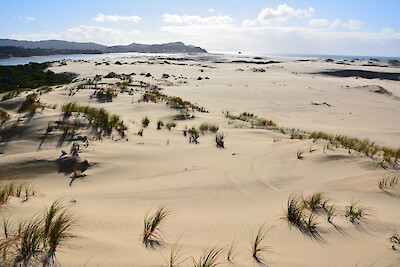
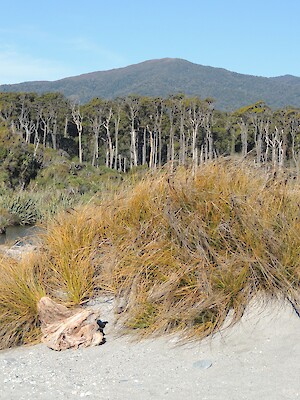
Coastal sand dune systems. It favours sloping and more or less unstable surfaces, growing mostly on the front face of active dunes but also on the rear face and rear dunes, provided that there is wind-blown sand. It can also grow on the top of sand hills. It is effective at trapping sand.
Threats
Competition from marram grass (Ammophila arenaria), dune stabilisation and compaction, harvesting, trampling, vehicle traffic and browsing animals. Because this species is wind-pollinated, individuals of small, isolated populations may not receive pollen during flowering, and therefore there will be no seed production. Browsing and trampling by sheep and horses; browsing of seedlings by possums; seed destruction by rodents; fire and insensitive harvesting.
Detailed taxonomy
Genus
Family
Synonyms
Isolepis spiralis A.Rich., Desmoschoenus spiralis (A.Rich.) Hook.f., Anthophyllum urvillei Steudel, Scirpus frondosus Boeck, Scirpus spiralis (A.Rich.) Druce
Taxonomic notes
Desmoschoenus has been submerged into the mainly South African genus Ficinia (Muasya & de Lange 2010) based on an analysis of molecular and morphological characters. Multiple DNA markers showed that Desmoschoenus was firmly embedded within Ficinia, and that, along with its possession of a gynophore (a small cup like structure found at the base of ovary/nut otherwise known only from Ficinia) were considered firm reasons for its merger. Furthermore Desmoschoenus closely resembles those Ficinia which the molecular study placed it with. Read more about this research: A new name and genus for pingao
Endemic taxon
Yes
Endemic genus
No
Endemic family
No
Ecology
Flowering
Spring and early summer
Fruiting
Late summer
Propagation technique
Can be grown from fresh seed and cuttings. Fresh seed germinates easily but plants resent root disturbance, and they should be grown in root trainers. Although it will tolerate most soils and moisture regimes, it obviously does best in coastal situations within active sand dunes.
Other information
Cultivation
Sold by a number of specialist native plant nurseries, such as Coastlands Nursery. Popular plant for dune restoration.
Plant of the Month
This plant has been featured as a Plant of the Month – see Trilepidea: NZPCN newsletter for September 2003 for the full story.
Etymology
ficinia: Named after Heinrich David Auguste Ficinus, 19th century German botanist
spiralis: From the Latin spira ‘coil’ or ‘twist’ and -alis ‘resembling’, resembling a twist or corkscrew, spiral-shaped
NVS code
The National Vegetation Survey (NVS) Databank is a physical archive and electronic databank containing records of over 94,000 vegetation survey plots - including data from over 19,000 permanent plots. NVS maintains a standard set of species code abbreviations that correspond to standard scientific plant names from the Ngä Tipu o Aotearoa - New Zealand Plants database.
FICSPI
Chromosome number
2n = 30
Previous conservation statuses
The conservation status of all known New Zealand vascular plant taxa at the rank of species and below were reassessed in 2022-2023 using the New Zealand Threat Classification System (NZTCS) – more information about this can be found on the NZTCS website. This report includes replaces all previous NZTCS lists for vascular plants. Previous assessments can be found here.
- Conservation status of vascular plants in Aotearoa New Zealand, 2023. 2024. Peter J. de Lange, Jane Gosden, Shannel P. Courtney, Alexander J. Fergus, John W. Barkla, Sarah M. Beadel, Paul D. Champion, Rowan Hindmarsh-Walls, Troy Makan and Pascale Michel Department of Conservation. Source: NZTCS and licensed by DOC for reuse under the Creative Commons Attribution 4.0 International licence.
2017 | At Risk – Declining | Qualifiers: PD, RR
2012 | At Risk – Declining | Qualifiers: PD, RR
2009 | At Risk – Relict | Qualifiers: CD, Inc, Sp
2004 | Gradual Decline
Regional conservation statuses
Northland: 2026 | Regionally At Risk – Regionally Declining | Qualifiers: DPS DPT
Current regional threat status assessments prepared according to Crisp et al. (2025) are displayed when available. The Northland conservation status information is sourced from the “Conservation status of indigenous vascular plants in Northland | Taitokerau” Ford et al. 2026 report.
Auckland: 2025 | Regionally At Risk – Regionally Declining | Qualifiers: CD, DPS, DPT, PF, RR
Current regional threat status assessments prepared according to Crisp et al. (2025) are displayed when available. The Auckland conservation status information is sourced from the “Conservation status of vascular plant species in Tāmaki Makaurau / Auckland” Simpkins E et al. 2025 report.
Otago: 2025 | Regionally Threatened – Regionally Critical | Qualifiers: CI, PF, RF, RR
Current regional threat status assessments prepared according to Crisp et al. (2025) are displayed when available. The Otago conservation status information is sourced from the “Conservation Status of Indigenous Vascular Plants in Otago, 2025” Jarvie S et al. (2025) report.
Wellington: 2025 | Regionally Threatened – Regionally Vulnerable
Current regional threat status assessments prepared according to Crisp et al. (2025) are displayed when available. The Wellington conservation status information is sourced from the “Conservation status of indigenous vascular plants in the Wellington region” Enright P et al. 2025 report.
Referencing and citations
References and further reading
Moore LB, Edgar E. 1970. Flora of New Zealand, Volume II. Indigenous Tracheophyta: Monocotyledones except Gramineae. Government Printer, Wellington, NZ. 354 p.
Muasya AM, de Lange PJ. 2010. Ficinia spiralis (Cyperaceae) a new genus and combination for Desmoschoenus spiralis. New Zealand Journal of Botany 48: 31–39. https://doi.org/10.1080/00288251003660703.
Attribution
Fact sheet prepared for NZPCN by P.J. de Lange (6 August 2006). Description adapted from Moore & Edgar (1970).
Some of this factsheet information is derived from Flora of New Zealand Online and is used under a Creative Commons Attribution 3.0 New Zealand licence.