
Mida salicifolia
Common names
maire
Biostatus
Native – Endemic taxon
Current conservation status
The conservation status of all known New Zealand vascular plant taxa at the rank of species and below were reassessed in 2022-2023 using the New Zealand Threat Classification System (NZTCS) – more information about this can be found on the NZTCS website. This report includes replaces all previous NZTCS lists for vascular plants. Previous assessments can be found here.
- Conservation status of vascular plants in Aotearoa New Zealand, 2023. 2024. Peter J. de Lange, Jane Gosden, Shannel P. Courtney, Alexander J. Fergus, John W. Barkla, Sarah M. Beadel, Paul D. Champion, Rowan Hindmarsh-Walls, Troy Makan and Pascale Michel Department of Conservation. Source: NZTCS and licensed by DOC for reuse under the Creative Commons Attribution 4.0 International licence.
2023 | At Risk – Declining | Qualifiers: DPS, DPT
Category
Vascular
Structural class
Trees & Shrubs - Dicotyledons
Simplified description
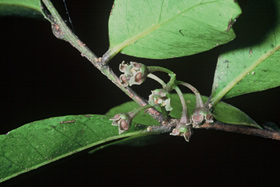
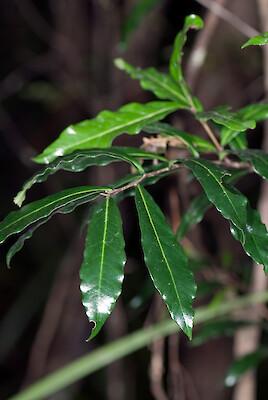
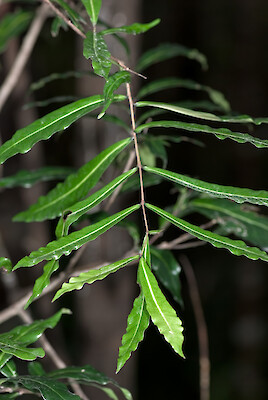
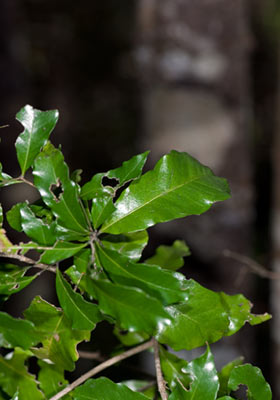
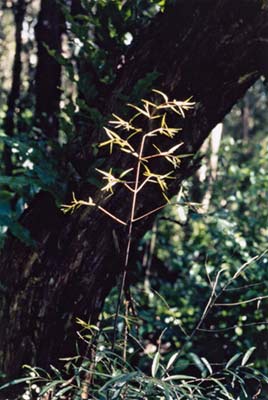
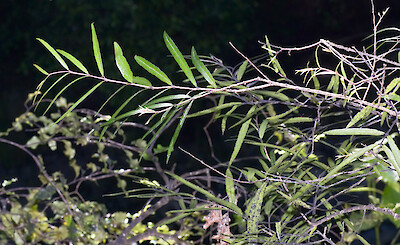
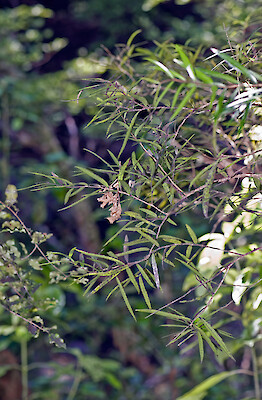
Small tree bearing a variety of shapes of dark green glossy leaves (that are sometimes in pairs) paler underneath with small dots inhabiting the North Island. Leaves narrow and thin or rounded, to 12cm long. Flowers small. Fruit red, in small clsuters at base of leaves.
Flower colours
Green, Red/Pink
Detailed description
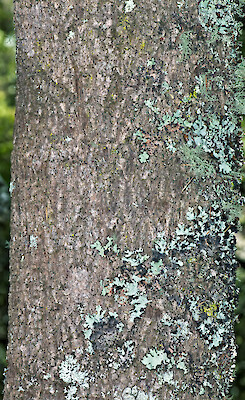
Small hemiparasitic, glabrescent to glabrous tree up to 6 m tall. Bark smooth, grey to grey-black, branchlets slender, brittle. Petioles slender, short, somewhat fleshy. Leaves mostly alternate, sometimes with a few subopposite to opposite, (50)–100–(120) × (10)–20–30–(40) mm, upper surface dark green to yellow green, very glossy, undersides paler and mat, lamina variable in shape ranging from linear, narrow-lanceolate, ovate to oblong-ovate, broad-elliptic to rhomboid, with all types occasionally present on the same individual, acute, subacuminate to acuminate, somewhat papery, membranous or semi-coriaceous, margins entire, sinuate or distinctly “scalloped”. Inflorescence and axillary, few-flowered raceme. Pedicels c. 5 mm. Flowers gynodioecious, greenish, pink or red. Tepals (4)–5–(6), broadly triangular, caducous. Stamens (4)–5–(6), subtended by small hair tufts. Disc (4)–5–(6)-lobed. Stigma 2–4-lobed. Fruit 7–12 × 6–8 mm, narrow-turbinate, bright red, receptacle rim persistent. Description adapted from Allan (1961).
Similar taxa
Most commonly confused in the vegetative state with species of maire (Nestegis) from which it can be distinguished because Nestegis spp. have leaves that are always opposite, not distichous and have finely spotted leaf surfaces (caused by glandular leaf hairs). In Nestegis spp. there are always short hairs on the young growth and the vegetative buds (which are usually two) are pointed and distinctly maroon-coloured.
Distribution
Endemic. New Zealand: North Island from North Cape to Wellington but scarce south of the Waikato and Bay of Plenty.
Habitat
Coastal to lowland forest. Often in association with kauri (Agathis australis) but also common in other mixed Podocarp forests. A generalist root parasite.
Threats
Threatened by possum, goat and deer browse, and in some places almost extinct from the actions of these animals. However it is also extremely common over large parts of its range, though most abundant on possum-free islands or sites with rigorous possum control.
Detailed taxonomy
Genus
Family
Synonyms
Mida cunninghamii Chatin, M. myrtifolia A. Cunn., M. salicifolia var. myrtifolia (A.Cunn.) Allan, M. eucalyptoides A.Cunn. Fusanus cunninghamii Benth. et Hook.f. ex Kirk,
Taxonomic notes
Mida and Nanodea have been segregated from the Santalaceae to form a new family the Nanodeaceae (Nickrent et al. 2010).
Endemic taxon
Yes
Endemic genus
Yes
Endemic family
No
Ecology
Flowering
September–November
Fruiting
October–February
Propagation technique
Difficult and should not be removed from the wild.
Other information
Plant of the Month
This plant has been featured as a Plant of the Month – see Trilepidea: NZPCN newsletter for June 2009 for the full story.
Etymology
mida: From maire, the Maori name for this species
salicifolia: From the Latin Salix ‘willow’ and -folia ‘leaf’, meaning ‘willow-leaved’
NVS code
The National Vegetation Survey (NVS) Databank is a physical archive and electronic databank containing records of over 94,000 vegetation survey plots - including data from over 19,000 permanent plots. NVS maintains a standard set of species code abbreviations that correspond to standard scientific plant names from the Ngä Tipu o Aotearoa - New Zealand Plants database.
MIDSAL
Chromosome number
2n = 66
Previous conservation statuses
The conservation status of all known New Zealand vascular plant taxa at the rank of species and below were reassessed in 2022-2023 using the New Zealand Threat Classification System (NZTCS) – more information about this can be found on the NZTCS website. This report includes replaces all previous NZTCS lists for vascular plants. Previous assessments can be found here.
- Conservation status of vascular plants in Aotearoa New Zealand, 2023. 2024. Peter J. de Lange, Jane Gosden, Shannel P. Courtney, Alexander J. Fergus, John W. Barkla, Sarah M. Beadel, Paul D. Champion, Rowan Hindmarsh-Walls, Troy Makan and Pascale Michel Department of Conservation. Source: NZTCS and licensed by DOC for reuse under the Creative Commons Attribution 4.0 International licence.
2017 | At Risk – Declining | Qualifiers: DP
2012 | Not Threatened
2009 | Not Threatened | Qualifiers: RF
2004 | Gradual Decline
Regional conservation statuses
Auckland: 2025 | Regionally At Risk – Regionally Declining | Qualifiers: CD, DPR, DPS, DPT, PF, RF
Current regional threat status assessments prepared according to Crisp et al. (2025) are displayed when available. The Auckland conservation status information is sourced from the “Conservation status of vascular plant species in Tāmaki Makaurau / Auckland” Simpkins E et al. (2025) report.
Northland: 2026 | Regionally At Risk – Regionally Declining
Current regional threat status assessments prepared according to Crisp et al. (2025) are displayed when available. The Northland conservation status information is sourced from the “Conservation status of indigenous vascular plants in Northland | Taitokerau” Ford et al. 2026 report.
Referencing and citations
References and further reading
Allan HH. 1961. Flora of New Zealand, Volume I. Indigenous Tracheophyta: Psilopsida, Lycopsida, Filicopsida, Gymnospermae, Dicotyledones. Government Printer, Wellington, NZ. 1085 p.
Gardner RO. 1997. Mida salicifolia our native sandalwood. Auckland Botanical Society Journal 52: 42–43.
Nickrent DL, Malecot V, Vidal-Russell R, Der JP. 2010. A revised classification of the Santalales. Taxon 59(2): 538–558. https://doi.org/10.1002/tax.592019.
Moorfield JC. 2005. Te Aka : Māori-English, English-Māori dictionary and index. Longman/Pearson Education, Auckland, NZ. 357 p.
Attribution
Prepared by P.J. de Lange April 2004. Description adapted from Allan (1961).
Some of this factsheet information is derived from Flora of New Zealand Online and is used under a Creative Commons Attribution 3.0 New Zealand licence.