
Ranunculus macropus
Common name
swamp buttercup
Synonyms
Ranunculus longipetiolatus Colenso
Family
Ranunculaceae
Flora category
Vascular – Native
Endemic taxon
Yes
Endemic genus
No
Endemic family
No
Structural class
Herbs - Dicotyledons other than Composites
NVS code
The National Vegetation Survey (NVS) Databank is a physical archive and electronic databank containing records of over 94,000 vegetation survey plots - including data from over 19,000 permanent plots. NVS maintains a standard set of species code abbreviations that correspond to standard scientific plant names from the Ngä Tipu o Aotearoa - New Zealand Plants database.
RANMAC
Chromosome number
2n = 96
Current conservation status
The conservation status of all known New Zealand vascular plant taxa at the rank of species and below were reassessed in 2017 using the New Zealand Threat Classification System (NZTCS) – more information about this can be found on the NZTCS website. This report includes a statistical summary and brief notes on changes since 2012 and replaces all previous NZTCS lists for vascular plants.
Please note, threat classifications are often suggested by authors when publications fall between NZTCS assessment periods – an interim threat classification status has not been assessed by the NZTCS panel.
- Conservation status of New Zealand indigenous vascular plants, 2017 . 2018. Peter J. de Lange, Jeremy R. Rolfe, John W. Barkla, Shannel P. Courtney, Paul D. Champion, Leon R. Perrie, Sarah M. Beadel, Kerry A. Ford, Ilse Breitwieser, Ines Schönberger, Rowan Hindmarsh-Walls, Peter B. Heenan and Kate Ladley. Department of Conservation. Source: NZTCS and licensed by DOC for reuse under the Creative Commons Attribution 4.0 International licence.
2017 | Data Deficient
Previous conservation statuses
2012 | Data Deficient
2009 | Data Deficient
2004 | Gradual Decline
Distribution
Endemic to the North and northern South Islands. In the North Island formerly widespread from the northern Waikato south to Wellington. Most recent collections come from the western Waikato, Rotorua Lakes District and East Cape to Hawke’s Bay. In the South Island, apparently always scarce, and there seem to have been few collections made over the last 20 or so years. Recently (2010) a population was found at Canadian Flats on the Taieri River in Otago, and scattered populations are present in wetlands on the Canterbury Plains west of Christchurch, and at Te Waihora/Lake Ellesmere.
Habitat
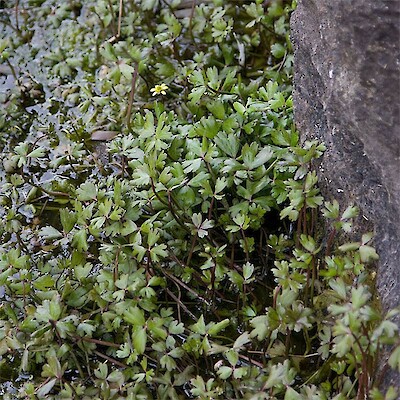
Coastal to lowland. Usually found in raupō (Typha orientalis) dominated wetlands where it grows in still moderately deep to deep water.
Wetland plant indicator status rating
Information derived from the revised national wetland plant list prepared to assist councils in delineating and monitoring wetlands (Clarkson et al., 2021 Manaaki Whenua – Landcare Research Contract Report LC3975 for Hawke’s Bay Regional Council). The national plant list categorises plants by the extent to which they are found in wetlands and not ‘drylands’. The indicator status ratings are OBL (obligate wetland), FACW (facultative wetland), FAC (facultative), FACU (facultative upland), and UPL (obligate upland). If you have suggestions for the Wetland Indicator Status Rating, please contact: [Enable JavaScript to view protected content]
OBL: Obligate Wetland
Almost always is a hydrophyte, rarely in uplands (non-wetlands).
Detailed description
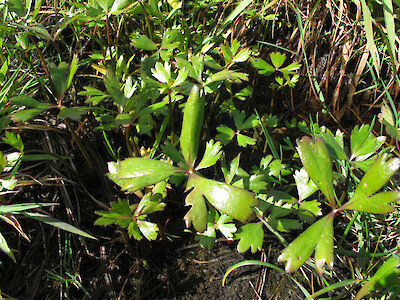
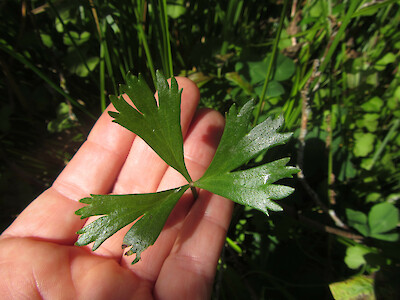
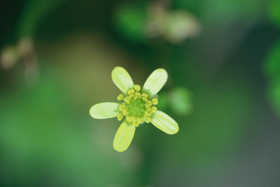
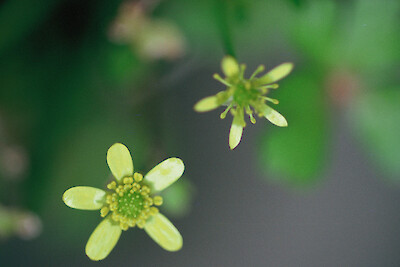
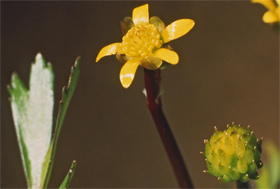
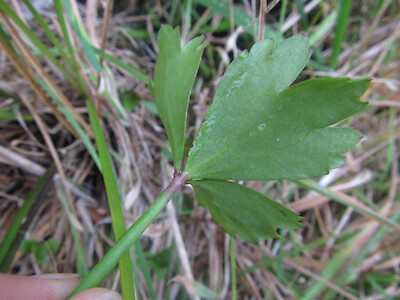
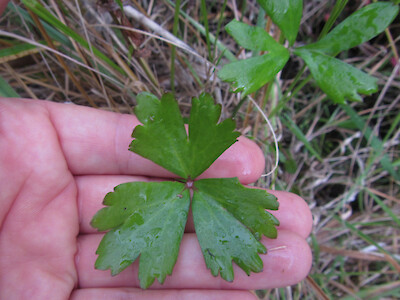
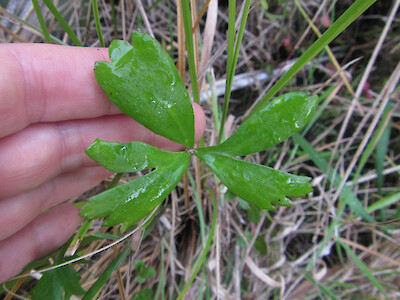
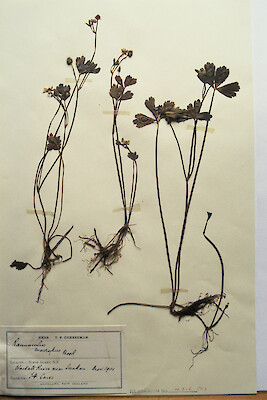
Semi-aquatic to aquatic herb. Rosettes tufted on stout creeping stems. Basal leaves on very stout petioles (7-)15-30(-40) mm x 5-10 mm, arising from bulbous nodes. Leaves ternate (15-)-20-40(-80) mm wide, leaflets sessile or shortly stalked, cuneiform, shallowly 3-fid, apices crenate, serrate or entire, lateral leaflets slightly to distinctly larger than terminal, caulien leaves few, similar to basal but smaller. Flowers (1-)3-5 per stem, 10-15(-20) mm diam., pedicels galbrous. Sepals speading or weakly recurved, glabrous. Petals (1-)3-5(-7), dark yellow, oblong to broadly oblong, shortly clawed, nectary single, 0.5-1(-1.5) mm from petal base. Receptacle with basal collar of bristles. Achenes 15-50(-65), hardly flattened, glabrous 1.5-2 mm, beak straight, 1-1.5 mm long.
Similar taxa
Confused with R. amphitrichus and R. glabrifolius. Species hybridizes with R. amphitrichus, the progeny of which are fertile (P. J. de Lange pers. obs.). Species is distinguished by the larger flower, with broad, irregularly spaced, oblong petals, whose nectary scale is virtually obscured by a dense cluster of carpels when viewed from above. In good habitat and growing conditions R. macropus is a very robust plant with very large, ternate leaves borne on stout petioles.
Flowering
September - April (but sporadic flowering may occur at anytime of the year)
Flower colours
Yellow
Fruiting
October - July
Propagation technique
Easy from the division of whole plants and from fresh seed. A wetland species which requires permanently damp but sunny situations, Good in shallow ponds.
Threats
Threatened by wetland drainage, modification and the spread of weeds. In large parts of its former range hybrids are now more commonly encountered than the actual species.
Etymology
ranunculus: From the Latin ‘rana’ frog, meaning little frog and probably refers to the plants typical marshy habit where frogs abound
macropus: Big foot
Where To Buy
Not commercially available.
Taxonomic notes
This species seems to be a shy flowerer, and is more often found in a sterile, vegetative state than reproductive. This trait is carried over into F1 hybrids. Hybrids are common wherever wetlands containing this species and R. amphitrichus have been modified, e..g, the wetlands of the lower Waikato. The taxonomic distinctiveness of Ranunculus macropus needs further study. It is truly, as Cheeseman (1925) makes clear a ‘critical species’.
Attribution
Fact Sheet prepared by P.J. de Lange (30 August 2003). Description based on Allan (1961), Webb et al. (1988) and fresh specimens.
References and further reading
Allan, H.H. 1961: Flora of New Zealand. Vol. I. Wellington, Government Printer
Cheeseman, T.F. 1925: Manual of the New Zealand Flora. Wellington, Government Printer.
Webb, C.J.; Sykes, W.R.; Garnock-Jones, P.J. 1988: Flora of New Zealand. Vol. IV. Christchurch, DSIR Botany Division.
NZPCN Fact Sheet citation
Please cite as: de Lange, P.J. (Year at time of access): Ranunculus macropus Fact Sheet (content continuously updated). New Zealand Plant Conservation Network. https://www.nzpcn.org.nz/flora/species/ranunculus-macropus/ (Date website was queried)