
Crassula ruamahanga







Biostatus
Native – Endemic taxon
Current conservation status
The conservation status of all known New Zealand vascular plant taxa at the rank of species and below were reassessed in 2022-2023 using the New Zealand Threat Classification System (NZTCS) – more information about this can be found on the NZTCS website. This report includes replaces all previous NZTCS lists for vascular plants. Previous assessments can be found here.
- Conservation status of vascular plants in Aotearoa New Zealand, 2023. 2024. Peter J. de Lange, Jane Gosden, Shannel P. Courtney, Alexander J. Fergus, John W. Barkla, Sarah M. Beadel, Paul D. Champion, Rowan Hindmarsh-Walls, Troy Makan and Pascale Michel Department of Conservation. Source: NZTCS and licensed by DOC for reuse under the Creative Commons Attribution 4.0 International licence.
2023 | At Risk – Naturally Uncommon | Qualifiers: Sp, DPS, DPT
Category
Vascular
Structural class
Herbs - Dicotyledons other than Composites
Flower colours
Red/Pink, White
Detailed description
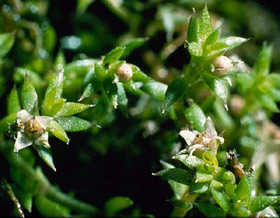
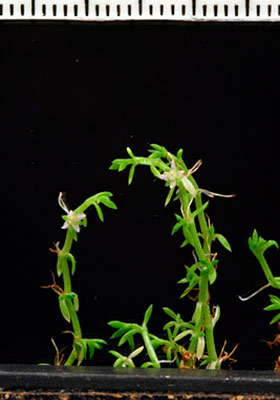
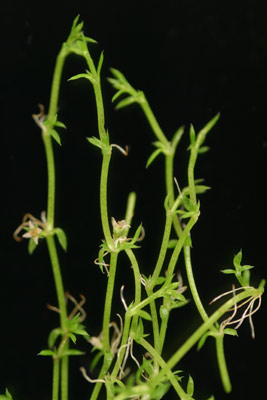
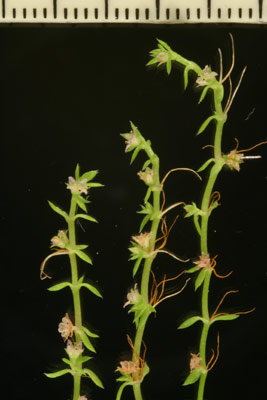
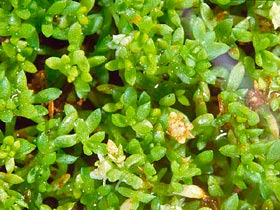
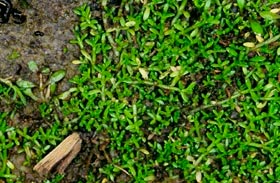
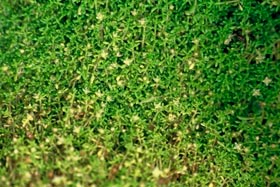
Perennial herb form small to large diffuse to dense bright green mats. Stems green or pink, prostrate, rooting at nodes, with ascending tips, much-branched. Leaves fused at base, 1.3-8 x 0.4-1.5 mm, 0.2-0.6 mm thick, lanceolate, linear-lanceolate or elliptic lanceolate, flattened or slightly concave above, convex beneath, apex usually sharply acute, shortly acuminate or apiculate, sometimes obtuse. Flowers solitary in leaf axils, scarcely fragrant, stellate, 4-merous, 1.8-2.5 mm diam.; pedicels 0.5-1 mm, scarcelty elongating at fruiting, Calyx lobes 0.8-1 x 0.4-0.6 mm, triangular or triangular-ovate, white or pink-flushed, acute, sharply acute, occasionally obtuse, slightly or much > calyx. Scales 0.5 mm long, cuneate. Follicles smooth. Seed 0.5 mm long.
Similar taxa
Crassula hunua A.P.Druce, from which it is only doubtfully distinct. From that species it is best distinguished by the acute tipped leaves and petals, persistent presence of a leaf apiculus, and generally by the sepal length exceeding the petals. However these characters seem to intergrade with C. hunua.
Distribution
Endemic. Uncommon, known from historic and extant records from Wairoa River near Dargaville south to Stewart Island and including Chatham Island. In the North Island most common in the Wairarapa, and in the South Island on the Southland plains
Habitat
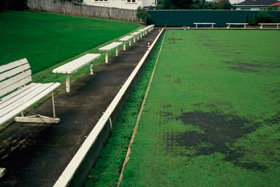
Sea level to lowland (rarely lower montane) (0-500 m a.s.l.). An opportunistic species which can be expected to occur in any suitably damp, open habitat. It has been collected from near estuarine conditions through to leaking pipes in urban centres, gravel foot paths, and bowling green turf. Its favoured habitat seems to be river sides and muddy hollows and pools within lowland alluvial forest.
Threats
Competition from other plants. Habitat destruction through heavy stock use, by cattle in particular.
Detailed taxonomy
Genus
Family
Synonyms
Tillaea acutifolia Kirk, Crassula acutifolia (Kirk) A.P.Druce et D.R.Given non. Crassula acutifolia Lam.; Crassula hunua A.P.Druce; Tillaea pusilla Kirk var. pusilla, Tillaea pusilla var. brevia Kirk, Crassula pusilla A.P.Druce et D.R.Given non C. pusilla Schönland
Taxonomic notes
Crassula hunua is now included within C. ruamahanga (see: de Lange et al 2007)
Endemic taxon
Yes
Endemic genus
No
Endemic family
No
Ecology
Flowering
Flowers may be present throughout the year
Fruiting
Flowers may be present throughout the year
Life cycle and dispersal
Minute follicles are dispersed by wind and water and possiblty also by attachment (Thorsen et al., 2009).
Propagation technique
Easy from rooted pieces, stem cuttings and seed. Can become a troublesome weed in damp soils and shaded sites, but makes an excellent ground cover or lawn on poorly drained soils. Flowers are sweetly scented.
Wetland plant indicator status rating
Information derived from the revised national wetland plant list prepared to assist councils in delineating and monitoring wetlands (Clarkson et al., 2021 Manaaki Whenua – Landcare Research Contract Report LC3975 for Hawke’s Bay Regional Council). The national plant list categorises plants by the extent to which they are found in wetlands and not ‘drylands’. The indicator status ratings are OBL (obligate wetland), FACW (facultative wetland), FAC (facultative), FACU (facultative upland), and UPL (obligate upland). If you have suggestions for the Wetland Indicator Status Rating, please contact: [Enable JavaScript to view protected content]
FACW: Facultative Wetland
Usually is a hydrophyte but occasionally found in uplands (non-wetlands).
Other information
Plant of the Month
This plant has been featured as a Plant of the Month – see Trilepidea: NZPCN newsletter for July 2004 for the full story.
Etymology
crassula: From the Latin crassus ‘thick’, meaning ‘rather thick’
Chromosome number
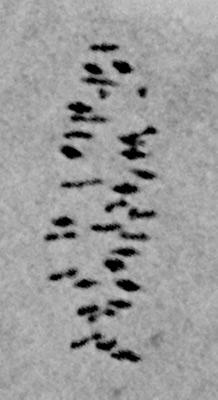
2n = 42,64,70,84,90
Previous conservation statuses
The conservation status of all known New Zealand vascular plant taxa at the rank of species and below were reassessed in 2022-2023 using the New Zealand Threat Classification System (NZTCS) – more information about this can be found on the NZTCS website. This report includes replaces all previous NZTCS lists for vascular plants. Previous assessments can be found here.
- Conservation status of vascular plants in Aotearoa New Zealand, 2023. 2024. Peter J. de Lange, Jane Gosden, Shannel P. Courtney, Alexander J. Fergus, John W. Barkla, Sarah M. Beadel, Paul D. Champion, Rowan Hindmarsh-Walls, Troy Makan and Pascale Michel Department of Conservation. Source: NZTCS and licensed by DOC for reuse under the Creative Commons Attribution 4.0 International licence.
2017 | At Risk – Naturally Uncommon | Qualifiers: DP, Sp
2012 | At Risk – Naturally Uncommon | Qualifiers: Sp
2009 | At Risk – Naturally Uncommon
2004 | Sparse
Regional conservation statuses
Auckland: 2025 | Regionally Threatened – Regionally Endangered | Qualifiers: DPR, DPS, DPT, EF, RR
Current regional threat status assessments prepared according to Crisp et al. (2025) are displayed when available. The Auckland conservation status information is sourced from the “Conservation status of vascular plant species in Tāmaki Makaurau / Auckland” Simpkins E et al. (2025) report.
Otago: 2025 | Regionally Threatened – Regionally Critical | Qualifiers: DPR, DPS, DPT, PF, Sp
Current regional threat status assessments prepared according to Crisp et al. (2025) are displayed when available. The Otago conservation status information is sourced from the “Conservation Status of Indigenous Vascular Plants in Otago, 2025” Jarvie S et al. (2025) report.
Northland: 2026 | Regionally Threatened – Regionally Critical
Current regional threat status assessments prepared according to Crisp et al. (2025) are displayed when available. The Northland conservation status information is sourced from the “Conservation status of indigenous vascular plants in Northland | Taitokerau” Ford et al. 2026 report.
Referencing and citations
References and further reading
de Lange, P.J.; Heenan, P.B.; Keeling, D.J.; Murray, B.G.; Smissen, R.; Sykes, W.R. 2008: Biosystematics and Conservation: A Case Study with Two Enigmatic and Uncommon Species of Crassula from New Zealand. Annals of Botany 101: 881-899
Thorsen, M. J.; Dickinson, K. J. M.; Seddon, P. J. 2009. Seed dispersal systems in the New Zealand flora. Perspectives in Plant Ecology, Evolution and Systematics 11: 285-309
Attribution
Fact Sheet by P.J. de Lange 4 May 2005. Description from de Lange et al. (2009).
NZPCN Fact Sheet citation
Please cite as: de Lange, P.J. (Year at time of access): Crassula ruamahanga Fact Sheet (content continuously updated). New Zealand Plant Conservation Network. https://www.nzpcn.org.nz/flora/species/crassula-ruamahanga/ (Date website was queried)