
Clianthus maximus

Past favourite plant finalist

Past favourite plant winner
Common names
kākābeak, kōwhai ngutu-kākā, kākā beak
Biostatus
Native – Endemic taxon
Current conservation status
The conservation status of all known New Zealand vascular plant taxa at the rank of species and below were reassessed in 2022-2023 using the New Zealand Threat Classification System (NZTCS) – more information about this can be found on the NZTCS website. This report includes replaces all previous NZTCS lists for vascular plants. Previous assessments can be found here.
- Conservation status of vascular plants in Aotearoa New Zealand, 2023. 2024. Peter J. de Lange, Jane Gosden, Shannel P. Courtney, Alexander J. Fergus, John W. Barkla, Sarah M. Beadel, Paul D. Champion, Rowan Hindmarsh-Walls, Troy Makan and Pascale Michel Department of Conservation. Source: NZTCS and licensed by DOC for reuse under the Creative Commons Attribution 4.0 International licence.
2023 | Threatened – Nationally Critical | Qualifiers: CD, RF, Sp
Category
Vascular
Structural class
Trees & Shrubs - Dicotyledons
Simplified description
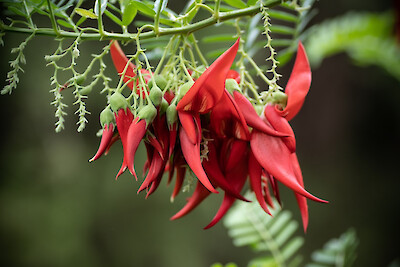
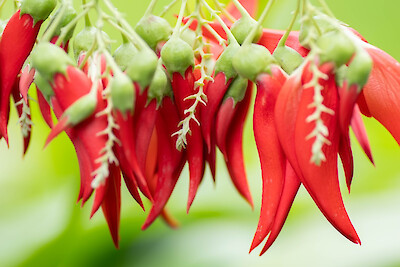
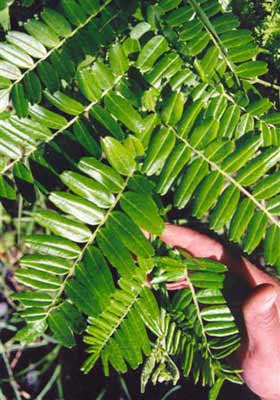
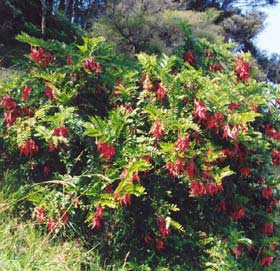
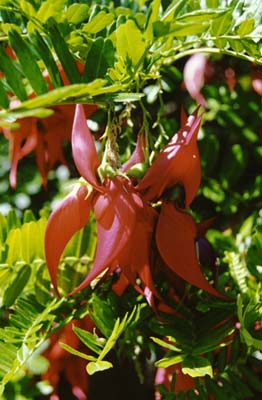
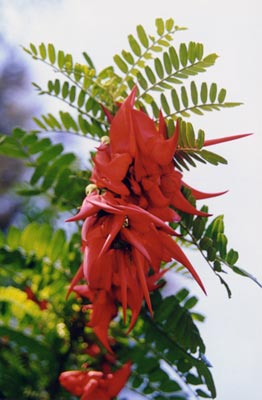
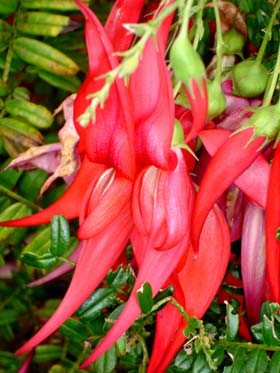
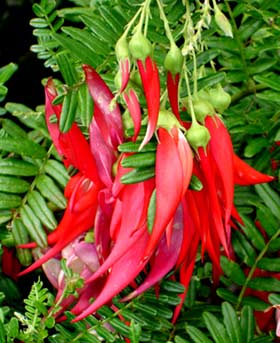
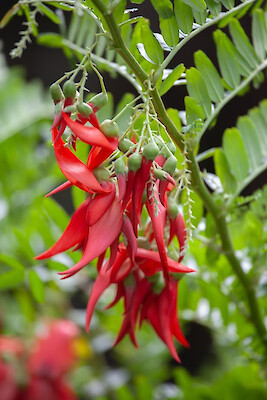
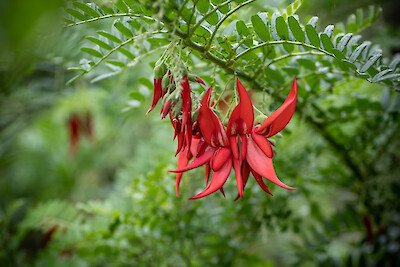
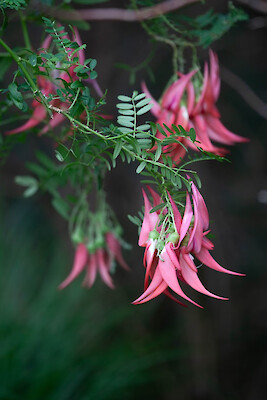
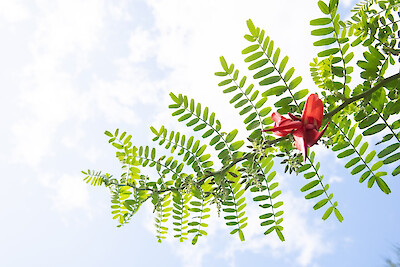
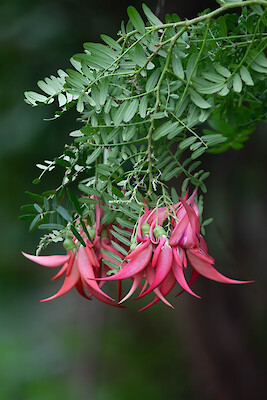
Rare (common in cultivation) small bushy shrub with drooping clusters of red sharp-tipped flowers. Leaves with many pairs of glossy leaflets arranged along a central stalk. Flowers 80mm long. Fruit a green pea-like pod that splits releasing the numerous hard small blotched seeds.
Flower colours
Black, Red/Pink
Detailed description
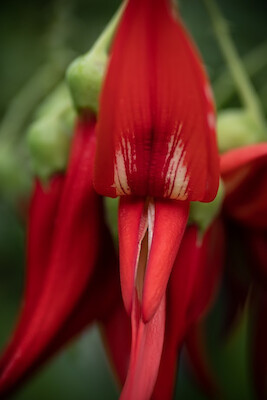
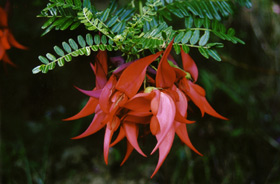
Shrub 1.5-6 m tall. Wood soft, stems “watery” easily broken. Branchlets semi-erect to weakly ascending, often decurved. Leaves 15-25 cm long, imparipinnate, with 15-30 pairs of subsessile leaflets. Leaflets, dark green, upper surface shiny (very glossy) 150-300 mm, linear-oblong, apex retuse or rounded. Inflorescences racemose, 15-30-flowered, located in leaf axils near branch apices. Flowers 80 mm, dark scarlet. Standard ovate-acuminate, 60 mm, dark scarlet, with a dark maroon (almost black blotch) and usually lacking stripes (these if present indistinct, often dotted; wings 30 mm long, lanceolate-falcate; keel 60 mm long, falcate-acuminate, dark scarlet. Pods long persistent, 80 mm, at first green and turgid, drying black and splitting open for entire length. Seeds numerous, c.1-1.5 mm diam, grey various striped or blotched with black, embedded in wispy grey, floccose hairs.
Similar taxa
Closely related to C. puniceus which has mat-green foliage, whose upper leaf surface is often slightly glaucous in colour. C. maximus leaves are dark green, and the upper leaf surface very glossy. C. puniceus flowers are slightly smaller, the standard is conspicuously striped white, and the spur blotched or striped white as well. C. maximus flowers are larger, very dark red, blotched dark purple-black near the base (very rarely with a few faint white stripes) and the spur is uniformly dark red.
Distribution
Endemic. North Island. Formerly on Great Barrier Island (Aotea Island). Still present in scattered populations from the East Coast of the North Island from Te Araroa south to northern Hawke’s Bay and Te Urewera in the west.
Habitat
Like the closely related C. puniceus (G.Don) Sol. ex Lindl. this species prefers early to mid successional shrubland habitats dominated by flax (Phormium cookianum Le Jolis, and P. tenax J.R.Forst et G.Forst) and tutu (Coriaria arborea Lindsay) in coastal, lowland and montane habitats. Often found along the tops and bases of unstable cliff faces or rock falls. Some habitats may not be natural, as this species, was said to have been grown by Maori, and many inland associations occur in the vicinity of former pa, kainga, gardens or canoe haul outs.
Threats
Though more widespread than C. puniceus this species is now at a very serious risk of extinction. Only 153 mature plants are known from the wild and at all sites they are threatened by a diverse range of introduced browsing animals, diseases, and natural senescence. Many populations occur in low scrub where they are threatened by fire, weed control operations, natural succession, and the unstable, erosion prone nature of the habitats in which they grow.
Overview of recovery work here.
Detailed taxonomy
Genus
Family
Synonyms
Clianthus puniceus var. maximus (Colenso) Kirk
Endemic taxon
Yes
Endemic genus
Yes
Endemic family
No
Ecology
Flowering
May flower throughout the year. However plants are mostly found in flower between August and January
Fruiting
Seed pods may be present at any time of the year
Life cycle and dispersal
Seeds are wind dispersed (Thorsen et al., 2009).
Propagation technique
Easily grown from seed, semi-hardwood cuttings, and stem layerings. Plants tend to be short-lived in cultivation (2-4 years), and benefit from hard pruning after flowering. Kaka beak is vulnerable to a range of common garden pests which include slugs and snails, it can be severely defoliated, by these animals, and young plants may be killed completely. Caterpillars, mites - which cause witches brooms, and various fungal diseases will also kill plants. To combat these problems grow plants in fertile, well drained, sunny sites free from surrounding shrubs. Despite its northerly distribution, kaka beak often does best in Southland, and is very tolerant of snowfall, and light frosts.
Other information
Cultivation
Now common in cultivation and widely sold. But prior to the early 1990s this species was virtually unknown in cultivation, most if not all horticultural stock then available being referrable to C. puniceus s.s.
Extra information
New Zealand Geographic article about kākābeak restoration work.
Etymology
clianthus: From Greek ‘kleios’ glory and ‘anthos’ flower, meaning glory flower
NVS code
The National Vegetation Survey (NVS) Databank is a physical archive and electronic databank containing records of over 94,000 vegetation survey plots - including data from over 19,000 permanent plots. NVS maintains a standard set of species code abbreviations that correspond to standard scientific plant names from the Ngä Tipu o Aotearoa - New Zealand Plants database.
CLIMAX
Chromosome number
2n = c.32
Previous conservation statuses
The conservation status of all known New Zealand vascular plant taxa at the rank of species and below were reassessed in 2022-2023 using the New Zealand Threat Classification System (NZTCS) – more information about this can be found on the NZTCS website. This report includes replaces all previous NZTCS lists for vascular plants. Previous assessments can be found here.
- Conservation status of vascular plants in Aotearoa New Zealand, 2023. 2024. Peter J. de Lange, Jane Gosden, Shannel P. Courtney, Alexander J. Fergus, John W. Barkla, Sarah M. Beadel, Paul D. Champion, Rowan Hindmarsh-Walls, Troy Makan and Pascale Michel Department of Conservation. Source: NZTCS and licensed by DOC for reuse under the Creative Commons Attribution 4.0 International licence.
2017 | Threatened – Nationally Critical | Qualifiers: CD, RF, Sp
2012 | Threatened – Nationally Critical | Qualifiers: CD, RF
2009 | Threatened – Nationally Critical | Qualifiers: RF, CD
2004 | Threatened – Nationally Endangered
Regional conservation statuses
Auckland: 2025 | Regionally Extirpated
Current regional threat status assessments prepared according to Crisp et al. (2025) are displayed when available. The Auckland conservation status information is sourced from the “Conservation status of vascular plant species in Tāmaki Makaurau / Auckland” Simpkins E et al. 2025 report.
Referencing and citations
References and further reading
Heenan, P.B. 2000: Clianthus (Fabaceae) in New Zealand: a reappraisal of Colenso’s taxonomy. New Zealand Journal of Botany 38(3): 361-371
Thorsen, M. J.; Dickinson, K. J. M.; Seddon, P. J. 2009. Seed dispersal systems in the New Zealand flora. Perspectives in Plant Ecology, Evolution and Systematics 11: 285-309
Attribution
Fact sheet prepared for NZPCN by P.J. de Lange 1 October 2003. Description adapted from Heenan (2000).