
Myosotidium hortensia
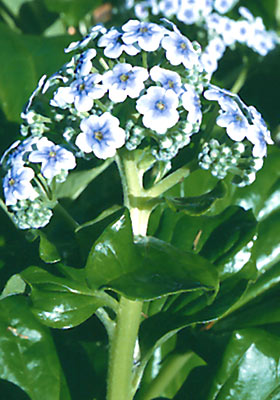
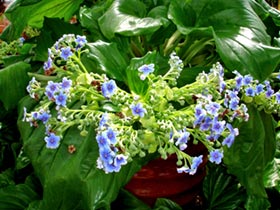
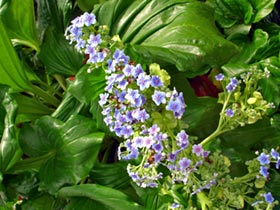
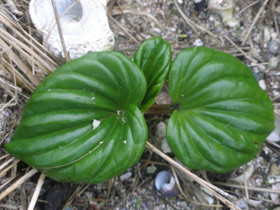

Past favourite plant finalist

Past favourite plant winner
Common names
kopakopa, Chatham Island forget-me-not, kopukapuka
Biostatus
Native – Endemic taxon
Current conservation status
The conservation status of all known New Zealand vascular plant taxa at the rank of species and below were reassessed in 2022-2023 using the New Zealand Threat Classification System (NZTCS) – more information about this can be found on the NZTCS website. This report includes replaces all previous NZTCS lists for vascular plants. Previous assessments can be found here.
- Conservation status of vascular plants in Aotearoa New Zealand, 2023. 2024. Peter J. de Lange, Jane Gosden, Shannel P. Courtney, Alexander J. Fergus, John W. Barkla, Sarah M. Beadel, Paul D. Champion, Rowan Hindmarsh-Walls, Troy Makan and Pascale Michel Department of Conservation. Source: NZTCS and licensed by DOC for reuse under the Creative Commons Attribution 4.0 International licence.
2023 | At Risk – Declining | Qualifiers: CD, DPT, IE
Category
Vascular
Structural class
Herbs - Dicotyledons other than Composites
Flower colours
Blue, Violet/Purple
Detailed description
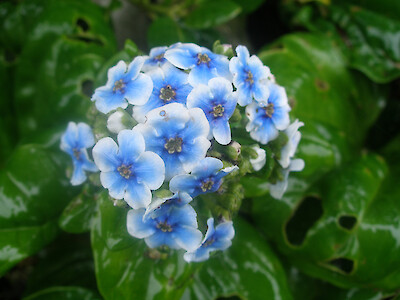
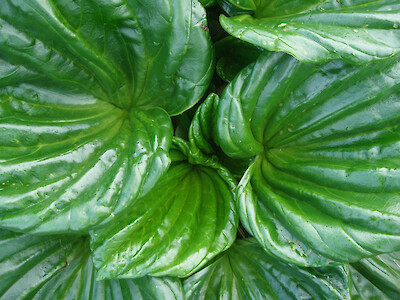
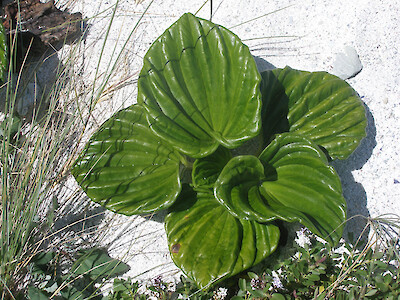
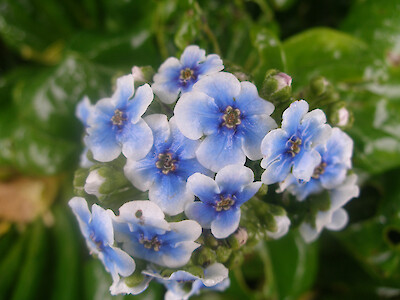
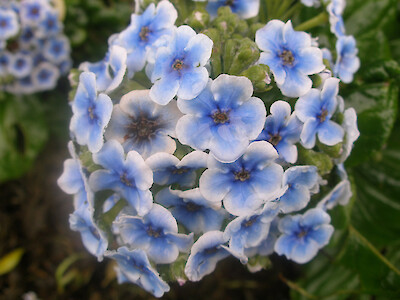
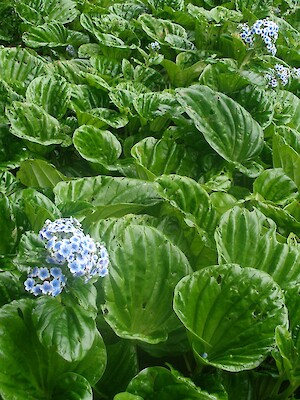
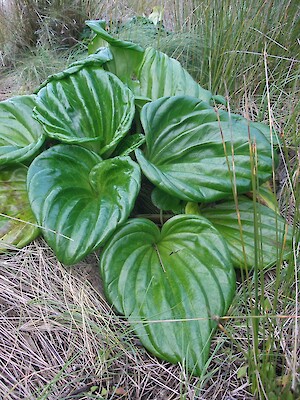
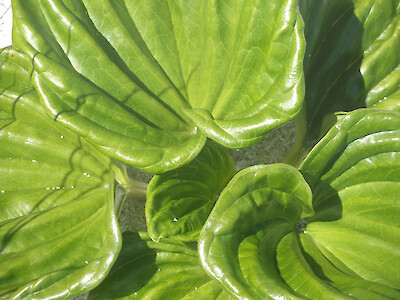
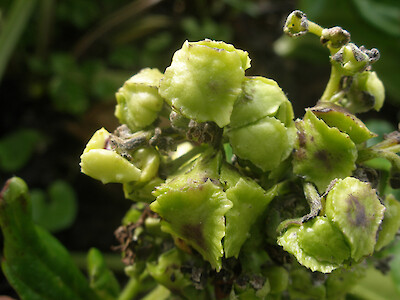
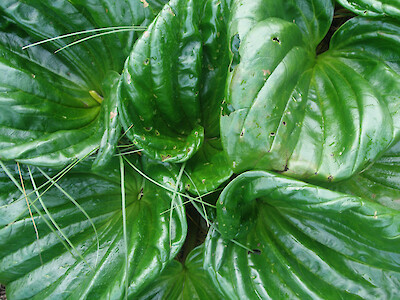
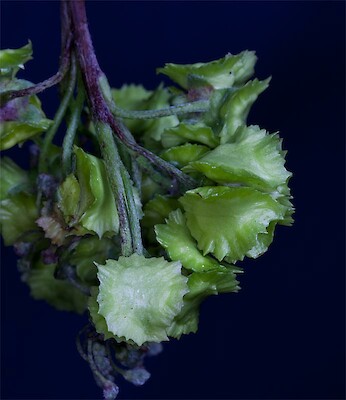
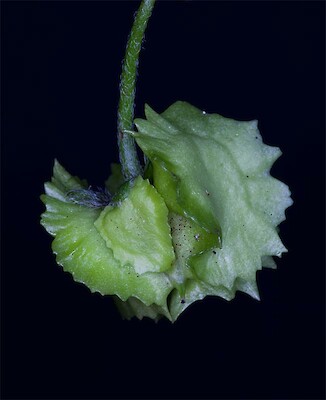
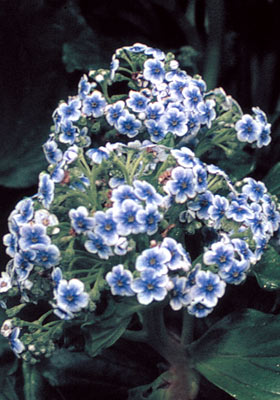
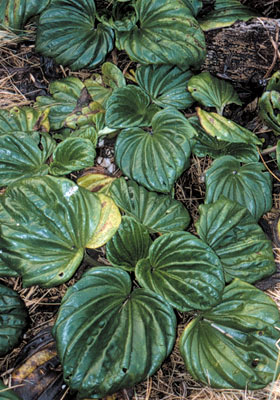
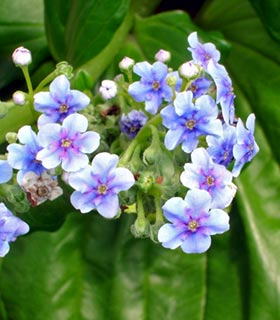
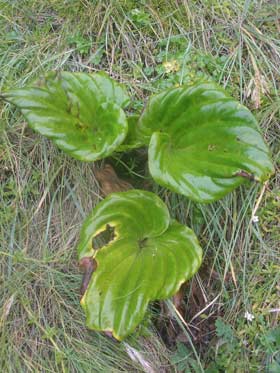
Robust, perennial herb, forming patches up to 1 m tall by 1.0–1.5 m diameter. Root stock stout, cylindric, rather fleshy, where emergent covered in numerous leaf scars, becoming woody with age. Petioles 0.1–0.5 m long, grooved above, channelled below. Lamina of basal leaves up to 0.4 m across, dark green to yellow-green, broadly ovate-cordate to reniform, thick, fleshy to coriaceous; upper surface glossy, glabrous; lower surface paler, minutely and evenly covered in retrorse hairs; margins entire; veins prominent, indented above, elevated below. Inflorescences lateral corymbose cymes, somewhat woody at base, with stem leaves; lower stem leaves similar to basal leaves, upper stem leaves smaller, oblong to broadly lanceolate or elliptic. Cymes 100–200 mm diameter, pedicels 10–15 mm long. Calyx lobes 5, 1.8–4.5 × 2.0–2.5 mm, broadly elliptic, covered in appressed hairs, apex obtuse, margin entire. Corolla 12–15 mm diameter, dark blue to pale blue, often flushing purple with age, occasionally white; lobes 5, 4.0–4.5 × 5.0–6.0 mm, orbicular, rounded, spreading, overlapping, apex obtuse; tube 2 mm long, throat partially occluded by 5 fleshy protuberances. Filaments c. 0.5 mm long, inserted near throat; anther included, 1.0–1.2 mm long. Ovary 4-lobed, style 0.7–1.0 mm long, stigma capitate. Fruit a nutlet, 10–15 mm diameter, brown to black, winged around margin; seed obovate, 7.5–9.0 mm long, testa black-brown.
Similar taxa
A distinctive and easily recognised species with large, glossy green leaves and large blue-flowered inflorescences.
Distribution
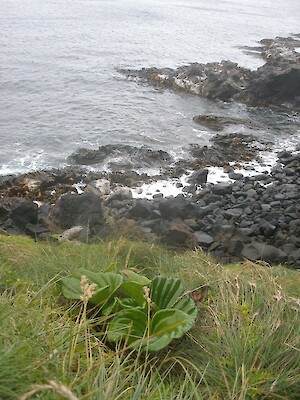
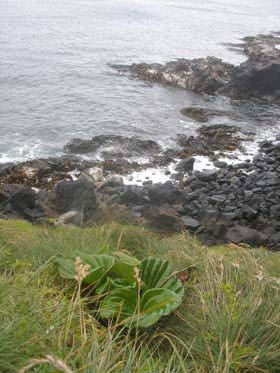
Endemic to the Chatham Islands. Found on Chatham (Rekohu), Pitt, South East, Mangere and most of the smaller islands, islets and some rock stacks.
Habitat
Coastal cliffs, rock outcrops, sandy and rocky beaches just above the strand zone and coastal forest openings.
Threats
Formerly abundant around the coasts and islets, the range of Myosotidium hortensia has been significantly reduced to scattered remnants by farming, competition from marram grass (Ammophila arenaria) and the depredations of feral animals, such as cattle, horses, sheep, possums, pigs, rats and weka who trample, uproot and browse plants. Possums, rodents, and weka are serious predators of flowers and fruits. Weed encroachment, especially by marram grass, has eliminated this species from most of its former dune habitat. Removing whole plants for private use in gardens is an ongoing problem for the more accessible populations. Coastal development destroyed the only known white-flowered wild plants, and remains a potential threat elsewhere.
Detailed taxonomy
Genus
Family
Synonyms
Myosotis hortensia Decne, Cynoglossum nobile Hook.f., Myosotidium nobile (Hook.f.) Hook.f.; Myosotidium hortensium (Decne.) Baill. orth.var.
Endemic taxon
Yes
Endemic genus
Yes
Endemic family
No
Ecology
Flowering
September - November
Fruiting
October - May
Propagation technique
Easy to grow provided the root stock is kept moist. It will not tolerate drought. It also dislikes humidity. Does best in a rich, well fertilised, peaty soil on the south-side of a building, or near a dripping tap. Also does well in partial shade under trees. Avoid competition from other plants. Seed germinates well if fresh but will not store long. A white-flowered form is occasionally grown.
Other information
Cultivation
Commonly available from most commercial and specialist native plant nurseries.
Plant of the Month
This plant has been featured as a Plant of the Month – see Trilepidea: NZPCN newsletter for December 2005 for the full story.
Etymology
myosotidium: Myosotis-like
NVS code
The National Vegetation Survey (NVS) Databank is a physical archive and electronic databank containing records of over 94,000 vegetation survey plots - including data from over 19,000 permanent plots. NVS maintains a standard set of species code abbreviations that correspond to standard scientific plant names from the Ngä Tipu o Aotearoa - New Zealand Plants database.
MYOHOR
Chromosome number
2n = 40-42
Previous conservation statuses
The conservation status of all known New Zealand vascular plant taxa at the rank of species and below were reassessed in 2022-2023 using the New Zealand Threat Classification System (NZTCS) – more information about this can be found on the NZTCS website. This report includes replaces all previous NZTCS lists for vascular plants. Previous assessments can be found here.
- Conservation status of vascular plants in Aotearoa New Zealand, 2023. 2024. Peter J. de Lange, Jane Gosden, Shannel P. Courtney, Alexander J. Fergus, John W. Barkla, Sarah M. Beadel, Paul D. Champion, Rowan Hindmarsh-Walls, Troy Makan and Pascale Michel Department of Conservation. Source: NZTCS and licensed by DOC for reuse under the Creative Commons Attribution 4.0 International licence.
2017 | Threatened – Nationally Vulnerable | Qualifiers: CD, IE
2012 | Threatened – Nationally Vulnerable | Qualifiers: CD, IE
2009 | Threatened – Nationally Vulnerable | Qualifiers: CD, IE, Inc, RR
2004 | Threatened – Nationally Endangered
Referencing and citations
References and further reading
de Lange, P.J.; Heenan, P.B.; Norton, D.A.; Rolfe, J.R.; Sawyer, J.W.D. 2010: Threatened Plants of New Zealand. Canterbury University Press, Christchurch.
Garnock-Jones PJ. 2014: Evidence-based review of the taxonomic status of New Zealand’s endemic seed plant genera, New Zealand Journal of Botany, DOI: 10.1080/0028825X.2014.902854
Attribution
Fact Sheet prepared for NZPCN by P.J. de Lange 1 February 2008. Description based on de Lange et al. (2010).
NZPCN Fact Sheet citation
Please cite as: de Lange, P.J. (Year at time of access): Myosotidium hortensia Fact Sheet (content continuously updated). New Zealand Plant Conservation Network. https://www.nzpcn.org.nz/flora/species/myosotidium-hortensia/ (Date website was queried)