
Metrosideros umbellata
Common names
southern rātā
Biostatus
Native – Endemic taxon
Current conservation status
The conservation status of all known New Zealand vascular plant taxa at the rank of species and below were reassessed in 2022-2023 using the New Zealand Threat Classification System (NZTCS) – more information about this can be found on the NZTCS website. This report includes replaces all previous NZTCS lists for vascular plants. Previous assessments can be found here.
- Conservation status of vascular plants in Aotearoa New Zealand, 2023. 2024. Peter J. de Lange, Jane Gosden, Shannel P. Courtney, Alexander J. Fergus, John W. Barkla, Sarah M. Beadel, Paul D. Champion, Rowan Hindmarsh-Walls, Troy Makan and Pascale Michel Department of Conservation. Source: NZTCS and licensed by DOC for reuse under the Creative Commons Attribution 4.0 International licence.
2023 | Not Threatened
Category
Vascular
Structural class
Trees & Shrubs - Dicotyledons
Simplified description
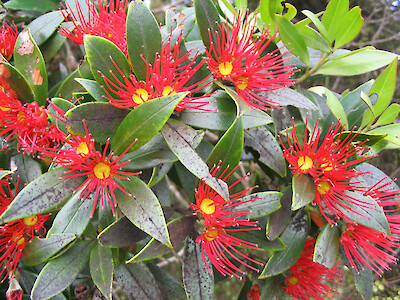
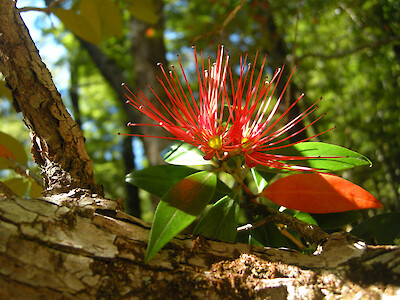
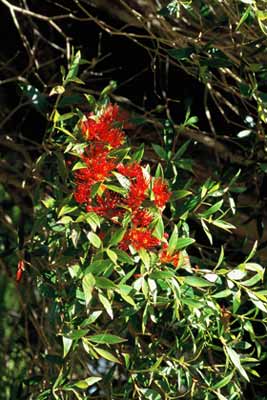
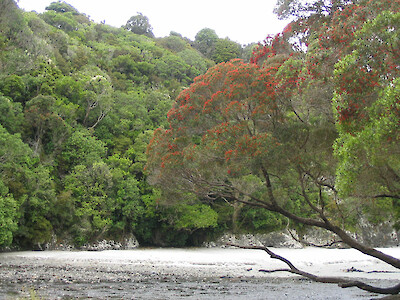
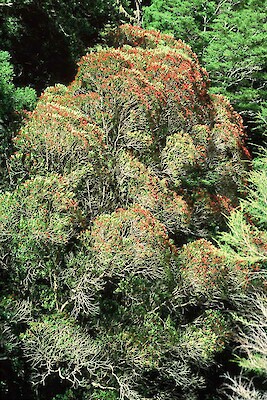
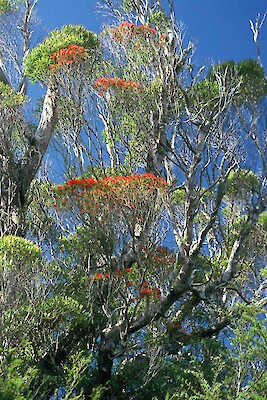
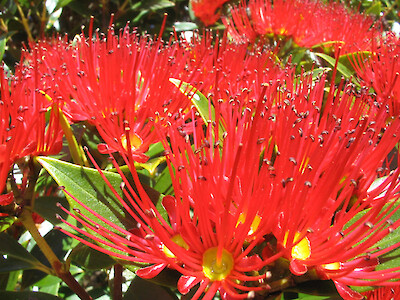
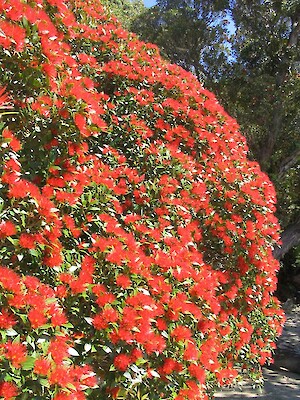
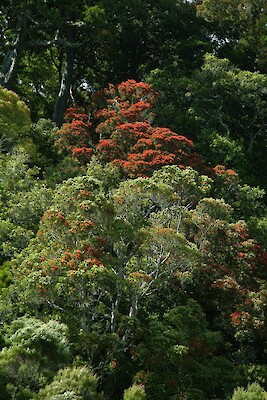
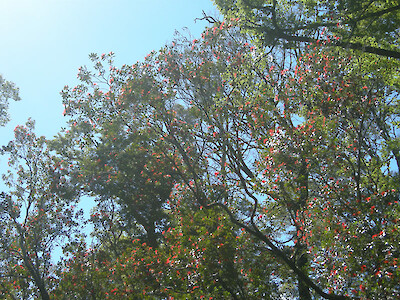
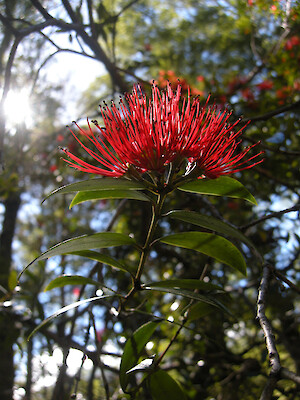
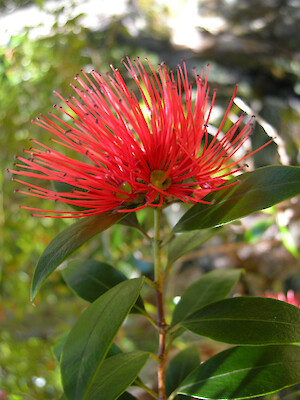
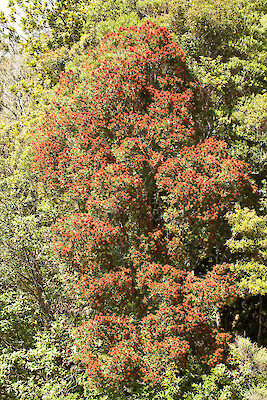
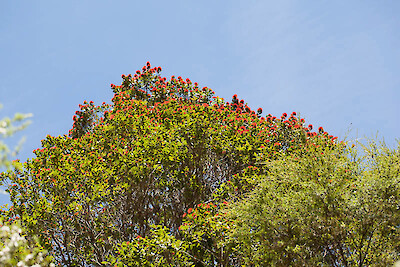
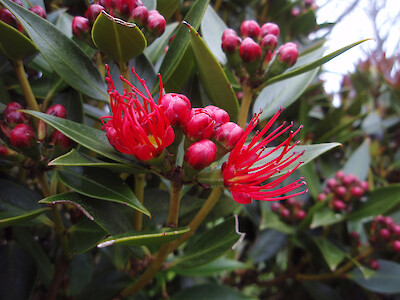
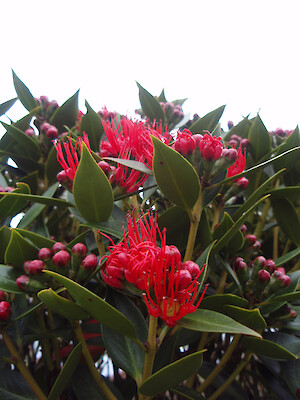
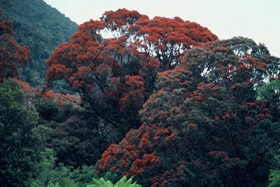
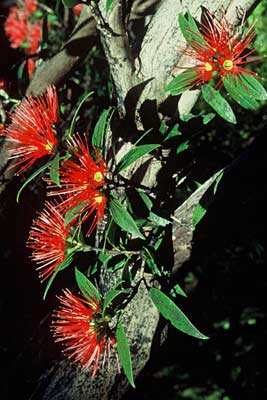
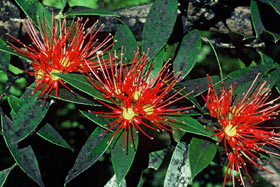
Tall forest tree bearing pairs of oval leathery leaves with masses of red bristly flowers in summer inhabiting much of the South Island and some upland North Island sites. Twigs rounded in cross section. Leaves 2.5–6 cm long by 1–2 cm wide, gradually narrowing to sharp tip and short stalk.
Flower colours
Red/Pink
Detailed description
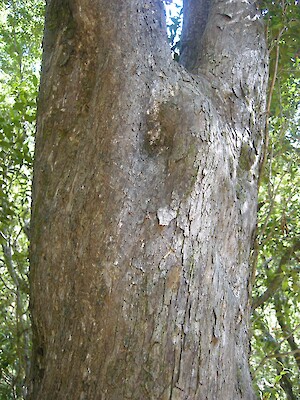
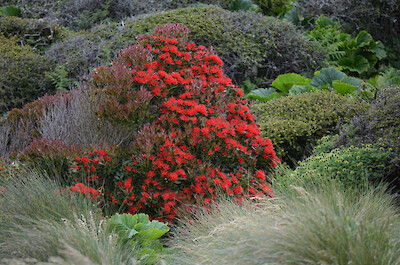
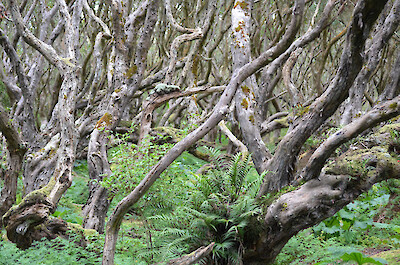
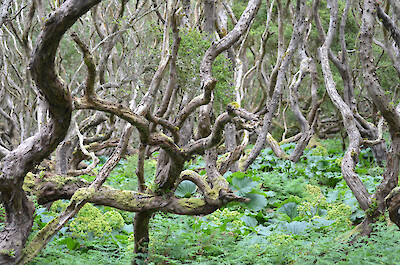
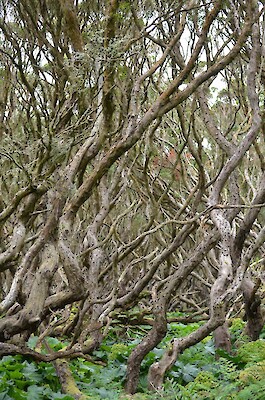
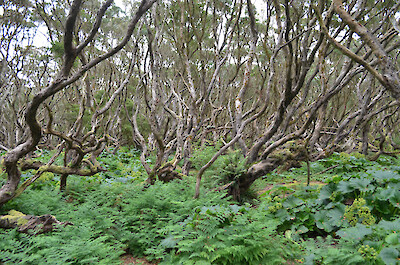
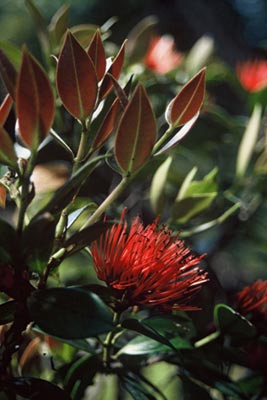
Robust forest tree up to 20 metres often leaning out from ground, gnarled branches, rarely starting as an epiphyte, occasionally reduced to bushy and even prostrate shrubs in exposed situations. Trunk(s) up to 1 metre or more diameter. Bark rough and flaky, light grey or fawn brown, separates from the trunk in thin strips. Branchlets numerous, very twiggy and branched, circular in cross section, glabrous when young. Leaves have petioles about 5 mm long, lamina (25-)30–50(-60) × (10-)15–20 mm. leathery, upper surface bright or dark green glabrous, underside pale green tiny glands are visible up close, ovate to lanceolate, apex acuminate, new growth coloured salmon-pink, orange-red, maturing to, old leaves are red then fall off. Inflorescence terminal, forms numerous cluster bearing flowers from central growth, on peduncles up to 10 mm long receptacle cone shaped, smooth, fused to ovary. Sepals deltoid, cupped, about 3 mm long. Petals about 5mm long, light red, oblong. Stamens numerous light red more or less 20 mm long, anthers versatile, pollen bright yellow, pistil same length as anthers, stigma capitate. Capsule almost spherical, 8-9 mm diameter, tough, woody, 3-valved. Seeds numerous per compartment, 2-3 mm long, narrowly elliptic, orange brown or henna, glossy.
Similar taxa
Similar appearance to Metrosideros robusta, with which it can hybridise. The leaves of each species have very distinguishable features M. robusta are blunt-tipped and have a notch in the apex, compared to M. umbellata having a sharply pointed tip. Hybrids might have both features, or completely lack the obvious differences explained here.
Distribution
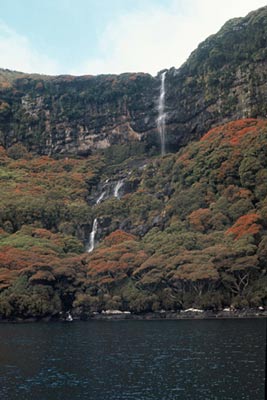
Endemic. North Island (locally present from Te Paki south to Mt Pirongia, the northern Kaimai Ranges (Ngatamahinerua) and Mt Manuoha (Te Urewera)), South Island (from Rangitoto ki te Tonga / D’Urville Island south to Fiordland, with a mainly westerly distribution—absent from Marlbrough, most of Canterbury and northern Otago), Stewart Island/Rakiura (common) and Auckland Islands (common).
Habitat
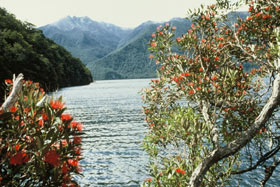
Coastal to Montane (0-1000 m.a.s.l). Well-lit banks, forest slopes, shrubland, scrub, rock.
Threats
Threat status elevated in 2017 due to the risk of Myrtle rust. Rather uncommon in the North Island, and at some sites it is locally threatened by possum browse.
Myrtle Rust (Austropuccinia psidii) is an invasive fungus which threatens native myrtle species - learn more myrtlerust.org.nz
Detailed taxonomy
Genus
Family
Synonyms
Melaleuca lucida G.Forst., Metrosideros lucida (G.Forst.) A.Rich.
Taxonomic notes
North Island plants are genetically (based on nrDNA ITS sequences) distinct from South Island plants but the differences cannot be matched to morphology. All recent southern rata collections made from the Tararua Ranges are the hybrid M. robusta × M. umbellata (Gardner et al. 2004). A few photographs taken in the 1930s from the Francis Ridge, Southern Tararua Ranges may have been genuine M. umbellata but the species cannot be found there now. Other northern Tararua records of M. umbellata appear to be based on M. robusta.
Endemic taxon
Yes
Endemic genus
No
Endemic family
No
Ecology
Flowering
(August-)October-March.
Fruiting
March-May.
Propagation technique
Easy from fresh seed but inclined to be rather slow-growing unless planted in ideal conditions. In cultivation this species prefers a moist soil. Can be grown from soft-wood and semi-hardwood cuttings but these can be very difficult to strike. A beautiful specimen tree which shoud be more widely planted in locations where conditions are suitable.
Wetland plant indicator status rating
Information derived from the revised national wetland plant list prepared to assist councils in delineating and monitoring wetlands (Clarkson et al., 2021 Manaaki Whenua – Landcare Research Contract Report LC3975 for Hawke’s Bay Regional Council). The national plant list categorises plants by the extent to which they are found in wetlands and not ‘drylands’. The indicator status ratings are OBL (obligate wetland), FACW (facultative wetland), FAC (facultative), FACU (facultative upland), and UPL (obligate upland). If you have suggestions for the Wetland Indicator Status Rating, please contact: [Enable JavaScript to view protected content]
UPL: Obligate Upland
Rarely is a hydrophyte, almost always in uplands (non-wetlands).
Other information
Etymology
metrosideros: Iron heart
umbellata: Bearing flowers in umbels
Manaaki Whenua Online Interactive Key
NVS code
The National Vegetation Survey (NVS) Databank is a physical archive and electronic databank containing records of over 94,000 vegetation survey plots - including data from over 19,000 permanent plots. NVS maintains a standard set of species code abbreviations that correspond to standard scientific plant names from the Ngä Tipu o Aotearoa - New Zealand Plants database.
METUMB
Chromosome number
2n = 22
Previous conservation statuses
The conservation status of all known New Zealand vascular plant taxa at the rank of species and below were reassessed in 2022-2023 using the New Zealand Threat Classification System (NZTCS) – more information about this can be found on the NZTCS website. This report includes replaces all previous NZTCS lists for vascular plants. Previous assessments can be found here.
- Conservation status of vascular plants in Aotearoa New Zealand, 2023. 2024. Peter J. de Lange, Jane Gosden, Shannel P. Courtney, Alexander J. Fergus, John W. Barkla, Sarah M. Beadel, Paul D. Champion, Rowan Hindmarsh-Walls, Troy Makan and Pascale Michel Department of Conservation. Source: NZTCS and licensed by DOC for reuse under the Creative Commons Attribution 4.0 International licence.
2017 | Threatened – Nationally Vulnerable | Qualifiers: DP, De
2012 | Not Threatened
2009 | Not Threatened
2004 | Not Threatened
Regional conservation statuses
Northland: 2026 | Regionally At Risk – Regionally Naturally Uncommon
Current regional threat status assessments prepared according to Crisp et al. (2025) are displayed when available. The Northland conservation status information is sourced from the “Conservation status of indigenous vascular plants in Northland | Taitokerau” Ford et al. 2026 report.
Auckland: 2025 | Regionally Threatened – Regionally Endangered | Qualifiers: DPS, DPT, PF, RR, Rel
Current regional threat status assessments prepared according to Crisp et al. (2025) are displayed when available. The Auckland conservation status information is sourced from the “Conservation status of vascular plant species in Tāmaki Makaurau / Auckland” Simpkins E et al. 2025 report.
Otago: 2025 | Regionally Not Threatened | Qualifiers: De
Current regional threat status assessments prepared according to Crisp et al. (2025) are displayed when available. The Otago conservation status information is sourced from the “Conservation Status of Indigenous Vascular Plants in Otago, 2025” Jarvie S et al. (2025) report.
Wellington: 2025 | Regionally Threatened – Regionally Critical
Current regional threat status assessments prepared according to Crisp et al. (2025) are displayed when available. The Wellington conservation status information is sourced from the “Conservation status of indigenous vascular plants in the Wellington region” Enright P et al. 2025 report.
Referencing and citations
References and further reading
Allan HH. 1961. Flora of New Zealand. Volume 1. Indigenous Tracheophyta: Psilopsida, Lycopsida, Filicopsida, Gymnospermae, Dicotyledones. Government Printer, Wellington, NZ. pg. 325-326.
Beddie AD. 1953. Root behaviour in Metrosideros. Wellington Botanical Society Bulletin 26: 2–6.
de Lange PJ. 1994. Southern rata Metrosideros umbellata confirmed from Mt Pirongia Western Waikato. Auckland Botanical Society Journal 49: 57–59.
Druce AP. 1959. Southern rata in the Tararuas. Wellington Botanical Society Bulletin 31: 12–15.
Gardner RC, de Lange PJ, Bowala T, Brown HA, Keeling J, Wright SD. 2004. A Quaternary phylogeography for New Zealand inferred from chloroplast DNA haplotypes in Metrosideros (Myrtaceae). Biological Journal of the Linnean Society 83: 399–412. https://doi.org/10.1111/j.1095-8312.2004.00398.x.
Wilson HD. 1982. Field Guide: Stewart Island plants. Field Guide Publications, Christchurch, NZ. Pg. 72.
Attribution
Some of this factsheet information is derived from Flora of New Zealand Online and is used under a Creative Commons Attribution 3.0 New Zealand licence.
NZPCN Fact Sheet citation
Please cite as: de Lange, P.J. (Year at time of access): Metrosideros umbellata Fact Sheet (content continuously updated). New Zealand Plant Conservation Network. https://www.nzpcn.org.nz/flora/species/metrosideros-umbellata/ (Date website was queried)