
Aciphylla dieffenbachii

Common name
Dieffenbach’s speargrass, soft speargrass, coxella
Synonyms
Gingidium dieffenbachii F.Muell., Ligusticum dieffenbachii Hook.f., Angelicia dieffenbachii Benth, et Hook.f., Coxella dieffenbachii (F.Muell.) Cheeseman et Hemsl.
Family
Apiaceae
Flora category
Vascular – Native
Endemic taxon
Yes
Endemic genus
No
Endemic family
No
Structural class
Herbs - Dicotyledons other than Composites
NVS code
The National Vegetation Survey (NVS) Databank is a physical archive and electronic databank containing records of over 94,000 vegetation survey plots - including data from over 19,000 permanent plots. NVS maintains a standard set of species code abbreviations that correspond to standard scientific plant names from the Ngä Tipu o Aotearoa - New Zealand Plants database.
ACIDIE
Chromosome number
2n = 22
Current conservation status
The conservation status of all known New Zealand vascular plant taxa at the rank of species and below were reassessed in 2017 using the New Zealand Threat Classification System (NZTCS) – more information about this can be found on the NZTCS website. This report includes a statistical summary and brief notes on changes since 2012 and replaces all previous NZTCS lists for vascular plants.
Please note, threat classifications are often suggested by authors when publications fall between NZTCS assessment periods – an interim threat classification status has not been assessed by the NZTCS panel.
- Conservation status of New Zealand indigenous vascular plants, 2017 . 2018. Peter J. de Lange, Jeremy R. Rolfe, John W. Barkla, Shannel P. Courtney, Paul D. Champion, Leon R. Perrie, Sarah M. Beadel, Kerry A. Ford, Ilse Breitwieser, Ines Schönberger, Rowan Hindmarsh-Walls, Peter B. Heenan and Kate Ladley. Department of Conservation. Source: NZTCS and licensed by DOC for reuse under the Creative Commons Attribution 4.0 International licence.
2017 | Threatened – Nationally Vulnerable | Qualifiers: CD, EF, IE, RR
Previous conservation statuses
2012 | Threatened – Nationally Vulnerable | Qualifiers: CD, EF, IE, RR
2009 | Threatened – Nationally Vulnerable | Qualifiers: CD, EF, IE, RR
2004 | Threatened – Nationally Vulnerable
Distribution
Endemic to the Chatham Islands where it is known from Chatham, Pitt, Mangere, Little Mangere, South East (Rangatira) islands and some of the Murumuru stacks and islets. It has also been deliberately introduced to Native Island and Ernest Islands off Stewart Island.
Habitat
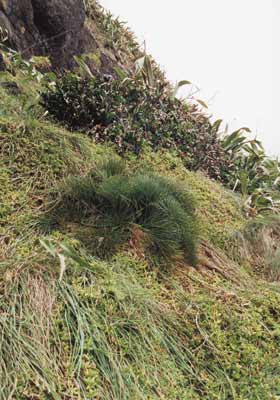
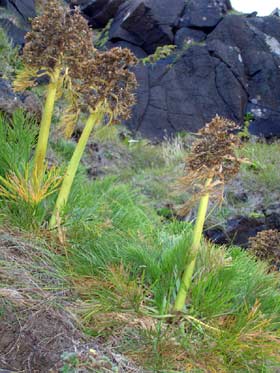
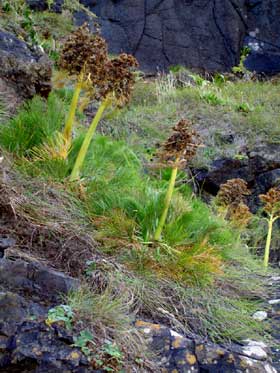
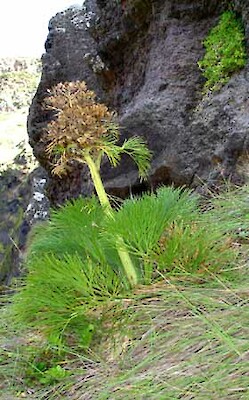
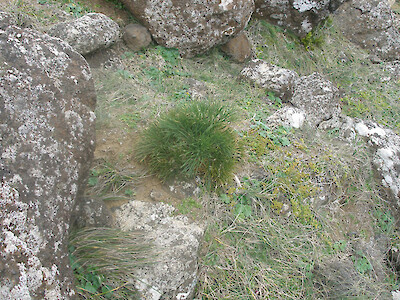
Strictly coastal. Former habitat preferences unclear. Now only known from the Chatham (Rekohu) Island from steep, usually south facing, cliffs, rock scarps, ledges and colluvial slopes. It is usually found on basalt rather than schist rock substrates. On the outer islands, particularly those free of browsing animals it occupies similar habitats but can also be found in Poa chathamica Petrie swards, and amongst petrel burrowed ground.
Detailed description
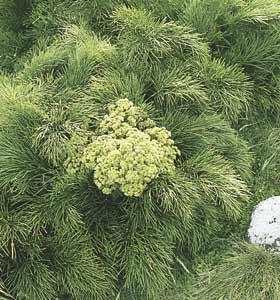
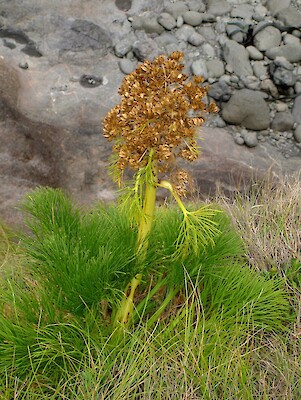
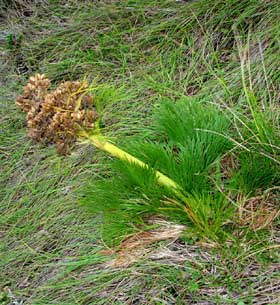
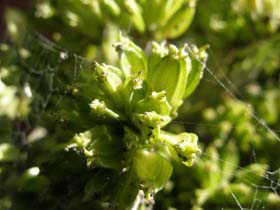
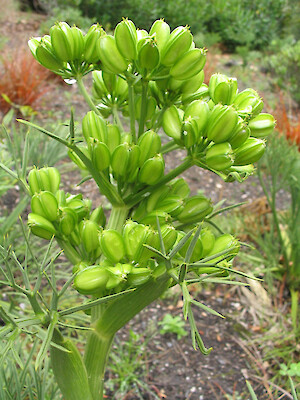
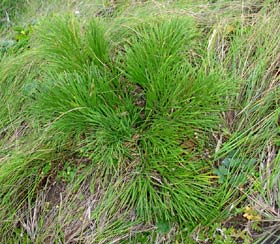
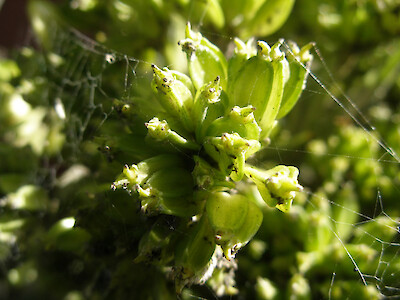
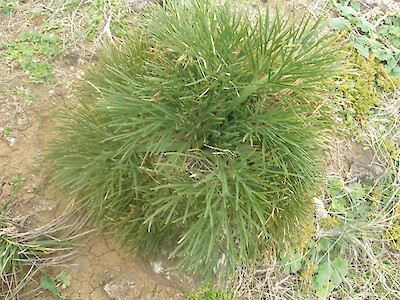
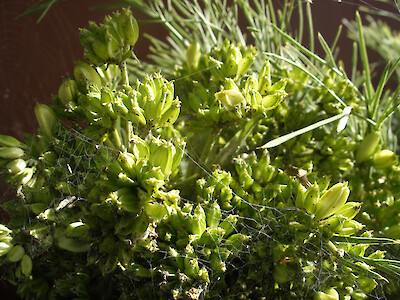
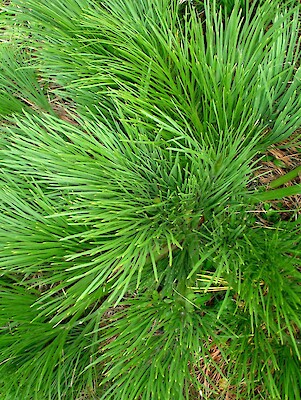
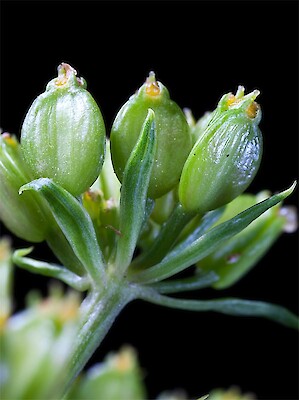
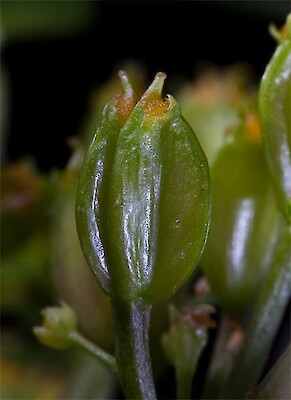
Tufted, dioecious, perennial with extremely stout, napiform taproot. All parts exuding white, sticky latex when damaged. Leaves glaucous, flaccid, up to 0.7m long. Petiole broadly sheathing near lamina junction, furnished on either side by blunt lobes. Leaf lamina 150–400 × 100–300 mm. Primary pinnae 4–7 pairs, segments up to 90 × 5 mm, linear, flaccid, apices bluntly mucronate. Inflorescence up to 1.0 × 0.6m diameter, rather stout, almost woody. Umbels numerous, subpaniculate. Peduncles rigid, stout, 50–150 mm long. Primary bracts pinnatisect with broad base. Male umbels with up to 15 rays, 10 mm long, slender; female umbels similar but with 3–6 rays. Involucral bracts linear–lanceolate, acuminate. Flowers golden–yellow. Male flowers with distinct triangular acute calyx–teeth; petals 2 mm long, oblong to ovate–oblong. Female calyx–teeth narrowly triangular, subacute; petals 1.5 mm long, obovate. Fruit 15 × 10 mm, golden yellow maturing light brown-grey, dorsally flattened, splitting at maturity into 2 more or less equal mericarps, these 2–3 winged, wings up to 3 mm wide.
Similar taxa
One of only two species of Aciphylla on the Chatham Islands. A. dieffenbachii is a strictly coastal species which differs from A. traversii (F.Muell.) Hook.f. by the flaccid, more heavily divided, glaucous, blunt-tipped leaves, shorter (up to 1 m), fewer though much stouter and denser inflorescences with golden yellow flowers, and much larger fruits. By comparison A. traversii is a species of peat bogs, lake margins and peaty ground in open forest clearings. It has much larger, less flaccid and less divided dark green, sharply-tipped leaves, more numerous, taller (up to 1.8 m) distnctly narrower, more open inflorescences with cream-coloured flowers, and smaller fruits.
Flowering
November - February
Flower colours
Yellow
Fruiting
January - June
Life cycle
Winged schizocarps are dispersed primarily by wind (Thorsen et al., 2009).
Propagation technique
Easy from fresh seed. Seed has short-term viability so will not store well. An attractive species ideal for a coastal situation. In good conditions spontaneous seedlings are often seen, and on occasion it can become invasive. It does best in full sun, with a moderately fertile to fertile, free draining soil. Does well in damp sand, frequently manured with sea weed. Plants should never be allowed to dry out, and even when well established are inclined to sudden collapse. This species often dies after a heavy flowering. Like most Chatham Island endemic plants this species dislikes humidity.
Threats
Domestic stock and feral mammals are the prime threats. Rodents probably eat seeds and seedlings; possums probably eat flowers and seedlings. The speargrass weevil (Hadramphus spinipennis) is dependent on the speargrass, but can be locally very damaging: adults eat stems, flowers and leaves; larvae eat roots as well. Thick exotic grass swards may inhibit seedling establishment.
Etymology
aciphylla: From the Latin acicula ‘needle’ and the Greek phyllum ‘leaf’, meaning needle-leaf.
dieffenbachii: Named after Dr. Ernst Dieffenbach, 19th century German naturalist
Attribution
Fact Sheet prepared for NZPCN by P.J. de Lange 1 August 2003. Description based on Allan (1961) supplemented with observations obtained from fresh plants and herbarium specimens - see also de Lange et al. (2010)
References and further reading
Allan, H.H. 1961. Flora of New Zealand. Vol. I. Government Printer, Wellington (as Coxella dieffenbachii Cheeseman & Hemsl.) de Lange, P.J.; Heenan, P.B.; Norton, D.A.; Rolfe, J.R.; Sawyer, J.W.D. 2010: Threatened Plants of New Zealand. Canterbury University Press, Christchurch. Dawson, J.W. 1969: New Zealand Umbelliferae. A Leaf Comparison of Aciphylla and Anisotome. New Zealand Journal of Botany 6: 450-458. Thorsen, M. J.; Dickinson, K. J. M.; Seddon, P. J. 2009. Seed dispersal systems in the New Zealand flora. Perspectives in Plant Ecology, Evolution and Systematics 11: 285-309
NZPCN Fact Sheet citation
Please cite as: de Lange, P.J. (Year at time of access): Aciphylla dieffenbachii Fact Sheet (content continuously updated). New Zealand Plant Conservation Network. https://www.nzpcn.org.nz/flora/species/aciphylla-dieffenbachii/ (Date website was queried)