
Dactylanthus taylorii
Common names
pua o te reinga, wood rose, flower of Hades
Biostatus
Native – Endemic taxon
Current conservation status
The conservation status of all known New Zealand vascular plant taxa at the rank of species and below were reassessed in 2022-2023 using the New Zealand Threat Classification System (NZTCS) – more information about this can be found on the NZTCS website. This report includes replaces all previous NZTCS lists for vascular plants. Previous assessments can be found here.
- Conservation status of vascular plants in Aotearoa New Zealand, 2023. 2024. Peter J. de Lange, Jane Gosden, Shannel P. Courtney, Alexander J. Fergus, John W. Barkla, Sarah M. Beadel, Paul D. Champion, Rowan Hindmarsh-Walls, Troy Makan and Pascale Michel Department of Conservation. Source: NZTCS and licensed by DOC for reuse under the Creative Commons Attribution 4.0 International licence.
2023 | Threatened – Nationally Vulnerable | Qualifiers: CD, PD, PF, RF
Category
Vascular
Structural class
Herbs - Dicotyledons other than Composites
Flower colours
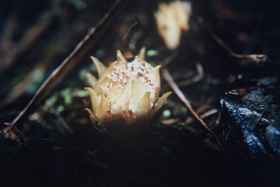
White
Detailed description
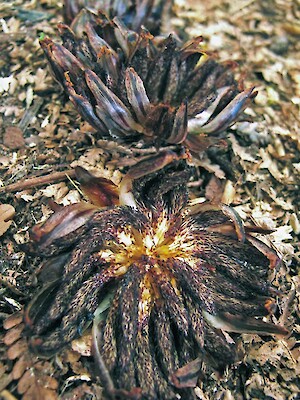
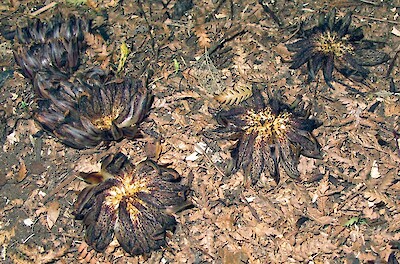
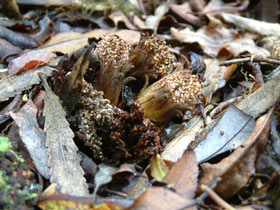
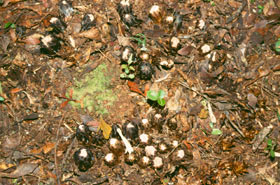
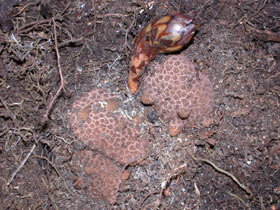
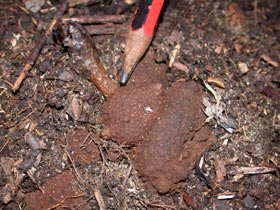
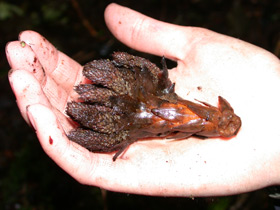
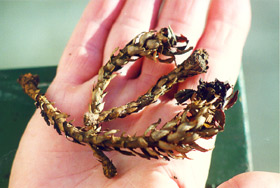
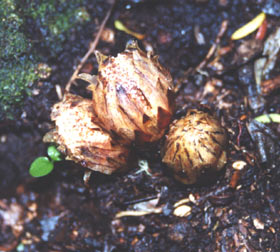
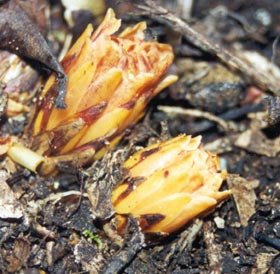
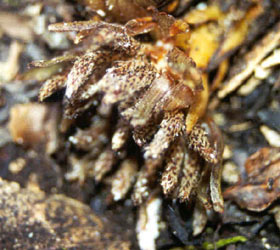
Dioecious, achlorophyllous, holoparasitic, root-parasite. Rhizomes mostly buried just below soil surface, usually terminal on host root and attached over a broad irregular surface to expanded end of host root; ± hemispherical, globose, up to 600 mm diameter, surface dark brown, externally covered with hard angular or warty papillae and old flower and fruiting bases, internally fleshy and ± starchy. Shoots seasonal, numerous, arising irregularly and mostly from base of rhizomes, unbranched 100–300 × 10–15 mm long, covered with glossy, dark brown, maroon-brown to red-brown, membranous, sessile, imbricating scale leaves; lamina 5–20 × 5–9 mm, broadly deltoid, claw-like, long-tapering from base, subacute to acute, entire, glabrous, becoming larger and paler toward shoot apex. Inflorescence a terminal capitulum of 15–28 spadices, 20–40 mm diameter, surrounded by an involucre of brown, cream, pink, red or yellow scale leaves, these up to 30 × 15 mm; spadix-axis erect, 20–25 mm long, ± grooved, flowers crowded on upper 2/3, occasionally diffusely scattered, sometimes admixed with bracts in lower 1/3. Flowers densely crowded; male perianth segments, 0–4 filamentous; stamen usually 1, rarely 2, subsessile or sessile, filament 0.2–0.45 mm, anther bilobed, white, pollen whitish, abundant; female perianth segments 2, usually unequal, adnate to ovary, ovary 2-loculed, style > ovary, filiform, stigma simple. Fruit 1.5–1.8 mm, ovate, asymmetric, angular, dark purple-brown to black brown, terminal end bearing remnant style and perianth. Nut 1.3–1.5 mm, elliptic to elliptic-ovate, asymmetric, glossy dark red-brown or purple-brown, glabrous.
Similar taxa
None but sometimes confused with galls and root galls found on beech trees, Rhizobium and Frankia nodules and other growths on exposed roots and basal trunks have been collected as wood rose. Dactylanthus can be distinguished from these by the presence of small circular scars on the exposed tuber left by former buds and flowering shoots.
Distribution
Distributed from Northland down to the Wairarapa. Historically recorded in the Kahurangi National Park area of northern South Island.
Habitat
Dactylanthus grows parasitically on the roots of about 30 species of native hardwood trees and shrubs such as Griselinia littoralis and Pseudopanax arboreus and Pittosporum tenuifolium. The plant prefers damp but well drained places and is often found at the head of small streams. It has been found at elevations from near sea level to 1200m.
Threats
Habitat destruction, collectors of wood roses and browsing animal such as possums. Cattle destroy plants through trampling. Decline in numbers of short-tailed bats may have also caused a decline in this species. Rats and pigs are also major browsing threats alongside possums.
Detailed taxonomy
Genus
Family
Synonyms
None known.
Endemic taxon
Yes
Endemic genus
Yes
Endemic family
No
Ecology
Flowering
January to May
Fruiting
January to August
Life cycle and dispersal
Fleshy nuts are dispersed by granivory and water (Thorsen et al., 2009).
Propagation technique
Unknown.
Other information
Extra information
NVS code
The National Vegetation Survey (NVS) Databank is a physical archive and electronic databank containing records of over 94,000 vegetation survey plots - including data from over 19,000 permanent plots. NVS maintains a standard set of species code abbreviations that correspond to standard scientific plant names from the Ngä Tipu o Aotearoa - New Zealand Plants database.
DACTAY
Previous conservation statuses
The conservation status of all known New Zealand vascular plant taxa at the rank of species and below were reassessed in 2022-2023 using the New Zealand Threat Classification System (NZTCS) – more information about this can be found on the NZTCS website. This report includes replaces all previous NZTCS lists for vascular plants. Previous assessments can be found here.
- Conservation status of vascular plants in Aotearoa New Zealand, 2023. 2024. Peter J. de Lange, Jane Gosden, Shannel P. Courtney, Alexander J. Fergus, John W. Barkla, Sarah M. Beadel, Paul D. Champion, Rowan Hindmarsh-Walls, Troy Makan and Pascale Michel Department of Conservation. Source: NZTCS and licensed by DOC for reuse under the Creative Commons Attribution 4.0 International licence.
2017 | Threatened – Nationally Vulnerable | Qualifiers: CD, PD, RF, Sp
2012 | Threatened – Nationally Vulnerable | Qualifiers: CD, PD, RF, Sp
2009 | Threatened – Nationally Vulnerable | Qualifiers: CD, PD, RF, Sp
2004 | Serious Decline
Regional conservation statuses
Auckland: 2025 | Regionally Threatened – Regionally Vulnerable | Qualifiers: CR, DE, DPS, DPT, PF, Rel
Current regional threat status assessments prepared according to Crisp et al. (2025) are displayed when available. The Auckland conservation status information is sourced from the “Conservation status of vascular plant species in Tāmaki Makaurau / Auckland” Simpkins E et al. (2025) report.
Northland: 2026 | Regionally Threatened – Regionally Critical | Qualifiers: CD RF PF
Current regional threat status assessments prepared according to Crisp et al. (2025) are displayed when available. The Northland conservation status information is sourced from the “Conservation status of indigenous vascular plants in Northland | Taitokerau” Ford et al. 2026 report.
Referencing and citations
References and further reading
Allan, H.H. 1961. Flora of New Zealand. Volume I. Indigenous Tracheophyta: Psilopsida, Lycopsida, Filicopsida, Gymnospermae, Dicotyledones.Wellington, Government Printer.
Image of Dactylanthus - rhizome and pistillate flowers (Transactions of the NZ Institute, Vol 56).
Thorsen, M. J.; Dickinson, K. J. M.; Seddon, P. J. 2009. Seed dispersal systems in the New Zealand flora. Perspectives in Plant Ecology, Evolution and Systematics 11: 285-309
Ju, H-J.; Hu, J-M.; Anderson, F.E.; Der, J.P.; Nickrent, D.L. 2015: Phylogenetic relationships of Santalales with insights into the origins of holoparasitic Balanophoraceae. Taxon 64 (3): 491–506.
Attribution
Factsheet and description prepared for NZPCN by P.J. de Lange. Description based on Allan (1961) and additional observations of herbarium specimens by P.J. de Lange.
Some of this factsheet information is derived from Flora of New Zealand Online and is used under a Creative Commons Attribution 3.0 New Zealand licence.
NZPCN Fact Sheet citation
Please cite as: de Lange, P.J. (Year at time of access): Dactylanthus taylorii Fact Sheet (content continuously updated). New Zealand Plant Conservation Network. https://www.nzpcn.org.nz/flora/species/dactylanthus-taylorii/ (Date website was queried)