
Ixerba brexioides




Past favourite plant finalist
Common names
tawari, whakou (flowers)
Biostatus
Native – Endemic taxon
Current conservation status
The conservation status of all known New Zealand vascular plant taxa at the rank of species and below were reassessed in 2022-2023 using the New Zealand Threat Classification System (NZTCS) – more information about this can be found on the NZTCS website. This report includes replaces all previous NZTCS lists for vascular plants. Previous assessments can be found here.
- Conservation status of vascular plants in Aotearoa New Zealand, 2023. 2024. Peter J. de Lange, Jane Gosden, Shannel P. Courtney, Alexander J. Fergus, John W. Barkla, Sarah M. Beadel, Paul D. Champion, Rowan Hindmarsh-Walls, Troy Makan and Pascale Michel Department of Conservation. Source: NZTCS and licensed by DOC for reuse under the Creative Commons Attribution 4.0 International licence.
2023 | Not Threatened
Category
Vascular
Structural class
Trees & Shrubs - Dicotyledons
Simplified description
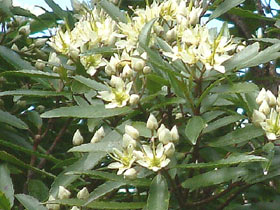
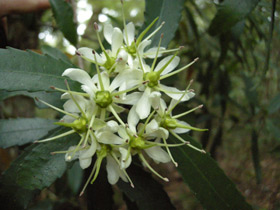
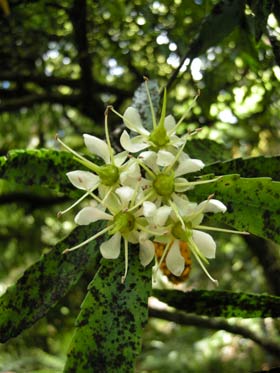
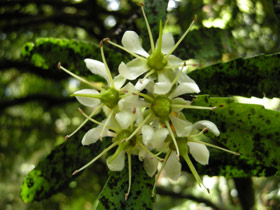
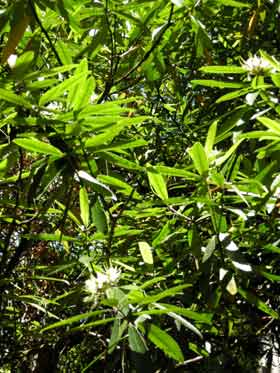
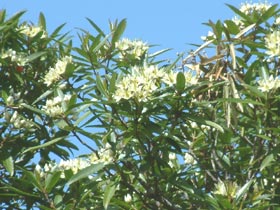
Bushy tree bearing narrow thick serrated dark green leaves and clusters of white flowers with a prominent green centre inhabiting the upper North Island. Leaves 6-16cm long by 1-4cm wide. Flowers 2.5-3.5cm wide. Fruit a green capsule, splits to reveal the black seeds on a fleshy orange and white base.
Flower colours
White
Detailed description
Small tree up to 10 m tall with spreading crown. Trunk 0.2-0.4 m diam., bark dark brown to grey-brown. Branchlets, leaves and inflorescences clade in fine pubescence when young. Petioles, stout, fleshy, 20 mm long. Leaves yellow-green to dark-green above, paler beneath, somewhat fleshy, distinctly leathery, 60-160 x 10-40 mm, lanceolate to elliptic or oblanceolate, apex acute to subacute, margins bluntly and coarsely serrated. Apex of each serration surmounted with a small gland. Juvenile leaves often reddish, linear-lanceolate. Inflorescence a terminal subumbellate 5-10-flowered panicle. Flowers 25-35 mm diam, furnished with plenty of nectar. Sepals broad-ovate, downy, 5-6 mm long; petals white, obovate-spathulate, clawed, 15-20 mm long, inserted below a 5-lobed disc; stamens 5 exserted, alternating with disc lobes; style twisted, 5-grooved. Capsule leathery, broadly ovoid, 5-celled, seeds orange, 5 mm long, very glossy.
Similar taxa
A very distinctive tree easily recognised by the leathery, somewhat fleshy, lanceolate leaves, whose serrations are glandular-tipped, large, showy, white flowers, and distinctive capsules which split to reveal rather large glossy black seeds.
Distribution
Endemic. New Zealand, North Island ( widespread from about Kaitaia south to Waitomo, Paeroa Range and Te Urewera).
Habitat
Often but not exclusively an associate of kauri (Agathis australis) forest. Also common in montane cloud forest. Prefers shaded or sheltered sites, often near streams and in permanently damp ground. Can be locally abundant in some areas but otherwise it is rather sporadic in its occurrences,
Detailed taxonomy
Genus
Family
Synonyms
None
Taxonomic notes
Ixerba has been placed in a range of families. Allan (1961) placed it in the Escallionaceae, however this placement was at best doubtful, and so it was placed in 2008 into its own family the monogeneric Ixerbaceae. it was then, for a very short time New Zealand’s only endemic vascular plant family. However, in 2009 the Ixerbaceae was merged with the New Caledonian Strasburgeriaceae (APG III 2009).
Endemic taxon
Yes
Endemic genus
Yes
Endemic family
No
Ecology
Flowering
(September-) October-November (-December)
Fruiting
November - January (-March)
Life cycle and dispersal
Arrilate seeds are dispersed by frugivory (Thorsen et al., 2009).
Propagation technique
Difficult to grow. It has been suggested that the species is mycorrhizal, and there is some evidence that if planted in association with Griselinia littoralis, Ixerba grows very easily.
Other information
Plant of the Month
This plant has been featured as a Plant of the Month – see Trilepidea: NZPCN newsletter for April 2005 for the full story.
Etymology
ixerba: An anagram of brexia
brexioides: Like a Brexia, a South African shrub
NVS code
The National Vegetation Survey (NVS) Databank is a physical archive and electronic databank containing records of over 94,000 vegetation survey plots - including data from over 19,000 permanent plots. NVS maintains a standard set of species code abbreviations that correspond to standard scientific plant names from the Ngä Tipu o Aotearoa - New Zealand Plants database.
IXEBRE
Chromosome number
2n = 50
Previous conservation statuses
The conservation status of all known New Zealand vascular plant taxa at the rank of species and below were reassessed in 2022-2023 using the New Zealand Threat Classification System (NZTCS) – more information about this can be found on the NZTCS website. This report includes replaces all previous NZTCS lists for vascular plants. Previous assessments can be found here.
- Conservation status of vascular plants in Aotearoa New Zealand, 2023. 2024. Peter J. de Lange, Jane Gosden, Shannel P. Courtney, Alexander J. Fergus, John W. Barkla, Sarah M. Beadel, Paul D. Champion, Rowan Hindmarsh-Walls, Troy Makan and Pascale Michel Department of Conservation. Source: NZTCS and licensed by DOC for reuse under the Creative Commons Attribution 4.0 International licence.
2017 | Not Threatened
2012 | Not Threatened
2009 | Not Threatened
2004 | Not Threatened
Regional conservation statuses
Northland: 2026 | Regionally Not Threatened
Current regional threat status assessments prepared according to Crisp et al. (2025) are displayed when available. The Northland conservation status information is sourced from the “Conservation status of indigenous vascular plants in Northland | Taitokerau” Ford et al. 2026 report.
Auckland: 2025 | Regionally Threatened – Regionally Vulnerable | Qualifiers: DPR, DPS, DPT
Current regional threat status assessments prepared according to Crisp et al. (2025) are displayed when available. The Auckland conservation status information is sourced from the “Conservation status of vascular plant species in Tāmaki Makaurau / Auckland” Simpkins E et al. 2025 report.
Referencing and citations
References and further reading
Allan, H.H. 1961: Flora of New Zealand. Vol. I. Wellington, Government Printer.
APG III 2009. An update of the Angiosperm Phylogeny Group classification of the orders and families of flowering plants: APG III. Botanical Journal of the Linnean Society 161: 105-121.
Thorsen, M. J.; Dickinson, K. J. M.; Seddon, P. J. 2009. Seed dispersal systems in the New Zealand flora. Perspectives in Plant Ecology, Evolution and Systematics 11: 285-309
Attribution
Fact Sheet prepared by P.J. de Lange (28 July 2005). Description based on Allan (1961), fresh material and herbarium specimens.
Some of this factsheet information is derived from Flora of New Zealand Online and is used under a Creative Commons Attribution 3.0 New Zealand licence.
NZPCN Fact Sheet citation
Please cite as: de Lange, P.J. (Year at time of access): Ixerba brexioides Fact Sheet (content continuously updated). New Zealand Plant Conservation Network. https://www.nzpcn.org.nz/flora/species/ixerba-brexioides/ (Date website was queried)