
Acianthus sinclairii
Common names
heart-leaved orchid, pixie cap
Biostatus
Native – Endemic taxon
Current conservation status
The conservation status of all known New Zealand vascular plant taxa at the rank of species and below were reassessed in 2022-2023 using the New Zealand Threat Classification System (NZTCS) – more information about this can be found on the NZTCS website. This report includes replaces all previous NZTCS lists for vascular plants. Previous assessments can be found here.
- Conservation status of vascular plants in Aotearoa New Zealand, 2023. 2024. Peter J. de Lange, Jane Gosden, Shannel P. Courtney, Alexander J. Fergus, John W. Barkla, Sarah M. Beadel, Paul D. Champion, Rowan Hindmarsh-Walls, Troy Makan and Pascale Michel Department of Conservation. Source: NZTCS and licensed by DOC for reuse under the Creative Commons Attribution 4.0 International licence.
2023 | Not Threatened
Category
Vascular
Structural class
Orchids
Flower colours
Green, Violet/Purple
Detailed description
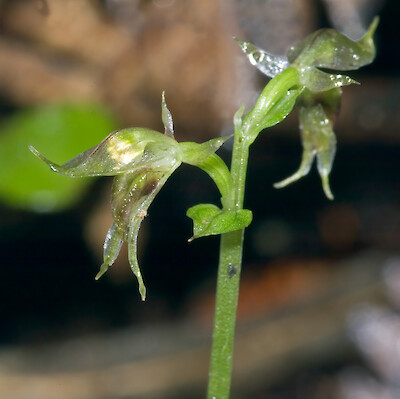
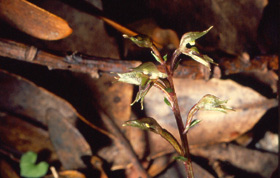
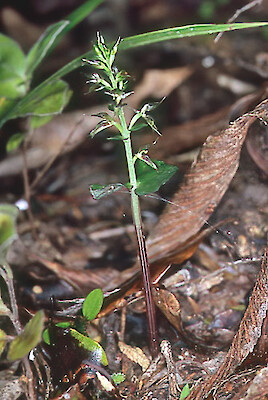
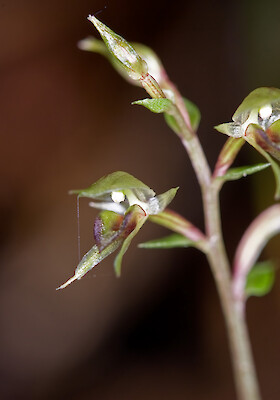
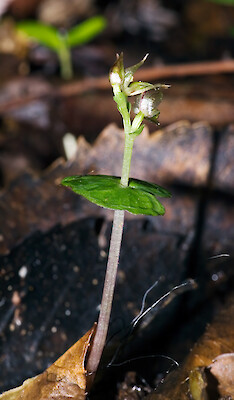
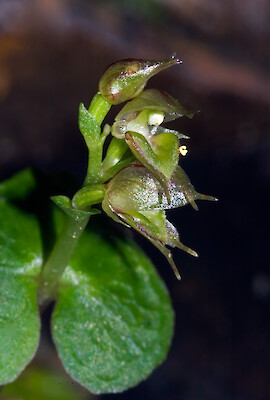
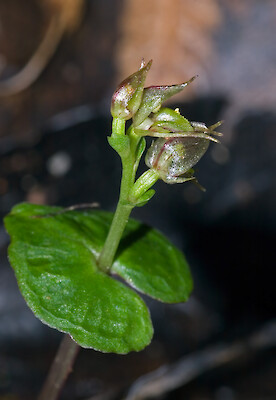
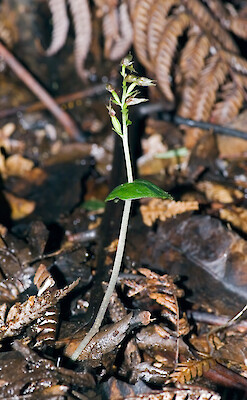
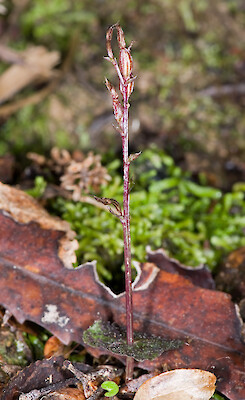
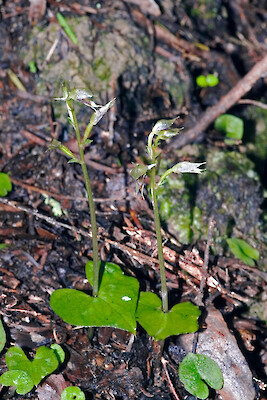
Diminutive perennial herb. Plants at flower up to 100 mm tall, often elongating further in seed. Stem erect, slender, hyaline suffused with red or purple. Leaf solitary, sessile, inserted at about ¼–½ way up stem, 10–35 mm long, green sometimes mottled or flecked maroon, ovate, acuminate, base cordate. Raceme to 50 mm long. Floral bract small, membranous, foliaceous, green or green tinged with maroon, ovate. Flowers 1–10 not obviously scented; perianth 6–8 mm long, more or less erect, usually greenish, often purpled, with dull red on labellum. Sepals shortly and abruptly caudate; dorsal sepal broadly lanceolate to ovate, concave, arched over column; lateral sepal similar of similar length, linear-lanceolate. Petals shorter, lanceolate, acuminate. Labellum shorter than sepals, broad-ovate; apex acute and more or less recurved, often coarsely papillose; proximal portion deeply concave, bearing two rounded calli at base. Column shorter than labellum, without wings. Pollinia globose, 4 in each anther cell, more or less coherent, eventually breaking into tetrads of grains toward the end of flowering.
Similar taxa
Most likely to be confused when vegetative with species of spider orchid (Nematoceras Hook.f.) from which it is not easily distinguished unless bearing flower buds, which are multiple in a raceme, rather than mostly solitary, rarely in pairs. Plants are somewhat similar to species of Cyrtostylis R.Br. but Cyrtostylis tend to favour more open habitats and these species have sessile leaves held close to or at the base of the stem and lying on or very close to the ground, and the labellum is larger, oblong, rather than ovate, and the petals are as long as, or longer than the lateral sepals, rather than much shorter. The very uncommon Townsonia deflexa forms interconnected creeping patches, and has a much smaller, petiolate leaf distinct from the flowering stem which supports a small, orbicular rather than ovate cauline leaf. Townsonia usually has 1–2–(4) rather than (1)–6–(10) flowers, a winged column (not winged in Acianthus sinclairii), and the sepals are not caudate (caudate in Acianthus sinclairii).
Distribution
Endemic. New Zealand: Kermadec Islands Raoul Island), Manawatāwhi / Three Kings Islands, North Island, South Island (rare in the east south of Marlborough, extending to Fiordland in the west), Stewart Island/Rakiura, Chatham Islands.
Habitat
Coastal to montane (up to 1100 m a.s.l.). Usually in lightly shaded to heavily shaded shrubland and forest. Very rarely found in more open, sunny habitats. Often near streams or within seepages in forest.
Detailed taxonomy
Genus
Family
Synonyms
Acianthus fornicatus var. sinclairii (Hook. f.) Hatch
Endemic taxon
Yes
Endemic genus
No
Endemic family
No
Ecology
Flowering
January–October
Fruiting
April–December
Life cycle and dispersal
Seeds are dispersed by attaching to fur, feathers and clothing (Thorsen et al., 2009)
Propagation technique
Easily grown from the division of whole plants. Does best in deep, moist leaf litter such as that produced under kanuka (Kunzea spp.) trees. Easily established in a semi-shaded site and excellent in pots. Should not be allowed to dry out during the growing season.
Other information
Etymology
acianthus: From the Latin acus ‘sharp, pointed’ and Greek anthos ‘flower’
sinclairii: After Sinclair (c. 1796–1861). Colonial Secretary and naturalist.
Manaaki Whenua Online Interactive Key
NVS code
The National Vegetation Survey (NVS) Databank is a physical archive and electronic databank containing records of over 94,000 vegetation survey plots - including data from over 19,000 permanent plots. NVS maintains a standard set of species code abbreviations that correspond to standard scientific plant names from the Ngä Tipu o Aotearoa - New Zealand Plants database.
ACISIN
Chromosome number
2n = 40
Previous conservation statuses
The conservation status of all known New Zealand vascular plant taxa at the rank of species and below were reassessed in 2022-2023 using the New Zealand Threat Classification System (NZTCS) – more information about this can be found on the NZTCS website. This report includes replaces all previous NZTCS lists for vascular plants. Previous assessments can be found here.
- Conservation status of vascular plants in Aotearoa New Zealand, 2023. 2024. Peter J. de Lange, Jane Gosden, Shannel P. Courtney, Alexander J. Fergus, John W. Barkla, Sarah M. Beadel, Paul D. Champion, Rowan Hindmarsh-Walls, Troy Makan and Pascale Michel Department of Conservation. Source: NZTCS and licensed by DOC for reuse under the Creative Commons Attribution 4.0 International licence.
2017 | Not Threatened
2012 | Not Threatened
2009 | Not Threatened
2004 | Not Threatened
Regional conservation statuses
Northland: 2026 | Regionally Not Threatened
Current regional threat status assessments prepared according to Crisp et al. (2025) are displayed when available. The Northland conservation status information is sourced from the “Conservation status of indigenous vascular plants in Northland | Taitokerau” Ford et al. 2026 report.
Auckland: 2025 | Regionally Not Threatened | Qualifiers: DPS, DPT
Current regional threat status assessments prepared according to Crisp et al. (2025) are displayed when available. The Auckland conservation status information is sourced from the “Conservation status of vascular plant species in Tāmaki Makaurau / Auckland” Simpkins E et al. 2025 report.
Otago: 2025 | Regionally Data Deficient
Current regional threat status assessments prepared according to Crisp et al. (2025) are displayed when available. The Otago conservation status information is sourced from the “Conservation Status of Indigenous Vascular Plants in Otago, 2025” Jarvie S et al. (2025) report.
Wellington: 2025 | Regionally Not Threatened
Current regional threat status assessments prepared according to Crisp et al. (2025) are displayed when available. The Wellington conservation status information is sourced from the “Conservation status of indigenous vascular plants in the Wellington region” Enright P et al. 2025 report.
Referencing and citations
References and further reading
Moore LB, Edgar E. 1970. Flora of New Zealand, Volume II. Indigenous Tracheophyta: Monocotyledones except Gramineae. Government Printer, Wellington, NZ. 354 p.
Thorsen MJ, Dickinson KJM, Seddon PJ. 2009. Seed dispersal systems in the New Zealand flora. Perspectives in Plant Ecology, Evolution and Systematics 11: 285–309. https://doi.org/10.1016/j.ppees.2009.06.001.
Attribution
Description adapted from: Moore and Edgar (1970).
Some of this factsheet information is derived from Flora of New Zealand Online and is used under a Creative Commons Attribution 3.0 New Zealand licence.