
Cordyline australis







Past favourite plant finalist
Common names
cabbage tree, tī, tī kōuka, palm lily
Biostatus
Native – Endemic taxon
Current conservation status
The conservation status of all known New Zealand vascular plant taxa at the rank of species and below were reassessed in 2022-2023 using the New Zealand Threat Classification System (NZTCS) – more information about this can be found on the NZTCS website. This report includes replaces all previous NZTCS lists for vascular plants. Previous assessments can be found here.
- Conservation status of vascular plants in Aotearoa New Zealand, 2023. 2024. Peter J. de Lange, Jane Gosden, Shannel P. Courtney, Alexander J. Fergus, John W. Barkla, Sarah M. Beadel, Paul D. Champion, Rowan Hindmarsh-Walls, Troy Makan and Pascale Michel Department of Conservation. Source: NZTCS and licensed by DOC for reuse under the Creative Commons Attribution 4.0 International licence.
2023 | Not Threatened
Category
Vascular
Structural class
Trees & Shrubs - Monocotyledons
Simplified description
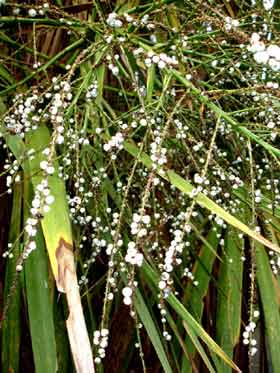
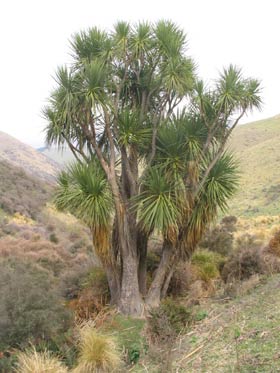
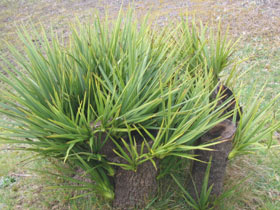
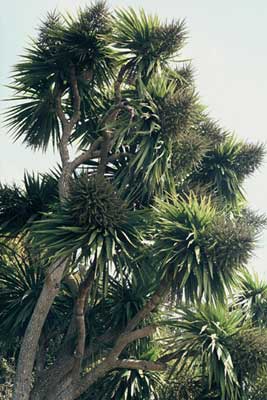
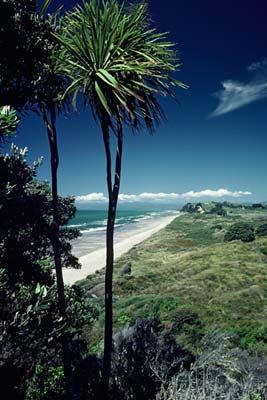
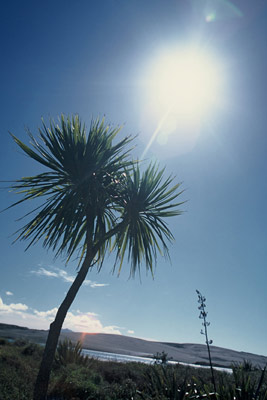
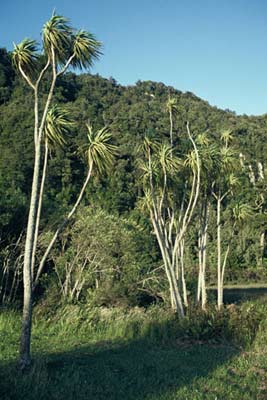
Common palm-like tree with an erect trunk branching into tufts of tough long narrow pointed leaves and with bushy sprays of small white flowers. Bark rough. Leaves 30-100cm long, only slightly tapered at base, dead leaves often forming a skirt around branches. Fruit small, white.
Flower colours
White
Detailed description
Tree up to 20 m tall, trunk stout, 1.5-2 m diam, many-branched above (prior to flowering, trunk slender and solitary, branching happens after the first flowering). Bark corky, persistent, fissured, pale to dark grey. Leaves numerous (0.2-)0.3-1(-1.5) x (0.2)-0.3(-0.6) m, dark to light green, narrowly lanceolate to lanceolate, erect to erecto-patent, scarcely inclined to droop, midrib indistinct. Petiole indistinct, short. Inflorescence a panicle. Peduncle stout, fleshy 40 mm or more in diam., panicle of numerous flowers, (0.6-)1(-1.8) x ).3-0.6(-0.8) m, branching to third or fourth order, these well spaced, basal bracts green and leaf-like, ultimate racemes 100-200 mm long, 20 mm diam., bearing well-spaced to somewhat crowded, almost sessile to sessile flowers and axes. Flowers sweetly perfumed, perianth 5-6 mm diam., white, tepals free almost to base, reflexed. Stamens about same length as tepals. Stigma short, trifid.
Similar taxa
Could be confused with the northern, primarily offshore island C. kaspar and its close relative, the Norfolk Island C. obtecta (probably both these should be merged). From these it can be distinguished by the larger heavily branched tree form, narrower leaves with a rather smaller, ill-defined, flat petiole, and smaller seeds. C. australis is rather variable, and some northerly offshore islands forms of it are either hybrids with, or might be better placed with C. kaspar.
Distribution
Endemic. Common in the North, South and Stewart Islands. Probably naturalised on the Chatham Islands.
Habitat
Widespread and common from coastal to montane forest. Most commonly encountered on alluvial terraces within riparian forest.
Threats
Populations have been decimated from some parts of the country due to a mysterious illness linked to a Myoplast Like Organisim (MLO) which is believed to cause the syndrome known as Sudden Decline. Plants stricken with this illness suddenly, and rapidly, wilt, with the leaves failing off still green. If the bark is peeled off the base of the tree near the soil line blackened or rotten spots are typically present. Once stricken with Sudden Decline there is no cure and the trees can die within days. Recently there has been some evidence to suggest the severity of Sudden Decline is lessening.
Cabbage trees, because they are very resilient are often the last indigenous plant to persist within cleared land. However, even these specimens will over time die, and unless such remnants are fenced as the young seedlings are greedily eaten by livestock. Cabbage trees remain a common and thriving species within much of the more highly modified ecosystems of coastal and lowland New Zealand. Recently there has been some evidence to suggest the severity of Sudden Decline is lessening.
Detailed taxonomy
Genus
Family
Synonyms
Dracaena australis Forst.f., Dracaenopsis australis (Forst.f.) Planchon
Endemic taxon
Yes
Endemic genus
No
Endemic family
No
Ecology
Flowering
(September-) October-December (-January)
Fruiting
(December-) January-March
Life cycle and dispersal
Fleshy berries are dispersed by frugivory (Thorsen et al., 2009).
Propagation technique
One of the most widely cultivated New Zealand natives, very popular in Europe, Britain and the U.S.A. Easily grown from fresh seed (seedlings often spontaneously appear in gardens from bird-dispersed seed), emergent shoot, stem and even trunk cuttings. Very hardy and will tolerate most soils and moisture regimes but dislikes long periods of drought. Excellent in pots and tubs. Numerous cultivars exist that will suit any situation.
Wetland plant indicator status rating
Information derived from the revised national wetland plant list prepared to assist councils in delineating and monitoring wetlands (Clarkson et al., 2021 Manaaki Whenua – Landcare Research Contract Report LC3975 for Hawke’s Bay Regional Council). The national plant list categorises plants by the extent to which they are found in wetlands and not ‘drylands’. The indicator status ratings are OBL (obligate wetland), FACW (facultative wetland), FAC (facultative), FACU (facultative upland), and UPL (obligate upland). If you have suggestions for the Wetland Indicator Status Rating, please contact: [Enable JavaScript to view protected content]
FAC: Facultative
Commonly occurs as either a hydrophyte or non-hydrophyte (non-wetlands).
Other information
Cultivation
Common in cultivation, and widely sold both within New Zealand and around the world.
Etymology
cordyline: From the Greek kordyle ‘club’
australis: Southern
NVS code
The National Vegetation Survey (NVS) Databank is a physical archive and electronic databank containing records of over 94,000 vegetation survey plots - including data from over 19,000 permanent plots. NVS maintains a standard set of species code abbreviations that correspond to standard scientific plant names from the Ngä Tipu o Aotearoa - New Zealand Plants database.
CORAUS
Chromosome number
2n = 38
Previous conservation statuses
The conservation status of all known New Zealand vascular plant taxa at the rank of species and below were reassessed in 2022-2023 using the New Zealand Threat Classification System (NZTCS) – more information about this can be found on the NZTCS website. This report includes replaces all previous NZTCS lists for vascular plants. Previous assessments can be found here.
- Conservation status of vascular plants in Aotearoa New Zealand, 2023. 2024. Peter J. de Lange, Jane Gosden, Shannel P. Courtney, Alexander J. Fergus, John W. Barkla, Sarah M. Beadel, Paul D. Champion, Rowan Hindmarsh-Walls, Troy Makan and Pascale Michel Department of Conservation. Source: NZTCS and licensed by DOC for reuse under the Creative Commons Attribution 4.0 International licence.
2017 | Not Threatened
2012 | Not Threatened
2009 | Not Threatened
2004 | Not Threatened
Regional conservation statuses
Auckland: 2025 | Regionally Not Threatened | Qualifiers: DPS, DPT
Current regional threat status assessments prepared according to Crisp et al. (2025) are displayed when available. The Auckland conservation status information is sourced from the “Conservation status of vascular plant species in Tāmaki Makaurau / Auckland” Simpkins E et al. (2025) report.
Otago: 2025 | Regionally Not Threatened
Current regional threat status assessments prepared according to Crisp et al. (2025) are displayed when available. The Otago conservation status information is sourced from the “Conservation Status of Indigenous Vascular Plants in Otago, 2025” Jarvie S et al. (2025) report.
Northland: 2026 | Regionally Not Threatened
Current regional threat status assessments prepared according to Crisp et al. (2025) are displayed when available. The Northland conservation status information is sourced from the “Conservation status of indigenous vascular plants in Northland | Taitokerau” Ford et al. 2026 report.
Referencing and citations
References and further reading
Beever, R. et al. 1996. Sudden decline of cabbage tree. NZ Journal of Ecology, 20(1): 53-68
Thorsen, M. J.; Dickinson, K. J. M.; Seddon, P. J. 2009. Seed dispersal systems in the New Zealand flora. Perspectives in Plant Ecology, Evolution and Systematics 11: 285-309
Attribution
Fact sheet prepared by P.J. de Lange for NZPCN (1 June 2013)
NZPCN Fact Sheet citation
Please cite as: de Lange, P.J. (Year at time of access): Cordyline australis Fact Sheet (content continuously updated). New Zealand Plant Conservation Network. https://www.nzpcn.org.nz/flora/species/cordyline-australis/ (Date website was queried)