
Sphaeropteris medullaris

Common names
mamaku, black tree fern
Biostatus
Native
Current conservation status
The conservation status of all known New Zealand vascular plant taxa at the rank of species and below were reassessed in 2022-2023 using the New Zealand Threat Classification System (NZTCS) – more information about this can be found on the NZTCS website. This report includes replaces all previous NZTCS lists for vascular plants. Previous assessments can be found here.
- Conservation status of vascular plants in Aotearoa New Zealand, 2023. 2024. Peter J. de Lange, Jane Gosden, Shannel P. Courtney, Alexander J. Fergus, John W. Barkla, Sarah M. Beadel, Paul D. Champion, Rowan Hindmarsh-Walls, Troy Makan and Pascale Michel Department of Conservation. Source: NZTCS and licensed by DOC for reuse under the Creative Commons Attribution 4.0 International licence.
2023 | Not Threatened | Qualifiers: SO
Category
Vascular
Structural class
Ferns
Simplified description
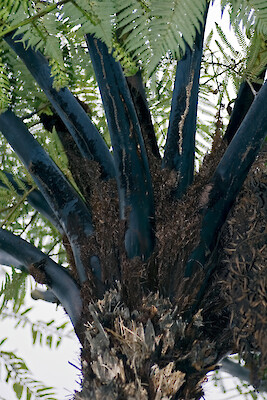
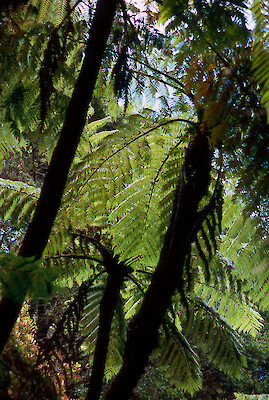
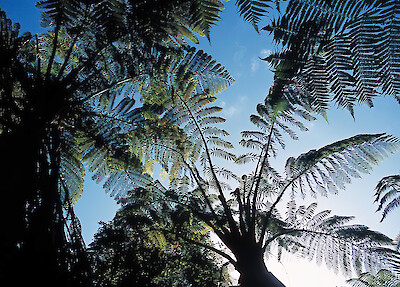
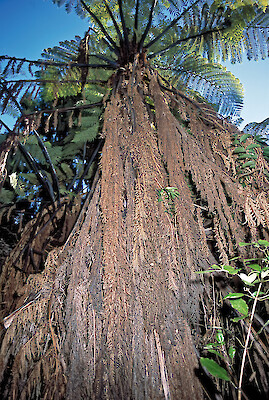
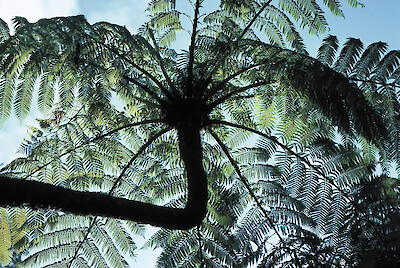
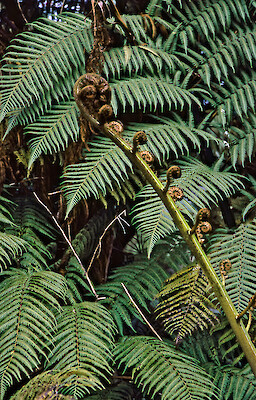
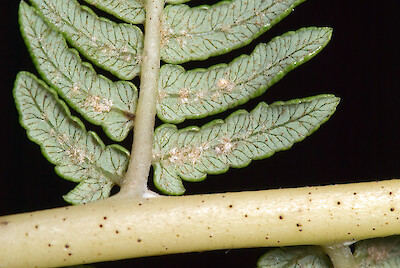
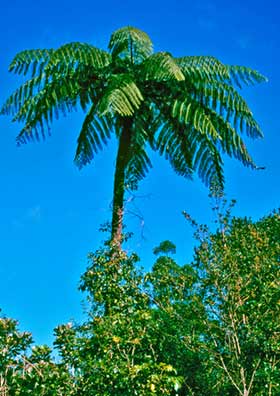
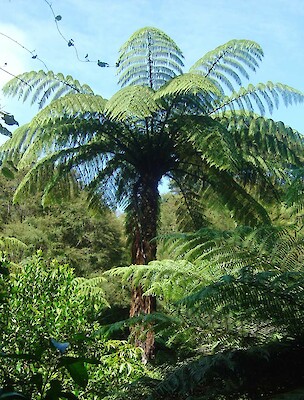
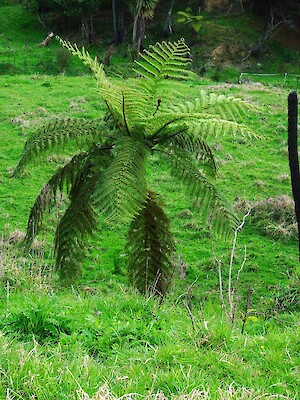
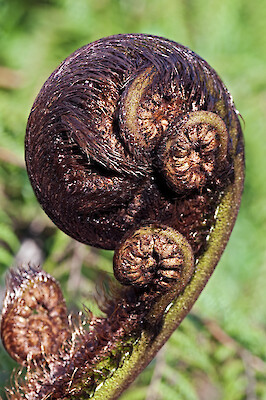
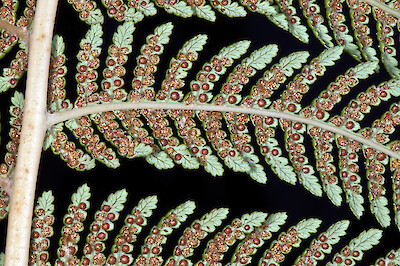
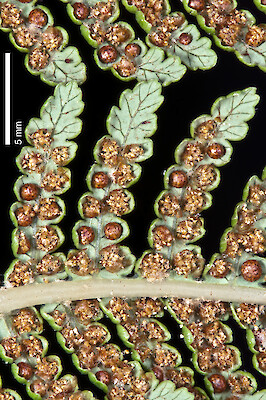
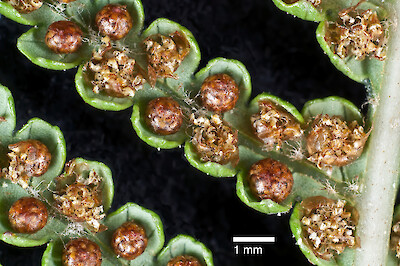
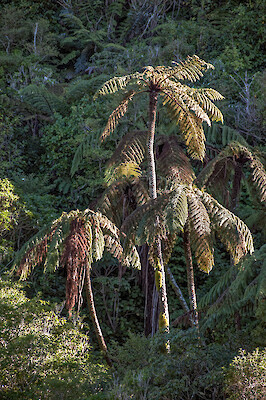
Large tree fern with black-stalked leaves to 5 m long. Trunk with obvious scars from old leaves, to 20 m tall. Leaf stems covered in small scales that have a spiny edge (lens needed). Sporangia arranged in small round capsules underneath leaves.
Flower colours
No flowers
Detailed description
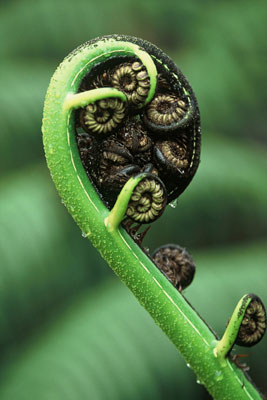
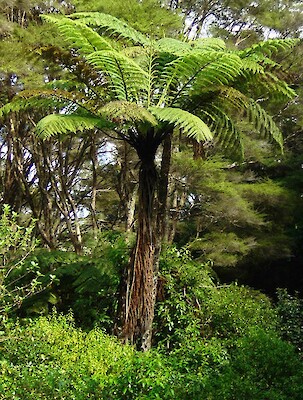
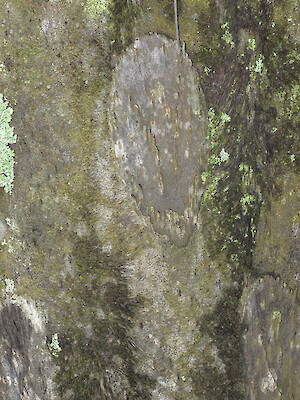
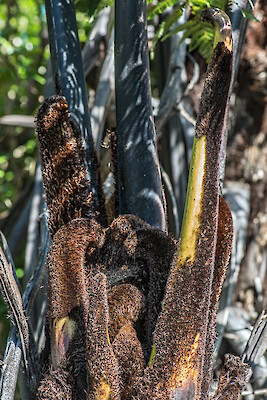
Tree fern up to 20 m tall. Trunk black covered with hexagonal stipe bases. Stipes thick, black, harsh to touch, covered in black scales. Scales with marginal spines. Fronds up to 5 m long, arching upwards from crown, 3-pinnate, leathery, dead fronds falling (except in very young plants). Longest primary pinnae 0.4–1 m long, undersurfaces bearing scales with marginal spines. Indusia completely covering sori at maturity, splitting irregularly.
Similar taxa
Easily recognised by trunk with its distinctive hexagonal stipe scars and by the scales which possess marginal spines.
Distribution
Indigenous. New Zealand: Manawatāwhi / Three Kings Islands, North Island, South Island (uncommon in the drier eastern portion, and apparently absent from Canterbury and Otago), Stewart Island/Rakiura, Chatham Islands (Chatham Island (Rēkohu), Pitt Island (Rangiauria)). Also Pacific Islands from Fiji to Picairn.
Habitat
Common in lowland forest throughout the North Island. Primarily in wetter coastal areas of the South Island.
Detailed taxonomy
Genus
Family
Synonyms
Cyathea medullaris (G. Forst.) Sw.; Cyathea medullaris var. polyneuron (Colenso) C.Chr.; Cyathea medullaris var. integra Hook.; Cyathea polyneuron Colenso; Polypodium medullare G.Forst.;
Endemic taxon
No
Endemic genus
No
Endemic family
No
Ecology
Flowering
Not applicable—spore producing
Fruiting
Not applicable—spore producing
Life cycle and dispersal
Minute spores are wind dispersed (Thorsen et al., 2009).
Propagation technique
Can be grown from fresh spores (but slow). Young plants transplant easily and freshly felled trunks will usually resprout if planted and carefully watered. Easy, once established in a variety of conditions. Should not be removed from the wild unless with landowner permission.
Wetland plant indicator status rating
Information derived from the revised national wetland plant list prepared to assist councils in delineating and monitoring wetlands (Clarkson et al., 2021 Manaaki Whenua – Landcare Research Contract Report LC3975 for Hawke’s Bay Regional Council). The national plant list categorises plants by the extent to which they are found in wetlands and not ‘drylands’. The indicator status ratings are OBL (obligate wetland), FACW (facultative wetland), FAC (facultative), FACU (facultative upland), and UPL (obligate upland). If you have suggestions for the Wetland Indicator Status Rating, please contact: [Enable JavaScript to view protected content]
FACW: Facultative Wetland
Usually is a hydrophyte but occasionally found in uplands (non-wetlands).
Other information
Cultivation
Commonly cultivated. Not as freely available from nurseries as other tree ferns because it is slow from spores and sporelings are notorious for failing following transplants.
Etymology
medullaris: Pithy (trunk)
NVS code
The National Vegetation Survey (NVS) Databank is a physical archive and electronic databank containing records of over 94,000 vegetation survey plots - including data from over 19,000 permanent plots. NVS maintains a standard set of species code abbreviations that correspond to standard scientific plant names from the Ngä Tipu o Aotearoa - New Zealand Plants database.
SPHMED
Chromosome number
2n = 138
Previous conservation statuses
The conservation status of all known New Zealand vascular plant taxa at the rank of species and below were reassessed in 2022-2023 using the New Zealand Threat Classification System (NZTCS) – more information about this can be found on the NZTCS website. This report includes replaces all previous NZTCS lists for vascular plants. Previous assessments can be found here.
- Conservation status of vascular plants in Aotearoa New Zealand, 2023. 2024. Peter J. de Lange, Jane Gosden, Shannel P. Courtney, Alexander J. Fergus, John W. Barkla, Sarah M. Beadel, Paul D. Champion, Rowan Hindmarsh-Walls, Troy Makan and Pascale Michel Department of Conservation. Source: NZTCS and licensed by DOC for reuse under the Creative Commons Attribution 4.0 International licence.
2017 | Not Threatened
2012 | Not Threatened
2009 | Not Threatened
2004 | Not Threatened
Regional conservation statuses
Auckland: 2025 | Regionally Not Threatened | Qualifiers: DPS, DPT
Current regional threat status assessments prepared according to Crisp et al. (2025) are displayed when available. The Auckland conservation status information is sourced from the “Conservation status of vascular plant species in Tāmaki Makaurau / Auckland” Simpkins E et al. (2025) report.
Otago: 2025 | Regionally Threatened – Regionally Critical | Qualifiers: Sp
Current regional threat status assessments prepared according to Crisp et al. (2025) are displayed when available. The Otago conservation status information is sourced from the “Conservation Status of Indigenous Vascular Plants in Otago, 2025” Jarvie S et al. (2025) report.
Northland: 2026 | Regionally Not Threatened
Current regional threat status assessments prepared according to Crisp et al. (2025) are displayed when available. The Northland conservation status information is sourced from the “Conservation status of indigenous vascular plants in Northland | Taitokerau” Ford et al. 2026 report.
Referencing and citations
References and further reading
Brownsey PJ, Smith-Dodsworth JC. 2000. New Zealand Ferns and Allied Plants. David Bateman, Auckland, NZ. 168 p.
Esler, W.R. 1976. Succession of fronds of mamaku (cyathea medullaris). Wellington Botanical Society Bulletin 39: 41–43.
Thorsen MJ, Dickinson KJM, Seddon PJ. 2009. Seed dispersal systems in the New Zealand flora. Perspectives in Plant Ecology, Evolution and Systematics 11: 285–309. https://doi.org/10.1016/j.ppees.2009.06.001.
Attribution
Fact sheet prepared for NZPCN by P.J. de Lange March 2004. Description adapted from Brownsey & Smith-Dodsworth (2000).