
Planchonella costata
Common name
tawāpou
Synonyms
Achras costata Endl., Pouteria costata (Endl.) Baehni, Planchonella novo-zelandica (F.Muell.) Allan, Achras novozelandica F. Muell.
Family
Sapotaceae
Flora category
Vascular – Native
Endemic taxon
No
Endemic genus
No
Endemic family
No
Structural class
Trees & Shrubs - Dicotyledons
NVS code
The National Vegetation Survey (NVS) Databank is a physical archive and electronic databank containing records of over 94,000 vegetation survey plots - including data from over 19,000 permanent plots. NVS maintains a standard set of species code abbreviations that correspond to standard scientific plant names from the Ngä Tipu o Aotearoa - New Zealand Plants database.
PLACOS
Chromosome number
2n = 28
Current conservation status
The conservation status of all known New Zealand vascular plant taxa at the rank of species and below were reassessed in 2017 using the New Zealand Threat Classification System (NZTCS) – more information about this can be found on the NZTCS website. This report includes a statistical summary and brief notes on changes since 2012 and replaces all previous NZTCS lists for vascular plants.
Please note, threat classifications are often suggested by authors when publications fall between NZTCS assessment periods – an interim threat classification status has not been assessed by the NZTCS panel.
- Conservation status of New Zealand indigenous vascular plants, 2017 . 2018. Peter J. de Lange, Jeremy R. Rolfe, John W. Barkla, Shannel P. Courtney, Paul D. Champion, Leon R. Perrie, Sarah M. Beadel, Kerry A. Ford, Ilse Breitwieser, Ines Schönberger, Rowan Hindmarsh-Walls, Peter B. Heenan and Kate Ladley. Department of Conservation. Source: NZTCS and licensed by DOC for reuse under the Creative Commons Attribution 4.0 International licence.
2017 | At Risk – Relict | Qualifiers: PD, TO
Previous conservation statuses
2012 | At Risk – Relict | Qualifiers: TO
2009 | Not Threatened
2004 | Not Threatened
Brief description
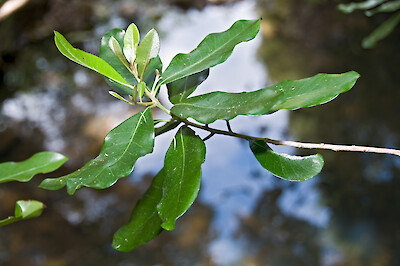
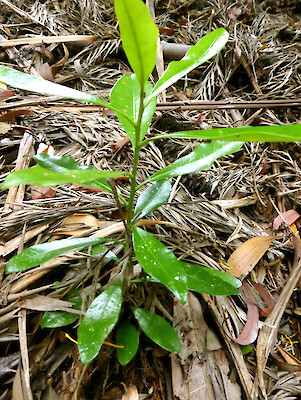
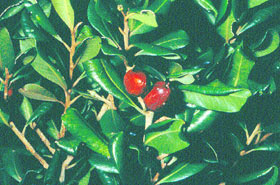
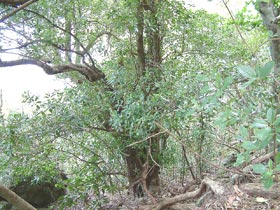
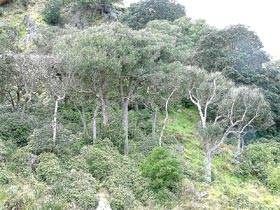
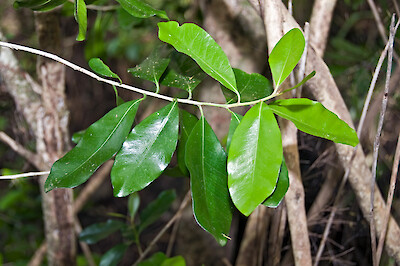
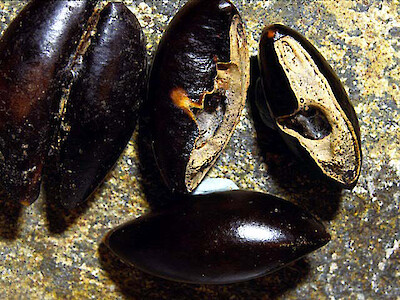
Small tree with leathery leaves that are paler underneath and with straight veins radiating from central vein more visible on the upper surface inhabiting coastal forest in the upper North Island. Twig fuzzy. Flowers tiny. Fruit 2.5-4cm long, red ripening to almost black, enclosing 2-4 hard narrow shiny seeds.
Distribution
Indigenous. Norfolk Island and New Zealand where it found in the North Island only from Te Paki south to the Manukau and Coromandel Peninsula after which it occurs in scattered sites as far south as East Cape in the East and Kawhia Harbour in the west. Some of these southerly occurrences are associated with Pa sites, and as the glossy seeds were used as necklaces by Maori it is possible that this species was planted over some parts of its southern North Island range. Tawapou is common on rodent-free offshore islands in the Hauraki Gulf, around the Coromandel Peninsula, Great Barrier Island, and on the Mokohinau, Poor Knights, Hen & Chickens and Three Kings Islands.
Habitat
Strictly coastal where it is usually a minor (rarely dominant) component of coastal forest on rocky headlands and talus slopes, windswept ridge-lines, forested islands and islets. Usually associated with pohutukawa (Metrosideros excelsa), puriri (Vitex lucens), karaka (Corynocarpus laevigatus), whau (Entelea arborescens), kowhai (Sophora chathamica), tawaroa ( the northern wide-leaved form of Beilschmedia tawa) and on offshore islands such as the Three Kings, Poor Knights, Mokohinau Islands with coastal maire (Nestegis apetala), Streblus spp., and Hoheria spp.
Detailed description
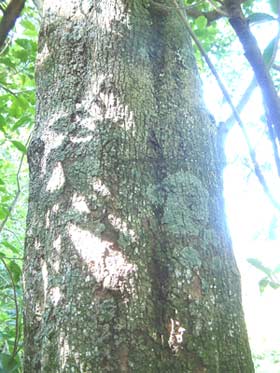
Tree up to 18 m. tall; trunk up to 1 m diameter; bark firm (not flaking), greyish-white to grey-brown, finely furrowed; branches numerous, erect and scarcey spreading, closely packed; branchlets clad in appressed hairs and ± lactescent (exuding amilky fluid). Leaves intially pubescent (pubescence comprising fine, matted greyish to grey-brown hairs), lactescent, petioles 8-12 mm long, rather stout and rigid. Lamina 40-150 × 20-50 mm, yellow-green to dark green, elliptic-to obovate-oblong, entire, very coriaceous, adaxially lustrous, when mature glabrous except on abaxial midrib, apex obtuse or retuse, base cuneately narrowed. Lateral veins numerous, set at a rather wide angle to midrib. Flowers axillary and/or cauliflorus, solitary or rarely 2 together, 3.8-6.2 mm diameter; [peduncles 6-12 mm long, rather stout and rigid ± curved; calyx 4(-5)-toothed, teeth narrowly to broadly ovate, pubescent, obtuse; hairs centrally affixed. Corolla greenish to yellow-green, slightly > calyx, deeply 4-5-partite; lobes obovate-oblong, 3.8-4.1 mm. long. Stamens 5, filaments thick; staminodes 5, subulate. Ovary 4-5-loculed. Fruit fleshy, 25-50 mm long, ovoid to ellipsoid, maturing dark purple-black, dark red or orange-yellow. Seeds 1-4, 22-48 mm long, curved, rather hard, testa black, glossy.
Similar taxa
None
Flowering
September - November
Flower colours
Green, Yellow
Fruiting
December - June
Propagation technique
Easily grown from fresh seed, Difficult from cuttings. A frost tender species that makes an excellent specimen tree for northern New Zealand parks and large gardens, and is ideal for planting in street avenues. Can be a little slow to establish in some sites but once it is established it is moderately fast growing, drought tolerant and has a pleasing growth habit. Tawapou can also be used as a hedge - though this spoils its attractive form.
Attribution
Description adapted from Allan (1961) by P. J. de Lange.
References and further reading
Allan, H.H. 1961: Flora of New Zealand. Vol. I, Wellington, Government Printer.
NZPCN Fact Sheet citation
Please cite as: de Lange, P.J. (Year at time of access): Planchonella costata Fact Sheet (content continuously updated). New Zealand Plant Conservation Network. https://www.nzpcn.org.nz/flora/species/planchonella-costata/ (Date website was queried)