
Leptospermum scoparium var. scoparium



Past favourite plant finalist
Common names
mānuka, kahikātoa
Biostatus
Native
Current conservation status
The conservation status of all known New Zealand vascular plant taxa at the rank of species and below were reassessed in 2022-2023 using the New Zealand Threat Classification System (NZTCS) – more information about this can be found on the NZTCS website. This report includes replaces all previous NZTCS lists for vascular plants. Previous assessments can be found here.
- Conservation status of vascular plants in Aotearoa New Zealand, 2023. 2024. Peter J. de Lange, Jane Gosden, Shannel P. Courtney, Alexander J. Fergus, John W. Barkla, Sarah M. Beadel, Paul D. Champion, Rowan Hindmarsh-Walls, Troy Makan and Pascale Michel Department of Conservation. Source: NZTCS and licensed by DOC for reuse under the Creative Commons Attribution 4.0 International licence.
2023 | Not Threatened
Category
Vascular
Structural class
Trees & Shrubs - Dicotyledons
Simplified description
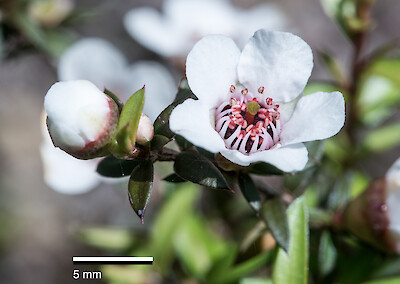
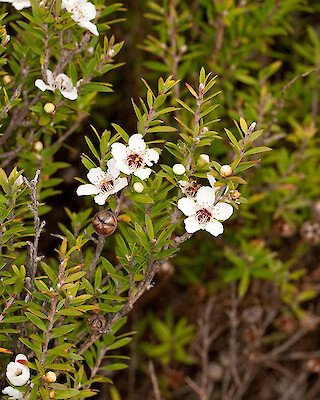
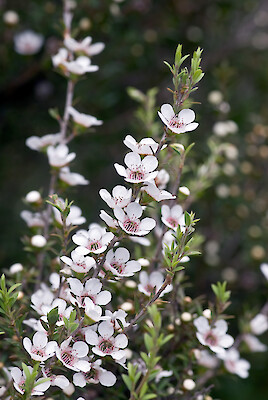
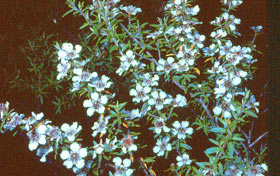
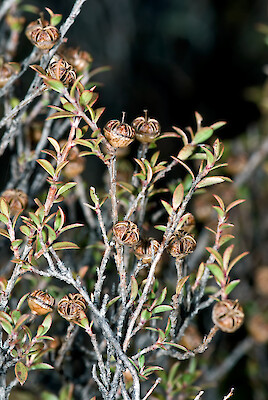
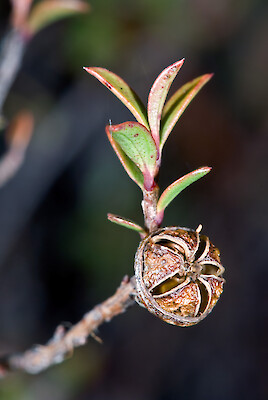
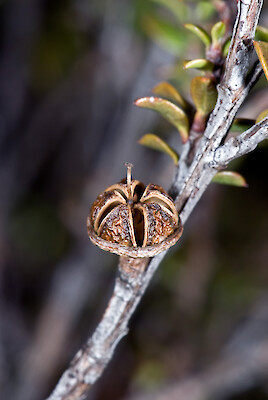
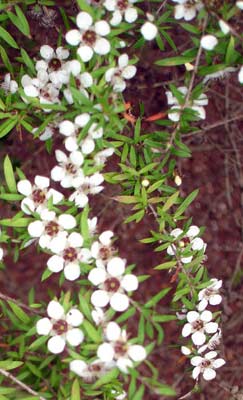
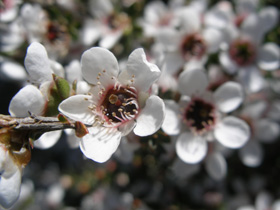
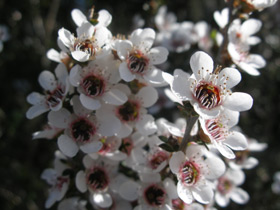
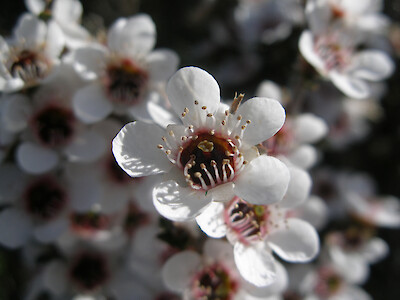
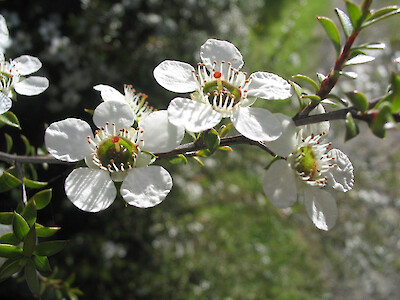
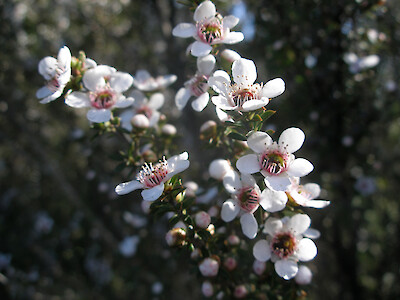
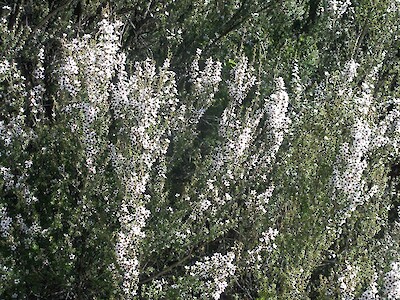
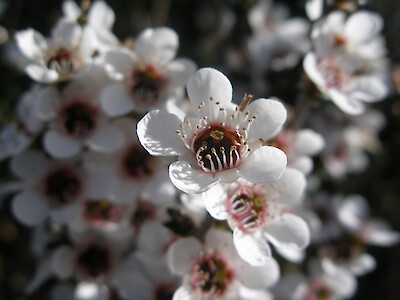
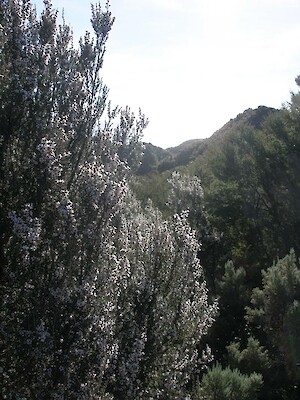
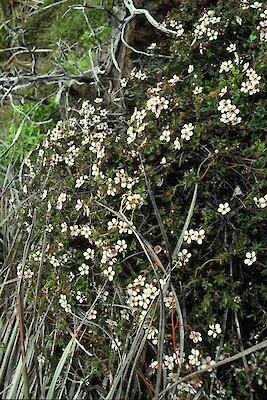
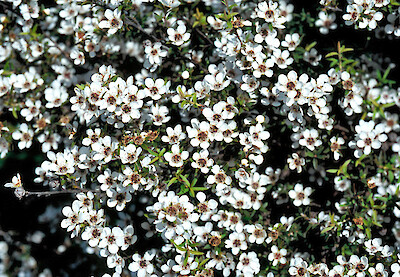
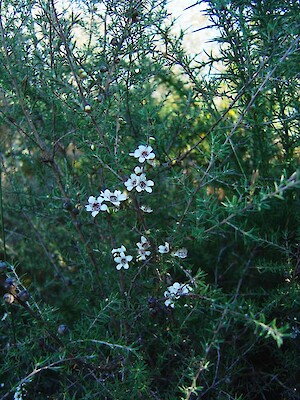
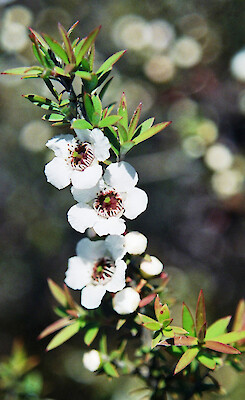
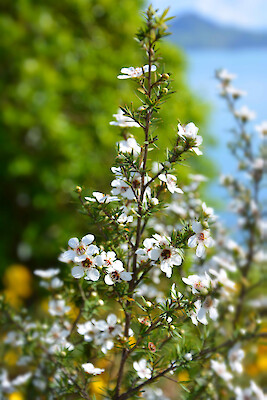
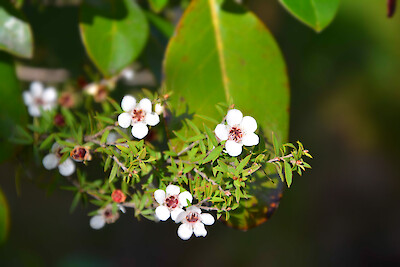
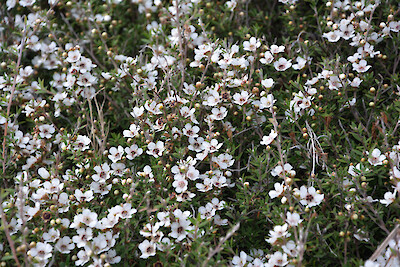
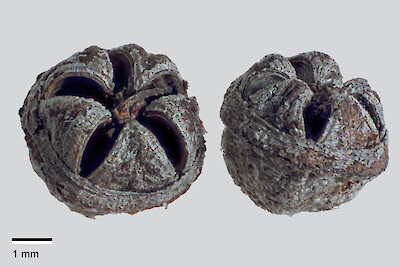
Common small prickly shrub or small tree with flaky bark and more or less hairy new growth and bearing masses of oval pointed leaves and white or pinkish red-centred flowers. Leaves hard, 5–20 mm long by 1–8 mm wide, prickly to grasp. Flowers to 25 mm wide. Fruit a dry 5–7mm wide capsule.
Flower colours
Red/Pink, White
Detailed description
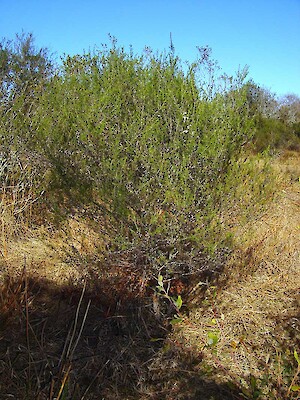
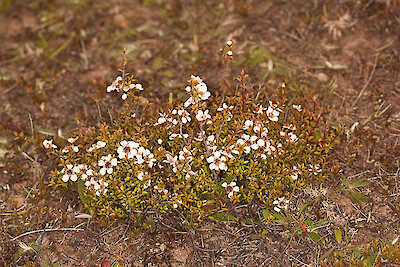
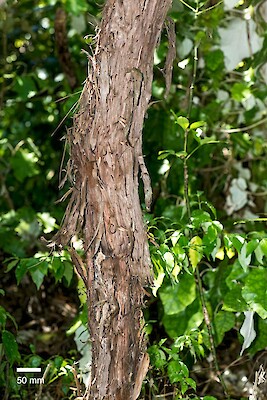
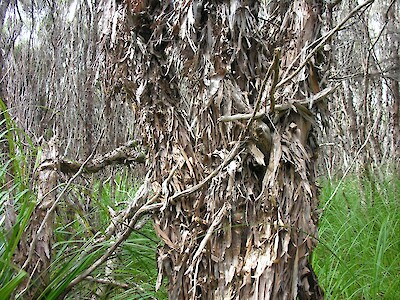
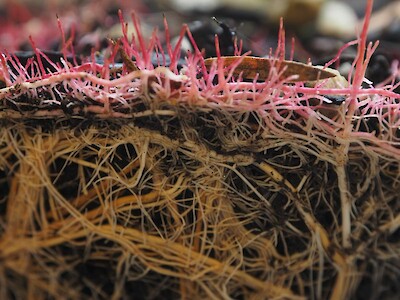
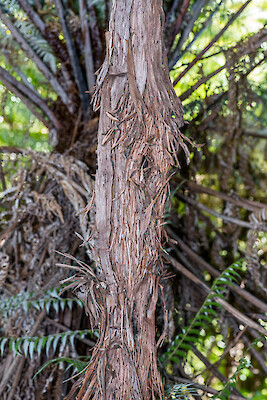
Decumbent shrub, subshrub, shrub, or small tree up to 5 m in height and in decumbent forms 2–4 m across. Bark light grey to charcoal grey, peeling in long papery flakes, these curling with age. Wood red. Branches numerous erect, spreading or decumbent, arising from base, sometimes sprouting adventitious roots and/or layering on contact with soil; young branches densely to sparingly clad in long silky, white hairs. Leaves leathery, pale to dark green, glabrescent to glabrous, linear-filiform, narrowly lanceolate, lanceolate, oblanceolate, to elliptic or obovate (5)–10–15–(20) × 1–2–5–(8) mm, invariably apex drawn out into a long stiff, pungent point, midrib usaully distinct sometimes obscure, leaf margin finely crenate, veins simple, scarcely branched; young leaves densely to sparingly clad in long silky, white hairs. Flowers solitary in leaf axils, (8)–10–20–(25) mm diameter; flower buds densely to sparingly clad in long silky, white hairs. Receptacle dark red, crimson or pink. Petals white, sometimes flushed pink or dark red. Stamens numerous.
Similar taxa
With the exception of L. scoparium var. incanum a broad circumscription of the the New Zealand forms of mānuka (L. scoparium) has been adopted. In this sense, mānuka could only be confused with kānuka (Kunzea spp.) and Great Barrier Island kānuka (Kunzea sinclairii), from which it can be easily distinguished by the hard, persistent, circular, nut-like fruits, with non persistent sepals, sharp-tipped minutely denticulate leaves, and flowers which appear to be solitary.
Distribution
Indigenous. New Zealand and Australia. Most Australian forms of L. scoparium do not match the range seen in New Zealand. However, plants from Tasmania are very similar, if not identical, to some South Island forms, differing in having a lignotuber, wider leaf bases, and longer, more pungent leaf apices. Leptospermum scoparium was also collected once from Rarotonga by Thomas Cheeseman in the 1800s. It has not been found there since. It’s biostatus on that island is unclear.
Habitat
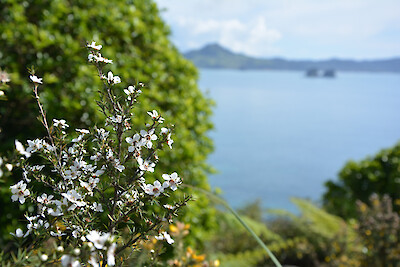
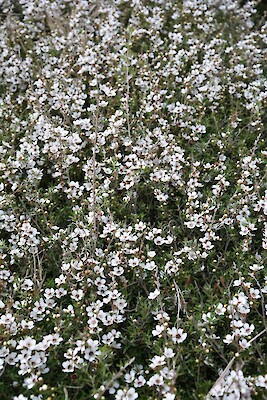
Abundant from coastal situations to low alpine habitats.
Threats
Although widespread and common, some stands are at risk from clearance for farmland or through felling for firewood. The recent (2017) arrival of myrtle rust (Austropuccinia psidii) may pose a more serious threat to Leptospermum (see below). See myrtlerust.org.nz for more information about this invasive fungus.
Detailed taxonomy
Genus
Family
Synonyms
None - a myriad of varieties have been proposed none of which has been strictly synonymised within L. scoparium. Allan (1961) discusses some of these, and accepted one (var. incanum). A modern taxonomic assessment of Leptospermum scoparium is urgently needed.
Endemic taxon
No
Endemic genus
No
Endemic family
No
Ecology
Flowering
Throughout the year
Fruiting
The capsules are long persistent so invariably mature plants possess at least some capsules.
Propagation technique
Very easy from fresh seed. Seed must be sown fresh, even if left for a few weeks before sowing viability can drop, especially if seed is allowed to dry out. Difficult from cuttings.
Wetland plant indicator status rating
Information derived from the revised national wetland plant list prepared to assist councils in delineating and monitoring wetlands (Clarkson et al., 2021 Manaaki Whenua – Landcare Research Contract Report LC3975 for Hawke’s Bay Regional Council). The national plant list categorises plants by the extent to which they are found in wetlands and not ‘drylands’. The indicator status ratings are OBL (obligate wetland), FACW (facultative wetland), FAC (facultative), FACU (facultative upland), and UPL (obligate upland). If you have suggestions for the Wetland Indicator Status Rating, please contact: [Enable JavaScript to view protected content]
FAC: Facultative
Commonly occurs as either a hydrophyte or non-hydrophyte (non-wetlands).
Other information
Myrtle Rust Threat
Myrtle rust (Austropuccinia psidii) was first detected in New Zealand in 2017. As there is as yet no known effective treatment for that rust. Overseas indications are that this rust is having a serious impact on Myrtaceae worldwide, including causing such severe declines in some that extinction of some species and genera seems inevitable. As such the New Zealand Threat Listing Panel elected to list all indigenous Myrtaceae using the ‘Precautionary Principle’ as ‘Threatened’ (de Lange et al. 2018). Hopefully this assessment will be proved wrong. As of 2018 there have been very few occurrences of myrtle rust on Leptospermum. However, the rust is still in its early establishment phase. Australian experience suggests it may take 10 or more years to truly establish which New Zealand Myrtaceae will be most affected.
Cultivation
Commonly cultivated. However many garden forms are horticultural selections based on crosses between L. scoparium var. incanum and white or red-flowered L. scoparium var. scoparium. Some seem to represent natural variations, others may stem for deliberate crosses with Australian forms of L. scoparium and allied species. Recently a number of Australian Leptospermum have been introduced into New Zealand, and these have been deliberately crossed with manuka.
Etymology
leptospermum: Slender seed
scoparium: Like a broom
Manaaki Whenua Online Interactive Key
NVS code
The National Vegetation Survey (NVS) Databank is a physical archive and electronic databank containing records of over 94,000 vegetation survey plots - including data from over 19,000 permanent plots. NVS maintains a standard set of species code abbreviations that correspond to standard scientific plant names from the Ngä Tipu o Aotearoa - New Zealand Plants database.
LEPSVS
Chromosome number
2n = 22
Previous conservation statuses
The conservation status of all known New Zealand vascular plant taxa at the rank of species and below were reassessed in 2022-2023 using the New Zealand Threat Classification System (NZTCS) – more information about this can be found on the NZTCS website. This report includes replaces all previous NZTCS lists for vascular plants. Previous assessments can be found here.
- Conservation status of vascular plants in Aotearoa New Zealand, 2023. 2024. Peter J. de Lange, Jane Gosden, Shannel P. Courtney, Alexander J. Fergus, John W. Barkla, Sarah M. Beadel, Paul D. Champion, Rowan Hindmarsh-Walls, Troy Makan and Pascale Michel Department of Conservation. Source: NZTCS and licensed by DOC for reuse under the Creative Commons Attribution 4.0 International licence.
2017 | At Risk – Declining | Qualifiers: DP, De
2012 | Not Threatened
2009 | Not Threatened
2004 | Not Threatened
Regional conservation statuses
Otago: 2025 | Regionally Not Threatened | Qualifiers: De
Current regional threat status assessments prepared according to Crisp et al. (2025) are displayed when available. The Otago conservation status information is sourced from the “Conservation Status of Indigenous Vascular Plants in Otago, 2025” Jarvie S et al. (2025) report.
Referencing and citations
References and further reading
de Lange, P.J.; Rolfe, J.R.; Barkla, J.W.; Courtney, S.P.; Champion, P.D.; Perrie, L.R.; Beadel, S.M.; Ford, K.A.; Breitwieser, I.; Schönberger, I.; Hindmarsh-Walls, R.; Heenan, P.B.; Ladley, K. 2018: Conservation status of New Zealand indigenous vascular plants. 2017. New Zealand Threat Classification Series 22: 1–82.
Attribution
Fact Sheet prepared for NZPCN by P.J. de Lange 1 February 2004. Description by P.J. de Lange.
NZPCN Fact Sheet citation
Please cite as: de Lange, P.J. (Year at time of access): Leptospermum scoparium var. scoparium Fact Sheet (content continuously updated). New Zealand Plant Conservation Network. https://www.nzpcn.org.nz/flora/species/leptospermum-scoparium-var-scoparium/ (Date website was queried)