
Pimelea eremitica
Common names
roimata ō Tohe, pimelea
Biostatus
Native – Endemic taxon
Current conservation status
The conservation status of all known New Zealand vascular plant taxa at the rank of species and below were reassessed in 2022-2023 using the New Zealand Threat Classification System (NZTCS) – more information about this can be found on the NZTCS website. This report includes replaces all previous NZTCS lists for vascular plants. Previous assessments can be found here.
- Conservation status of vascular plants in Aotearoa New Zealand, 2023. 2024. Peter J. de Lange, Jane Gosden, Shannel P. Courtney, Alexander J. Fergus, John W. Barkla, Sarah M. Beadel, Paul D. Champion, Rowan Hindmarsh-Walls, Troy Makan and Pascale Michel Department of Conservation. Source: NZTCS and licensed by DOC for reuse under the Creative Commons Attribution 4.0 International licence.
2023 | Threatened – Nationally Critical | Qualifiers: DPR, OL
Category
Vascular
Structural class
Trees & Shrubs - Dicotyledons
Simplified description
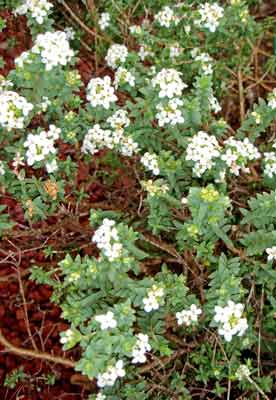
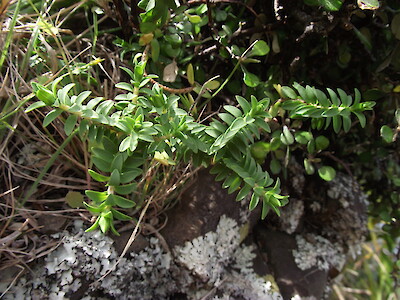
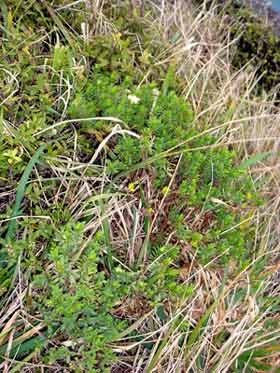
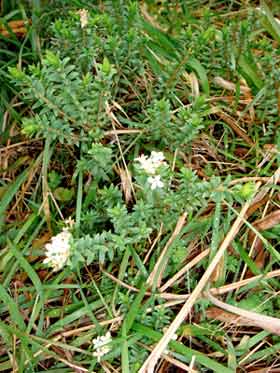
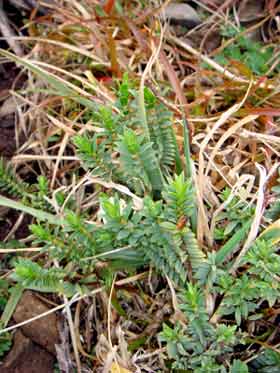
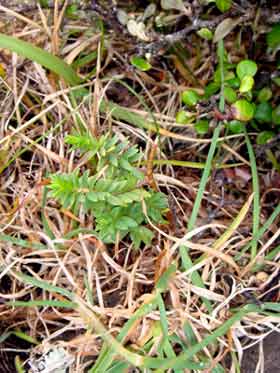
Low growing sprawling shrub to 40cm tall with greyish-hairy thin flexible twigs bearing small narrow blue-green leaves, hairy white flowers and whiteish fruit inhabiting Maunganui Bluff in Northland. Leaves 4-6mm long by 1.5-2mm wide, with a glistening under surface.
Flower colours
White
Detailed description
A small to medium-sized, erect to suberect shrub, up to 400 mm tall, branching sympodially and with many erect, thin lateral branches. Young branchlets light brown, moderately densely covered with white to grey-white appressed hair. Internodes 1.0–1.5 mm. Older stems glabrate to hairless, brown to dark grey. Node buttresses usually short (0.2 mm), lunate, sometimes elongate masked by hair on young branchlets, small but moderately prominent on some leafless branchlets. Leaves decussate, ascendant, becoming patent on larger plants, on short (0.5–1 mm) red petioles, often persistent. Lamina slightly keeled, moderately stiff, 4–6 × 1.5–2 mm, elliptic, glabrous, medium-green, sometimes red-margined, midvein evident abaxially, but not prominent; acute, but blunt tipped, base cuneate. Stomata present on adaxial side only. Abaxial surface glistens. Inflorescences terminal on leading stems, 1–5-flowered, involucral bracts 4, similar in size to adjacent leaves or wider (7 × 3.5 mm). Plants gynodioecious. Flowers white, on very short pedicels (0.3 mm), circumscissile near base, outside of tube and calyx lobes moderately hairy, inside hairless. Female tube 3 mm long, ovary portion 2.6 mm, calyx lobes (ascendant) 2 × 1 mm; hermaphrodite tube 6 mm long, ovary portion 2.5 mm, calyx lobes 3.5× 2.5 mm. Anther dehiscence semi-latrorse. Ovary with short hairs at summit and a few down to base. Fruits ovoid, fleshy, white with pink flush, opaque 4 × 2.7 mm. Seeds 3 × 1.8 mm.
Similar taxa
Pimelea eremitica is allied to P. telura and P. sporadica. From P. telura is differs by its smaller stature (plants up to 400 mm cf. 1.0 m tall) and smaller leaves whose undersides that are adaxially concave or keeled. From P. sporadica it differs by the thinner (up to 2.5 mm c.f 4.0 mm thick), flexible, sympodial and ascendant lateral stems, strong keeled rather than adaxially concave or keeled leaves and pinkish rather than white fruits. Pimelea telura is confined to the Three Kings, P. sporadica North Cape and Cape Brett, Bay of Islands, near Maunganui Bluff and at Hicks Bay (East Cape). Pimelea eremitica is known only from Maunganui Bluff.
Distribution
Endemic. North Island: Maunganui Bluff
Habitat
Coastal. On the exposed summit of a large basaltic outcrop growing in short exotic grassland and low shrubs amongst basalt boulders
Threats
Previously listed by de Lange et al (2009) in Appendix 2, under the informal name Pimelea (f) (AK 189577; Maunganui Bluff) (OL - One Location)) as taxonomically Indeterminate / Data Deficient. Burrows (2009) states that the single population is of limited size making the future of this species precarious. Cultivation, planting-out, and cautious management to increase numbers are desirable. During September 2010 the Department of Conservation together with Te Rorowa who maintain mana whenua over Maunganui Bluff undertook a survey and found 24 plants in a single site which is threatened by goats. As such this species qualifies as Nationally Critical, a status it should obtain when the next threat listing is undertaken.
Detailed taxonomy
Genus
Family
Synonyms
None (first described in 2009)
Endemic taxon
Yes
Endemic genus
No
Endemic family
No
Ecology
Flowering
October - February
Fruiting
November - May
Propagation technique
Difficult. Should not be removed from the wild.
Other information
Etymology
pimelea: from Greek pimelē, meaning “lard” or “soft fat,” presumably referring to the oily seeds or fleshy cotyledons.
Previous conservation statuses
The conservation status of all known New Zealand vascular plant taxa at the rank of species and below were reassessed in 2022-2023 using the New Zealand Threat Classification System (NZTCS) – more information about this can be found on the NZTCS website. This report includes replaces all previous NZTCS lists for vascular plants. Previous assessments can be found here.
- Conservation status of vascular plants in Aotearoa New Zealand, 2023. 2024. Peter J. de Lange, Jane Gosden, Shannel P. Courtney, Alexander J. Fergus, John W. Barkla, Sarah M. Beadel, Paul D. Champion, Rowan Hindmarsh-Walls, Troy Makan and Pascale Michel Department of Conservation. Source: NZTCS and licensed by DOC for reuse under the Creative Commons Attribution 4.0 International licence.
2017 | Threatened – Nationally Critical | Qualifiers: OL
2012 | Threatened – Nationally Critical | Qualifiers: OL
2009 | Data Deficient
2004 | Data Deficient
Regional conservation statuses
Northland: 2026 | Regionally Threatened – Regionally Critical | Qualifiers: CD CR DPR DPS DPT RR CI OL
Current regional threat status assessments prepared according to Crisp et al. (2025) are displayed when available. The Northland conservation status information is sourced from the “Conservation status of indigenous vascular plants in Northland | Taitokerau” Ford et al. 2026 report.
Referencing and citations
References and further reading
Burrows, C.J. 2009: Genus Pimelea (Thymelaeaceae) in New Zealand 2. The endemic Pimelea prostrata and Pimelea urvilliana species complexes. New Zealand Journal of Botany 47: 163–229.
de Lange, P.J.; Norton, D.A.; Courtney, S.P.; Heenan, P.B.; Barkla, J.W.; Cameron, E.K.; Hitchmough, R.; Townsend, A.J. 2009: Threatened and uncommon plants of New Zealand (2008 revision). New Zealand Journal of Botany 47: 61-96.
Attribution
Fact sheet prepared for NZPCN by P.J. de Lange (30 August 2009). Description adapted from Burrows (2009).
NZPCN Fact Sheet citation
Please cite as: de Lange, P.J. (Year at time of access): Pimelea eremitica Fact Sheet (content continuously updated). New Zealand Plant Conservation Network. https://www.nzpcn.org.nz/flora/species/pimelea-eremitica/ (Date website was queried)