
Shawia traversiorum
Common names
hakapiri, Chatham Island akeake
Biostatus
Native – Endemic taxon
Current conservation status
The conservation status of all known New Zealand vascular plant taxa at the rank of species and below were reassessed in 2022-2023 using the New Zealand Threat Classification System (NZTCS) – more information about this can be found on the NZTCS website. This report includes replaces all previous NZTCS lists for vascular plants. Previous assessments can be found here.
- Conservation status of vascular plants in Aotearoa New Zealand, 2023. 2024. Peter J. de Lange, Jane Gosden, Shannel P. Courtney, Alexander J. Fergus, John W. Barkla, Sarah M. Beadel, Paul D. Champion, Rowan Hindmarsh-Walls, Troy Makan and Pascale Michel Department of Conservation. Source: NZTCS and licensed by DOC for reuse under the Creative Commons Attribution 4.0 International licence.
2023 | At Risk – Declining | Qualifiers: DPR, DPS, DPT, IE, NO, RF
Category
Vascular
Structural class
Trees & Shrubs - Dicotyledons
Simplified description
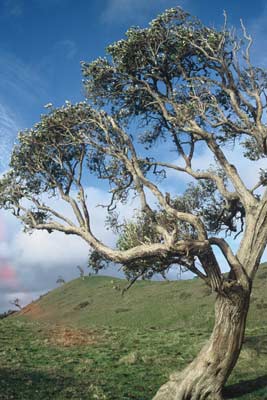
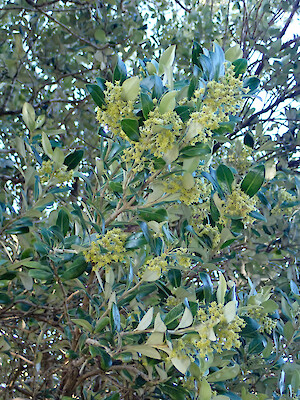
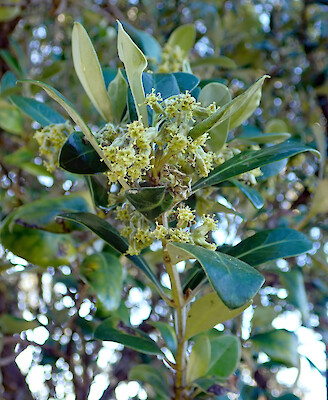
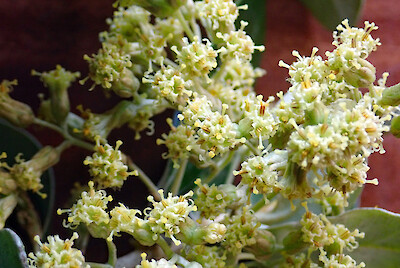
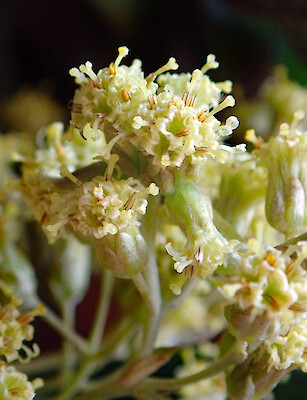
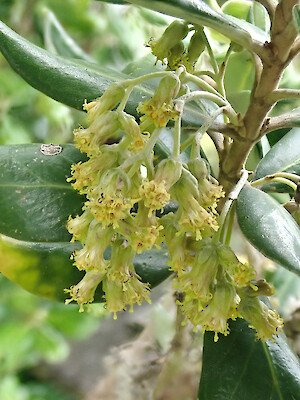
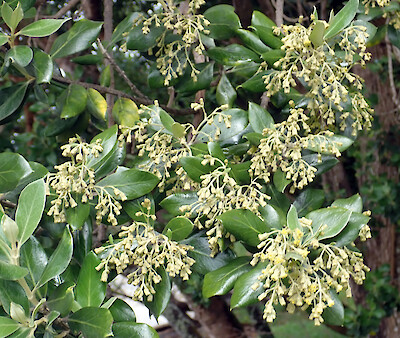
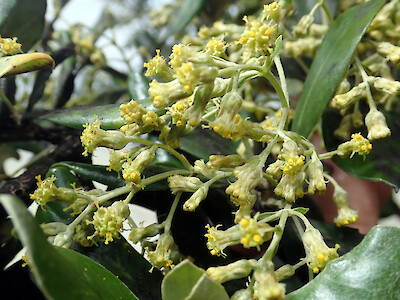
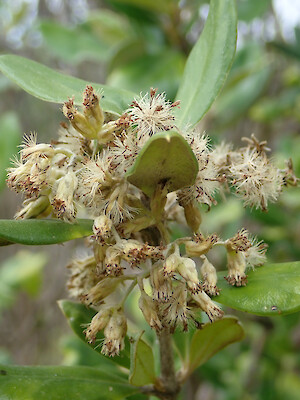
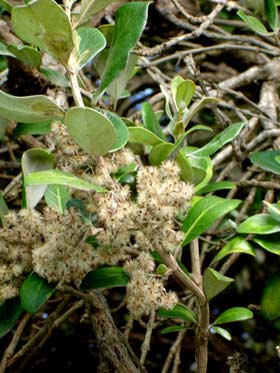
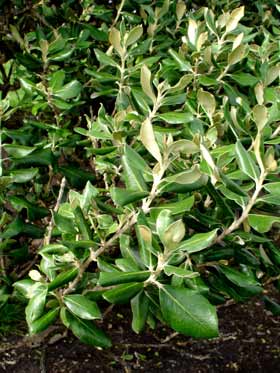
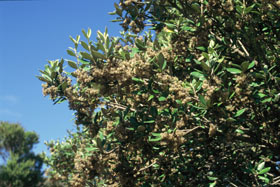
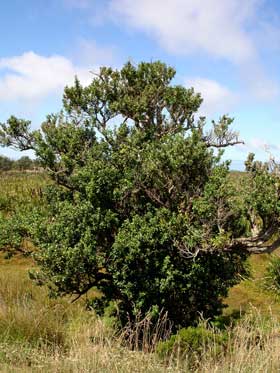
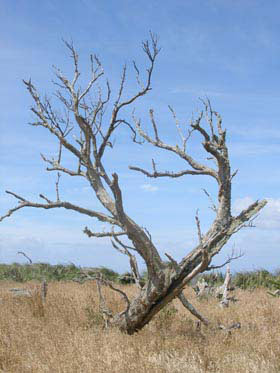
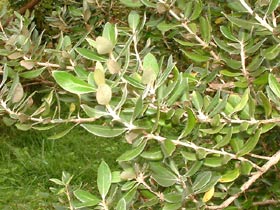
Small tree with oval dark green leathery leaves that are whiteish underneath and persistent seed heads inhabiting drier sites on the Chatham Islands. Leaves 15-80mm long by 10-46mm wide. Flowers cream or brownish, in small clusters, appearing late spring. Seeds fluffy.
Flower colours
Cream, Yellow
Detailed description
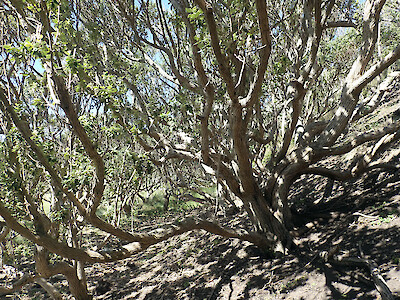
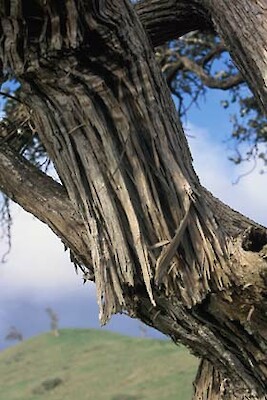
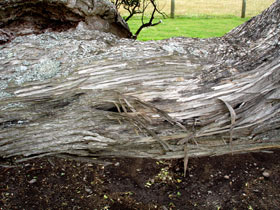
Tree 12–18 m tall; trunks up to 1 m diameter, upright to spreading; occasionally with epicormic shoots. Bark light grey, becoming coarsely fibrous, deeply fissured, and rough textured on trunk and old branches; branchlets quadrangular, stout, 2.0–2.6 mm diameter. Leaves opposite, lamina 15–80 × 10–46 mm, broadly elliptic, obovate, broad-obovate, or occasionally elliptic; upper surface dark green, glossy, midrib raised and prominent; underside with dense appressed, off-white, tomentum; apex subacute to obtuse, with a small apiculus; base cuneate to obtuse, sometimes attenuate; petiole 5–10 mm long, covered in dense appressed tomentum. Inflorescence an axillary panicle with 5–68 capitula, persistent after fruiting; primary branches in 3–6 opposite pairs; lower pairs of branches with 3–19 capitula, upper 1–3 branches each with 1–3 capitula. Bracts subtending primary branches, 2.0–5.0 × 0.8–1.2 mm, lanceolate to narrowly triangular, apex subacute. Bracteoles 2.0–3.0 × 0.5–0.8 mm, margin entire, apex subacute. Capitulum 5.0–7.0 mm long, involucre cylindric; involucral bracts 10–14, 1–2-seriate, upper surface glabrous, underside moderately to densely hairy, margins entire, apex acute to subacute; outer bracts 2.0–2.8 × 0.8–1.1 mm, narrowly triangular to elliptic; inner bracts 3.3–4.0 × 0.6–1.1 mm, lanceolate to narrow triangular. Florets 7–11 per capitulum; corolla usually cream to buff, sometimes pale yellow. Pistillate florets 3–5. Hermaphrodite florets 3–7. Style 4.5–5.5 mm long; stigmatic arms 0.4–0.6 mm long. Ovary 0.8–1.6 × 0.4–0.6 mm. Anthers 1.3–1.5 mm long, white, dehiscent in bud, apex apiculate; filaments 0.5–0.6 mm long, inserted at top of corolla tube. Seeds 1.2–2.1 × 0.6–0.8 mm, narrow-cylindric, light brown, with 4–5 pale ribs, sparsely to moderately hairy; pappus 2.2–3.3 mm long, off-white to buff, finely scabrid.
Similar taxa
Shawia telmatica is closely related. It differs from hakapiri by its restriction to permanently flooded swamp habitats, smaller stature, slender trunk, narrower leaves, lemon-yellow and less hairy corolla, less branched inflorescence with fewer capitula, fulvous hairs on the inflorescence, earlier flowering season, readily dispersed seed, and abscising inflorescences
Distribution
Endemic. Chatham Islands
Habitat
A tree common of lowland forests, now most commonly found on dune systems. It also occurs along the edge of larger lagoons and lakes (but only in free draining soils) and sometimes on cliff tops.
Threats
The wood of this tree is used for fence posts and as firewood.
Detailed taxonomy
Genus
Family
Synonyms
Eurybia traversii F.Muell., Olearia traversii (F.Muell.) Hook.f. ortho. var., Olearia traversiorum (F.Muell.) Hook.f.
Endemic taxon
Yes
Endemic genus
No
Endemic family
No
Ecology
Flowering
November – January
Fruiting
January – June
Propagation technique
Easily grown from semi-hardwood cuttings and fresh seed. Fast growing and an excellent shelter belt. This species rarely flowers in the northern part of New Zealand.
Other information
Extra information
This tree has long been known by the name ‘akeake’, that name has caused some confusion because of the unclear relationship with the unrelated Dodonaea viscosa (Sapindaceae) known in New Zealand as ‘akeake’ and on the Chatham Islands as Akeake Rautini. In part to resolve this confusion Shawia traversiorum has become more widely known as ‘Chatham Island akeake’. Recently it has been pointed out that the Moriori ta re name for this Chatham Islands endemic is ‘hakapiri’. On advice from the Moriori imi this name is now used preferentially here.
Etymology
shawia: After Thomas Shaw (1694-1751), English scholar and traveller.
traversiorum: William Thomas Locke Travers (1819-1903) was an Irish lawyer, magistrate, politician, explorer, naturalist, photographer. He lived in New Zealand from 1849 and was a fellow of the Linnean Society. Olearia traversiorum is named for both William and his son, Henry Travers, both of whom explored the Nelson region extensively and collected alpine plants which were sent to Kew Botanic Gardens.
NVS code
The National Vegetation Survey (NVS) Databank is a physical archive and electronic databank containing records of over 94,000 vegetation survey plots - including data from over 19,000 permanent plots. NVS maintains a standard set of species code abbreviations that correspond to standard scientific plant names from the Ngä Tipu o Aotearoa - New Zealand Plants database.
OLETRA
Chromosome number
2n = 108
Previous conservation statuses
The conservation status of all known New Zealand vascular plant taxa at the rank of species and below were reassessed in 2022-2023 using the New Zealand Threat Classification System (NZTCS) – more information about this can be found on the NZTCS website. This report includes replaces all previous NZTCS lists for vascular plants. Previous assessments can be found here.
- Conservation status of vascular plants in Aotearoa New Zealand, 2023. 2024. Peter J. de Lange, Jane Gosden, Shannel P. Courtney, Alexander J. Fergus, John W. Barkla, Sarah M. Beadel, Paul D. Champion, Rowan Hindmarsh-Walls, Troy Makan and Pascale Michel Department of Conservation. Source: NZTCS and licensed by DOC for reuse under the Creative Commons Attribution 4.0 International licence.
2017 | Threatened – Nationally Vulnerable | Qualifiers: CD, DP, IE, RF
2012 | Threatened – Nationally Vulnerable | Qualifiers: CD, DP, IE, RF
2009 | Threatened – Nationally Vulnerable | Qualifiers: CD, DP, IE, RF
2004 | Range Restricted
Referencing and citations
References and further reading
Heenan, P.B.; de Lange, P.J.; Houliston, G.J.; Murray, B.G. 2008: Olearia telmatica (Asteraceae: Astereae), a new tree species endemic to the Chatham Islands. New Zealand Journal of Botany 46: 567-583.
Saldivia, P.; Nicol, D.A. 2025: Reinstatement, broader circumscription, and infrageneric classification of Shawia (Astereae, Celmisiinae), a large woody genus endemic to Australasia. Phytoneuron 49: 1–43.
Attribution
Fact Sheet prepared by Peter J. de Lange (12 December 2008). Description based on Heenan et al. (2008).
NZPCN Fact Sheet citation
Please cite as: de Lange, P.J. (Year at time of access): Shawia traversiorum Fact Sheet (content continuously updated). New Zealand Plant Conservation Network. https://www.nzpcn.org.nz/flora/species/shawia-traversiorum/ (Date website was queried)