
Poa foliosa


Common names
muttonbird poa
Biostatus
Native – Endemic taxon
Current conservation status
The conservation status of all known New Zealand vascular plant taxa at the rank of species and below were reassessed in 2022-2023 using the New Zealand Threat Classification System (NZTCS) – more information about this can be found on the NZTCS website. This report includes replaces all previous NZTCS lists for vascular plants. Previous assessments can be found here.
- Conservation status of vascular plants in Aotearoa New Zealand, 2023. 2024. Peter J. de Lange, Jane Gosden, Shannel P. Courtney, Alexander J. Fergus, John W. Barkla, Sarah M. Beadel, Paul D. Champion, Rowan Hindmarsh-Walls, Troy Makan and Pascale Michel Department of Conservation. Source: NZTCS and licensed by DOC for reuse under the Creative Commons Attribution 4.0 International licence.
2023 | At Risk – Naturally Uncommon | Qualifiers: RR, SO
Category
Vascular
Structural class
Grasses
Detailed description
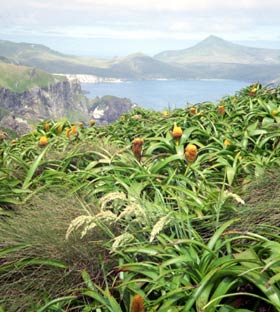
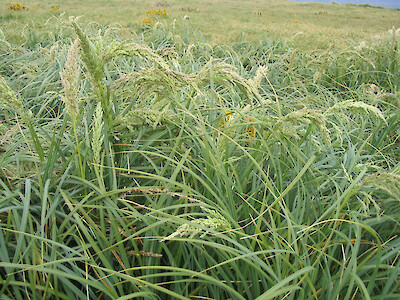
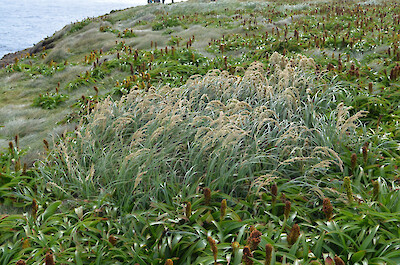
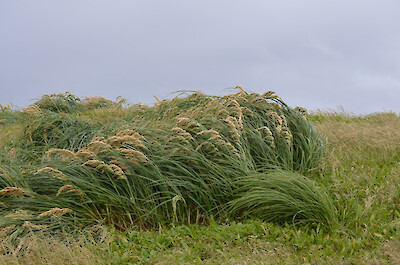
Dioecious, robust, green tussocks up to 1.5 m tall, arising from short, narrow, woody stolons, with shoots covered at base by abundant fibrous remnants of sheaths. Branching extravaginal; leaf-blades persistent. Leaf-sheath light brown, coriaceous, glabrous, closely striate, keel prominent above. Ligule 1–3 mm, apically glabrous, entire, rounded, abaxially finely scabrid. Leaf-blade 150–500 × 1–6 mm, coriaceous, tough, flat, abaxially smooth with prominent midrib and many lateral ribs, adaxially short-scabrid, bearing two prominent ridges along centre; margins thickened, smooth, tip entire, smooth, semi-pungent. Culm 200–600 mm, internodes glabrous. Panicle 100–250 mm, dense, with all branches, except the longer ones, bearing spikelets almost to base; rachis and branches mostly smooth. Spikelets 5.5–9.0 mm, 3–6-flowered, light greenish brown. Glumes subequal, long-acuminate, membranous, except for thickened nerves, smooth, but with a few prickle-teeth on nerves above and occasionally on margins; lower 3–6 mm, 1–3-nerved, narrow-lanceolate, upper 4.0–6.5 mm, 3-nerved, narrow elliptic-lanceolate. Lemma 5–7 mm, 5-nerved, acute or with midnerve very shortly excurrent, scabrid except near base, midnerve ciliate to more than halfway, outer lateral nerves, internerves, and margins with minute hairs in lower ⅓. Palea 3.5–4.5 mm, keel rather densely ciliate-scabrid, interkeel and flanks with sparse minute hairs and prickle-teeth. Callus with large tuft of crinkled hairs just below midnerve of lemma. Rachilla c. 0.5 mm, glabrous. Lodicules 0.4–0.7 mm, rarely hair-tipped. Dioecious: male with anthers 2.0–3.3 mm, gynoecium 0; female with pollen-sterile anthers c. 0.6–1.0 mm, often on long filaments; stigma-styles c. 2 mm. Seed 2 mm; rarely perfect.
Similar taxa
Similar to Poa tennantiana Petrie which is a superficially similar southern New Zealand robust grass of coastal areas, especially near sea bird nesting grounds. Poa tennantiana differs from P. foliosa by its monoecious rather than dioecious habit, yellow-green rather than green leaves, by the lower leaf-sheaths scabrid between the nerves, rather than smooth, and by the glabrous rather than hairy (hairs crinkly in a prominent tuft) callus.
Distribution
Endemic. New Zealand: Stewart Island/Rakiura (north-eastern Titi Islands), Solander Island, Antipodes Islands, Auckland Islands, Campbell Island, and Macquarie Island (Australian Territory but part of the New Zealand Botanical region).
Habitat
Coastal, usually near sea bird nesting grounds, often on steep slopes, sometimes in turf near shore.
Threats
Not Threatened. Listed because it is a narrow range, offshore island endemic. It is abundant in its known locations with no obvious threats.
Detailed taxonomy
Genus
Family
Synonyms
Festuca foliosa Hook.f.; Poa foliosa (Hook.f.) Hook.f. var. foliosa; Festuca foliosa var. â Hook.f.
Endemic taxon
Yes
Endemic genus
No
Endemic family
No
Ecology
Flowering
October–December
Fruiting
November–April
Propagation technique
Easily grown from fresh seed and rooted pieces. Dislikes humidity and will not flower or thrive in warm climates.
Other information
Etymology
poa: Meadow grass
foliosa: Leafy
Manaaki Whenua Online Interactive Key
NVS code
The National Vegetation Survey (NVS) Databank is a physical archive and electronic databank containing records of over 94,000 vegetation survey plots - including data from over 19,000 permanent plots. NVS maintains a standard set of species code abbreviations that correspond to standard scientific plant names from the Ngä Tipu o Aotearoa - New Zealand Plants database.
POAFOL
Chromosome number
2n = 28
Previous conservation statuses
The conservation status of all known New Zealand vascular plant taxa at the rank of species and below were reassessed in 2022-2023 using the New Zealand Threat Classification System (NZTCS) – more information about this can be found on the NZTCS website. This report includes replaces all previous NZTCS lists for vascular plants. Previous assessments can be found here.
- Conservation status of vascular plants in Aotearoa New Zealand, 2023. 2024. Peter J. de Lange, Jane Gosden, Shannel P. Courtney, Alexander J. Fergus, John W. Barkla, Sarah M. Beadel, Paul D. Champion, Rowan Hindmarsh-Walls, Troy Makan and Pascale Michel Department of Conservation. Source: NZTCS and licensed by DOC for reuse under the Creative Commons Attribution 4.0 International licence.
2017 | At Risk – Naturally Uncommon | Qualifiers: RR, SO
2012 | At Risk – Naturally Uncommon | Qualifiers: RR, SO
2009 | At Risk – Naturally Uncommon
2004 | Range Restricted
Referencing and citations
References and further reading
Edgar E, Connor HE. 2000. Flora of New Zealand. Vol. V. Grasses. Manaaki Whenua Press, Christchurch, NZ. 650 p.
Attribution
Description modified from Edgar and Connor (2000).
Some of this factsheet information is derived from Flora of New Zealand Online and is used under a Creative Commons Attribution 3.0 New Zealand licence.