
Pectinopitys ferruginea

Common names
miro, brown pine
Biostatus
Native – Endemic taxon
Current conservation status
The conservation status of all known New Zealand vascular plant taxa at the rank of species and below were reassessed in 2022-2023 using the New Zealand Threat Classification System (NZTCS) – more information about this can be found on the NZTCS website. This report includes replaces all previous NZTCS lists for vascular plants. Previous assessments can be found here.
- Conservation status of vascular plants in Aotearoa New Zealand, 2023. 2024. Peter J. de Lange, Jane Gosden, Shannel P. Courtney, Alexander J. Fergus, John W. Barkla, Sarah M. Beadel, Paul D. Champion, Rowan Hindmarsh-Walls, Troy Makan and Pascale Michel Department of Conservation. Source: NZTCS and licensed by DOC for reuse under the Creative Commons Attribution 4.0 International licence.
2023 | Not Threatened
Category
Vascular
Structural class
Trees & Shrubs - Gymnosperms
Flower colours
No flowers
Detailed description
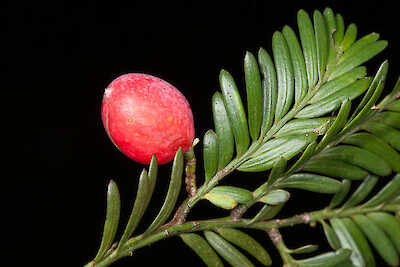
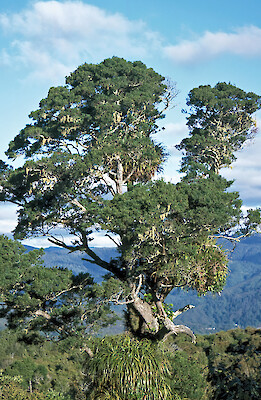
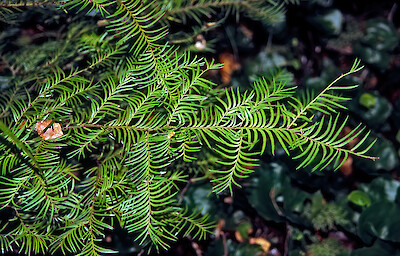
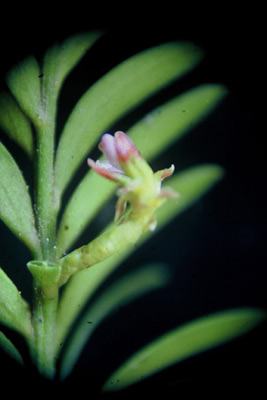
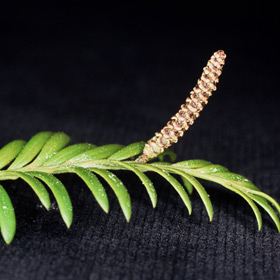
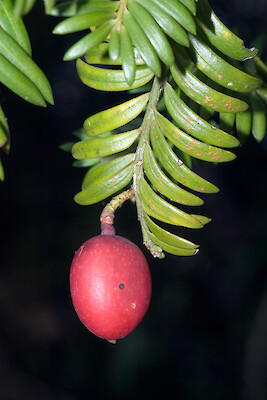
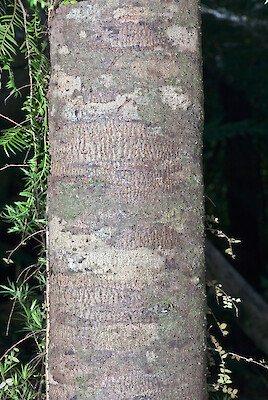
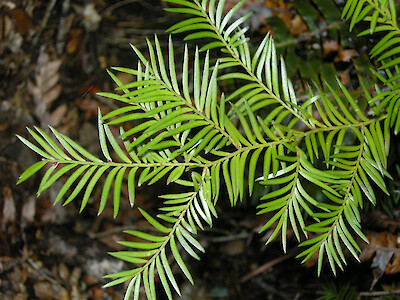
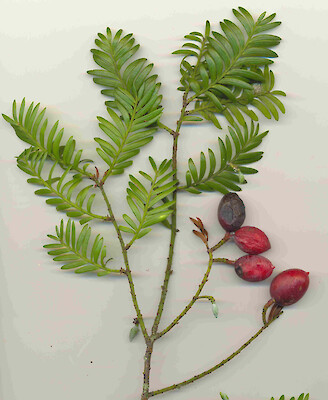
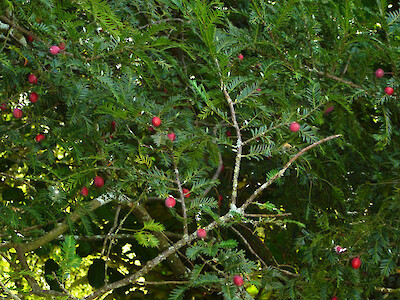
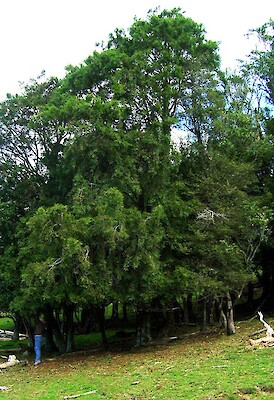
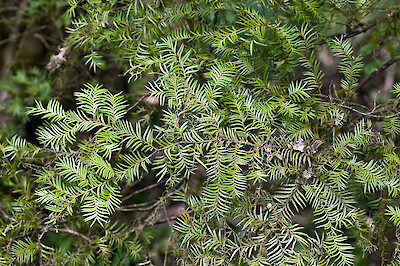
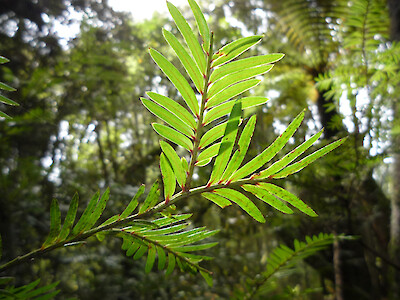
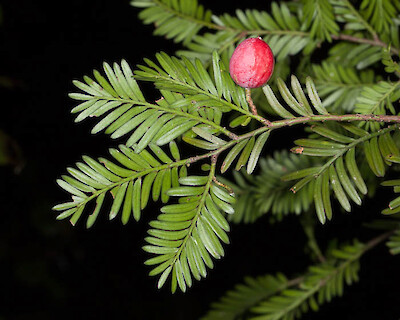
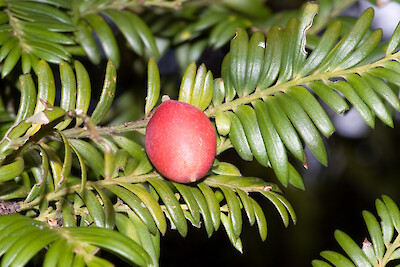
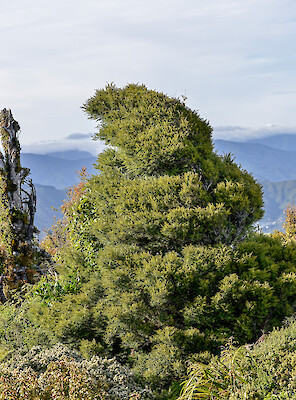
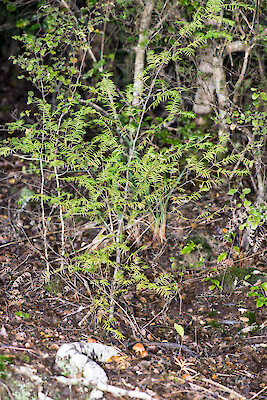
Stout tree up to 25 m tall. Trunk 1–1.5 m diameter, in adults clear of branches for ⅔ of length. Bark thick, grey, falling in thick, sinuous flakes. Leaves feathery, dark green, green to bronze-green, distichous, erect, narrow-linear, acute, falcate to subfalcate, acute to subacute, mid vein distinct, margins recurved, juveniles up to 30 mm long, those of adults 15–25 × 2–3 mm. Male cones (strobili) solitary, axillary, 5–15 mm long. Ovules solitary (rarely paired), on short branchlets ≤ 10 mm long. Fruit a broadly oblong to sub-spherical red, pink-red fleshy drupe up to 20 mm long, fleshy, oily, smelling and tasting strongly of terpenes; stone elliptic to broadly elliptic 11–17 mm long, dark brown to black-brown.
Similar taxa
The bright green to bronze-green, feathery foliage, and pink-red, to red plum-like drupes are quite unlike any other New Zealand conifer. However young miro plants might be confused with yew (Taxus baccata), but can be distinguished by their lack of petioles.
Distribution
Endemic. North Island, South Island and Stewart Island/Rakiura.
Habitat
Common tree of lowland to montane forest.
Threats
Not Threatened, although as a forest-type it has been greatly reduced through widespread logging. Very few intact examples of miro-dominated forest remain in the country.
Detailed taxonomy
Genus
Family
Synonyms
Podocarpus ferruginea D.Don, Stachypitys ferruginea (D.Don) Bobrov et Melikyan nom. illegit., Stachycarpus ferruginea (D.Don) Tieghem, Prumnopitys ferruginea (D.Don) Laubenf.
Taxonomic notes
Stachypitys proposed by Bobrov & Melikyan (2000) is regarded as illegitimate because it is a parahomonym of Stachyopitys a fossil conifer genus. More recently Page (2019) created the genus Pectinopitys to accommodate New Zealand miro, allied species in Eastern Australia (one), New Caledonia (one), and three South American species. It has long been recognised that miro was an ‘ill fit’ in Prumnopitys, which was why Bobrov & Melikayn (2000) made an attempt to move it out of that genus, so this more recent segregation should come as no surprise.
Endemic taxon
Yes
Endemic genus
No
Endemic family
No
Ecology
Flowering
June–August–October
Fruiting
Fruits take 12–18 months to mature. Ripe fruits are mainly found from November–April.
Propagation technique
Easily grown from fresh seed. Seed may take up to 2 years to germinate. Can be grown from hard-wood cuttings but rather slow to strike.
Wetland plant indicator status rating
Information derived from the revised national wetland plant list prepared to assist councils in delineating and monitoring wetlands (Clarkson et al., 2021 Manaaki Whenua – Landcare Research Contract Report LC3975 for Hawke’s Bay Regional Council). The national plant list categorises plants by the extent to which they are found in wetlands and not ‘drylands’. The indicator status ratings are OBL (obligate wetland), FACW (facultative wetland), FAC (facultative), FACU (facultative upland), and UPL (obligate upland). If you have suggestions for the Wetland Indicator Status Rating, please contact: [Enable JavaScript to view protected content]
FACU: Facultative Upland
Occasionally is a hydrophyte but usually occurs in uplands (non-wetlands).
Other information
Cultural Use/Importance
The large, oily, red fruits are an important part of the diet of the New Zealand pigeon/kererū/kukupā (Hemiphaga novaezelandiae). Indeed, kererū are the only native extand bird species which can disperse these large drupes.
Etymology
ferruginea: Rust coloured
NVS code
The National Vegetation Survey (NVS) Databank is a physical archive and electronic databank containing records of over 94,000 vegetation survey plots - including data from over 19,000 permanent plots. NVS maintains a standard set of species code abbreviations that correspond to standard scientific plant names from the Ngä Tipu o Aotearoa - New Zealand Plants database.
PECFER
Chromosome number
2n = 36
Previous conservation statuses
The conservation status of all known New Zealand vascular plant taxa at the rank of species and below were reassessed in 2022-2023 using the New Zealand Threat Classification System (NZTCS) – more information about this can be found on the NZTCS website. This report includes replaces all previous NZTCS lists for vascular plants. Previous assessments can be found here.
- Conservation status of vascular plants in Aotearoa New Zealand, 2023. 2024. Peter J. de Lange, Jane Gosden, Shannel P. Courtney, Alexander J. Fergus, John W. Barkla, Sarah M. Beadel, Paul D. Champion, Rowan Hindmarsh-Walls, Troy Makan and Pascale Michel Department of Conservation. Source: NZTCS and licensed by DOC for reuse under the Creative Commons Attribution 4.0 International licence.
2017 | Not Threatened
2012 | Not Threatened
2009 | Not Threatened
2004 | Not Threatened
Regional conservation statuses
Northland: 2026 | Regionally Not Threatened
Current regional threat status assessments prepared according to Crisp et al. (2025) are displayed when available. The Northland conservation status information is sourced from the “Conservation status of indigenous vascular plants in Northland | Taitokerau” Ford et al. 2026 report.
Auckland: 2025 | Regionally Not Threatened | Qualifiers: DPS, DPT
Current regional threat status assessments prepared according to Crisp et al. (2025) are displayed when available. The Auckland conservation status information is sourced from the “Conservation status of vascular plant species in Tāmaki Makaurau / Auckland” Simpkins E et al. 2025 report.
Otago: 2025 | Regionally Not Threatened
Current regional threat status assessments prepared according to Crisp et al. (2025) are displayed when available. The Otago conservation status information is sourced from the “Conservation Status of Indigenous Vascular Plants in Otago, 2025” Jarvie S et al. (2025) report.
Wellington: 2025 | Regionally Not Threatened
Current regional threat status assessments prepared according to Crisp et al. (2025) are displayed when available. The Wellington conservation status information is sourced from the “Conservation status of indigenous vascular plants in the Wellington region” Enright P et al. 2025 report.
Referencing and citations
References and further reading
Allan HH. 1961. Flora of New Zealand, Volume I. Indigenous Tracheophyta: Psilopsida, Lycopsida, Filicopsida, Gymnospermae, Dicotyledones. Government Printer, Wellington, NZ. 1085 p.
Bobrov AVFCh, Melikyan AP. 2000. Morphology of female reproductive structures and an attempt of the construction of phyogenetic system of orders Podocarpales, Cephalotaxales and Taxales. Botanicheskii Zhurnal (Moscow & Lenningrad) 85(7):50–68.
Page CN. 2019. New and maintained genera in the taxonomic alliance of Prumnopitys s.l (Podocarpaceae), and circumscription of a new genus: Pectinopitys. New Zealand Journal of Botany 57(3): 137–153. https://doi.org/10.1080/0028825X.2019.1625933.
Attribution
Prepared by P.J. de Lange for NZPCN, 3 February 2006. Description based on Allan (1961)
Some of this factsheet information is derived from Flora of New Zealand Online and is used under a Creative Commons Attribution 3.0 New Zealand licence.