
Hypolepis ambigua
Biostatus
Native – Endemic taxon
Current conservation status
The conservation status of all known New Zealand vascular plant taxa at the rank of species and below were reassessed in 2022-2023 using the New Zealand Threat Classification System (NZTCS) – more information about this can be found on the NZTCS website. This report includes replaces all previous NZTCS lists for vascular plants. Previous assessments can be found here.
- Conservation status of vascular plants in Aotearoa New Zealand, 2023. 2024. Peter J. de Lange, Jane Gosden, Shannel P. Courtney, Alexander J. Fergus, John W. Barkla, Sarah M. Beadel, Paul D. Champion, Rowan Hindmarsh-Walls, Troy Makan and Pascale Michel Department of Conservation. Source: NZTCS and licensed by DOC for reuse under the Creative Commons Attribution 4.0 International licence.
2023 | Not Threatened
Category
Vascular
Structural class
Ferns
Flower colours
No flowers
Detailed description
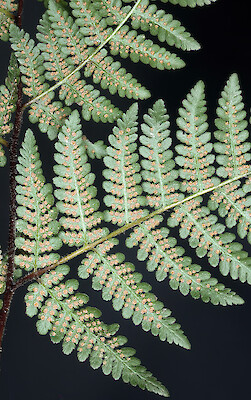
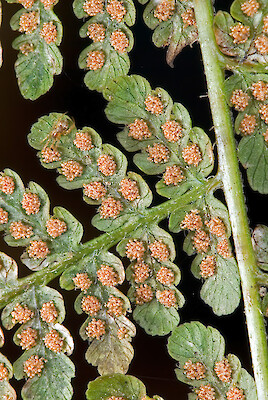
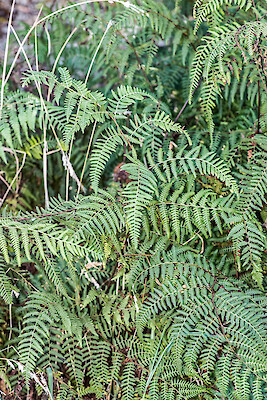
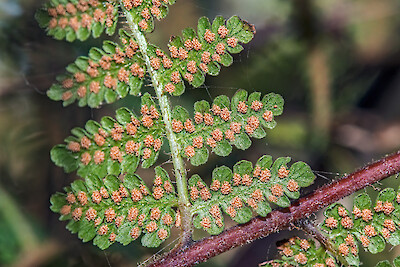
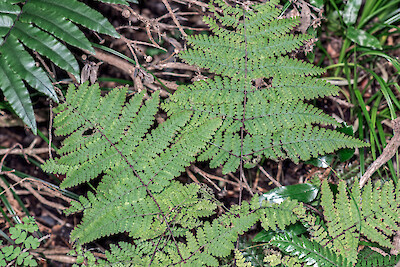
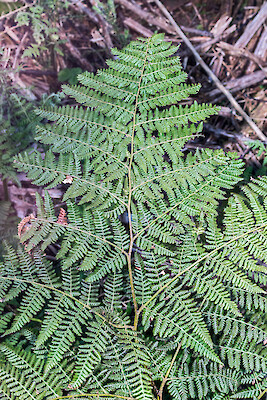
Rhizome long-creeping, 2–4 mm diameter, covered in red-brown hairs up to 2.5 mm long, stipes arising at intervals of 90–200 mm (abundant near growing tip, sparse elsewhere). Stipes 80–600 mm long, 1.5–5 mm diameter, red-brown at very base, pale red-brown or yellow-brown above, covered at base in red-brown hairs, up to 3 mm long, sparse above and paler. Laminae ovate or broadly ovate, 0.2–1.2 × 0.15–1.0 m, bipinnate at apex, tripinnate or quadripinnate below. Rachis red-brown or yellow-brown at base, green at apex, sparsely covered in pale brown hairs like those of stipe. Primary pinnae in 22–30 pairs, opposite or subopposite, the lowest arising at 20–50° to stem upper ones at 70–90°, the longest near the base 150–550 × 85–270 mm; lowest ones 50–240 mm apart, middle ones 15–80 mm apart; upper ones narrowly ovate or ± parallel-sided, lower ones ovate or broadly ovate narrowly winged. Secondary pinnae narrowly ovate or broadly ovate; parallel-sided, broadly winged, 50–160 × 20–53 mm those on the lower pinnae decreasing markedly in length along the pinnae. Tertiary pinnae narrowly ovate or parallel-sided, 10–30 × 5–12 mm. Quaternary pinnae (when present) 2.5–8.0 × 1.5–4.0 mm. Veins reaching margin at tooth apex. Hairs: glistening colourless non-glandular hairs on underside of lamina, costae and midribs, absent from lamina margin; brown-tinged hairs on upper surfaces abundant on midribs; 0.3–1.0 mm long (mostly c. 0.5 mm), those on pinna midribs and costae often longer. Sori: one on acroscopic edge of each ultimate segment, originating away from margin; protected at maturity by slightly reflexed pinnules margin which also often bears a few short hairs at this point; hairs also often present in sorus (0.3–0.5 mm long). Spores pale, brown, echinate.
Similar taxa
Hypolepis ambigua is most often confused with H. dicksonioides. A much less common species of mostly northern New Zealand and associated offshore islands, as well as the Kermadec Islands. Hypolepis ambiqua is readily distinguished from H. dicksonioides by the young emergent fronds which are not profusely covered in sticky, glandular hairs (indeed the fronds are also devoid of glandular hairs), and by the sorus which is only partially protected (if at all) by a marginal flap (cf. the sorus protected by a prominent marginal flap in H. dicksonioides). However, hybrids are common wherever the ranges of these two species overlap, and these can only be reliably determined by their aborted spores.
Distribution
Endemic. New Zealand: Manawatāwhi / Three Kings Islands, North Island, South Island, Stewart Island/Rakiura, Chatham Islands.
Habitat
Coastal to montane. A ‘weedy’ species of disturbed sites in open forest, forest clearings, forest margins, in scrub, and in open grassland. It is often a component of brackenfield and as with H. dicksonioides, H. ambigua frequently colonises urban areas, where at times it can become a troublesome ‘weed’.
Detailed taxonomy
Genus
Family
Synonyms
Hypolepis tenuifolia sensu Hook.f.; Polypodium amplum Colenso; Cheilanthes ambigua A.Rich.; Hypolepis petrieana Carse; Hypolepis punctata sensu Dobbie
Endemic taxon
Yes
Endemic genus
No
Endemic family
No
Ecology
Flowering
Not applicable—spore producing
Fruiting
Not applicable—spore producing
Life cycle and dispersal
Minute spores are wind dispersed (Thorsen et al., 2009).
Propagation technique
Easily cultivated from fresh spores and by the division of established plants. Hypolepis ambigua is a short-lived, and at times aggressive species such that it is probably not well suited to garden conditions.
Wetland plant indicator status rating
Information derived from the revised national wetland plant list prepared to assist councils in delineating and monitoring wetlands (Clarkson et al., 2021 Manaaki Whenua – Landcare Research Contract Report LC3975 for Hawke’s Bay Regional Council). The national plant list categorises plants by the extent to which they are found in wetlands and not ‘drylands’. The indicator status ratings are OBL (obligate wetland), FACW (facultative wetland), FAC (facultative), FACU (facultative upland), and UPL (obligate upland). If you have suggestions for the Wetland Indicator Status Rating, please contact: [Enable JavaScript to view protected content]
UPL: Obligate Upland
Rarely is a hydrophyte, almost always in uplands (non-wetlands).
Other information
Etymology
hypolepis: From the greek hypo (under) and lepis (scale), referring to the position of the sori on the ferns
ambigua: From the Latin ambiguus ‘ambiguous, uncertain’
NVS code
The National Vegetation Survey (NVS) Databank is a physical archive and electronic databank containing records of over 94,000 vegetation survey plots - including data from over 19,000 permanent plots. NVS maintains a standard set of species code abbreviations that correspond to standard scientific plant names from the Ngä Tipu o Aotearoa - New Zealand Plants database.
HYPAMB
Chromosome number
2n = 208
Previous conservation statuses
The conservation status of all known New Zealand vascular plant taxa at the rank of species and below were reassessed in 2022-2023 using the New Zealand Threat Classification System (NZTCS) – more information about this can be found on the NZTCS website. This report includes replaces all previous NZTCS lists for vascular plants. Previous assessments can be found here.
- Conservation status of vascular plants in Aotearoa New Zealand, 2023. 2024. Peter J. de Lange, Jane Gosden, Shannel P. Courtney, Alexander J. Fergus, John W. Barkla, Sarah M. Beadel, Paul D. Champion, Rowan Hindmarsh-Walls, Troy Makan and Pascale Michel Department of Conservation. Source: NZTCS and licensed by DOC for reuse under the Creative Commons Attribution 4.0 International licence.
2017 | Not Threatened
2012 | Not Threatened
2009 | Not Threatened
2004 | Not Threatened
Regional conservation statuses
Auckland: 2025 | Regionally Not Threatened | Qualifiers: DPS, DPT
Current regional threat status assessments prepared according to Crisp et al. (2025) are displayed when available. The Auckland conservation status information is sourced from the “Conservation status of vascular plant species in Tāmaki Makaurau / Auckland” Simpkins E et al. (2025) report.
Otago: 2025 | Regionally Not Threatened
Current regional threat status assessments prepared according to Crisp et al. (2025) are displayed when available. The Otago conservation status information is sourced from the “Conservation Status of Indigenous Vascular Plants in Otago, 2025” Jarvie S et al. (2025) report.
Northland: 2026 | Regionally Not Threatened
Current regional threat status assessments prepared according to Crisp et al. (2025) are displayed when available. The Northland conservation status information is sourced from the “Conservation status of indigenous vascular plants in Northland | Taitokerau” Ford et al. 2026 report.
Referencing and citations
References and further reading
Brownsey PJ, Chinnock RJ. 1984. A Taxonomic revision of the New Zealand species of Hypolepis. New Zealand Journal of Botany 22(1): 43–80. https://doi.org/10.1080/0028825X.1984.10425234.
Thorsen MJ, Dickinson KJM, Seddon PJ. 2009. Seed dispersal systems in the New Zealand flora. Perspectives in Plant Ecology, Evolution and Systematics 11: 285–309. https://doi.org/10.1016/j.ppees.2009.06.001.
Attribution
Fact sheet prepared for NZPCN by P.J. de Lange (8 November 2012). Description from Brownsey & Chinnock (1984).