
Libocedrus bidwillii
Common names
pāhautea, kaikawaka, New Zealand cedar
Biostatus
Native – Endemic taxon
Current conservation status
The conservation status of all known New Zealand vascular plant taxa at the rank of species and below were reassessed in 2022-2023 using the New Zealand Threat Classification System (NZTCS) – more information about this can be found on the NZTCS website. This report includes replaces all previous NZTCS lists for vascular plants. Previous assessments can be found here.
- Conservation status of vascular plants in Aotearoa New Zealand, 2023. 2024. Peter J. de Lange, Jane Gosden, Shannel P. Courtney, Alexander J. Fergus, John W. Barkla, Sarah M. Beadel, Paul D. Champion, Rowan Hindmarsh-Walls, Troy Makan and Pascale Michel Department of Conservation. Source: NZTCS and licensed by DOC for reuse under the Creative Commons Attribution 4.0 International licence.
2023 | Not Threatened
Category
Vascular
Structural class
Trees & Shrubs - Gymnosperms
Flower colours
No flowers
Detailed description
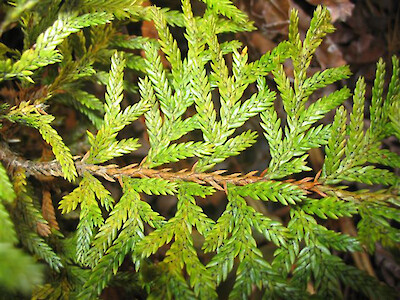
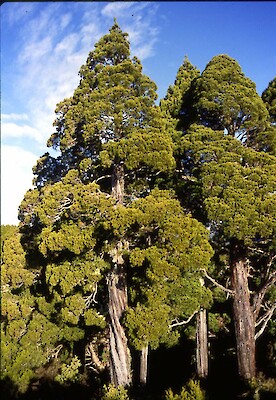
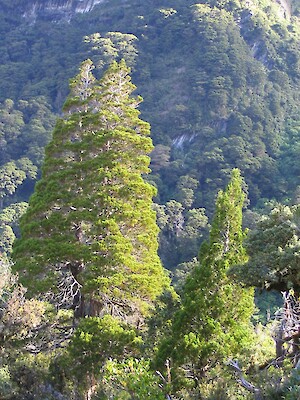
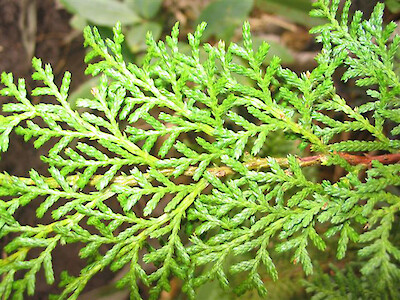
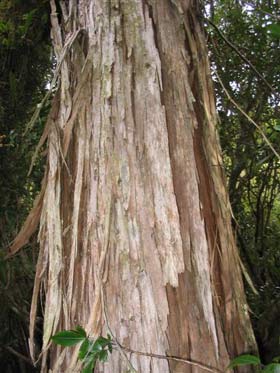
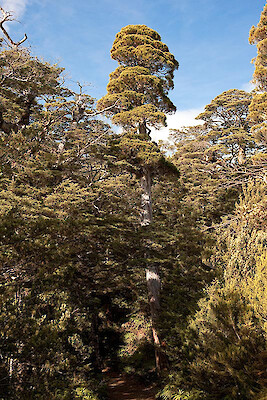
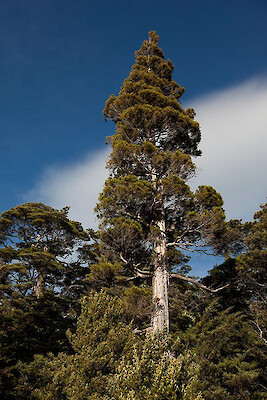
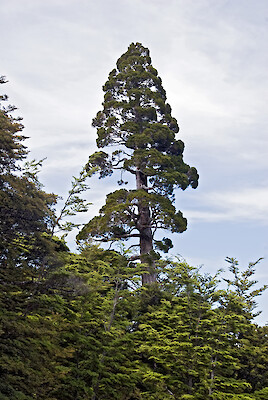
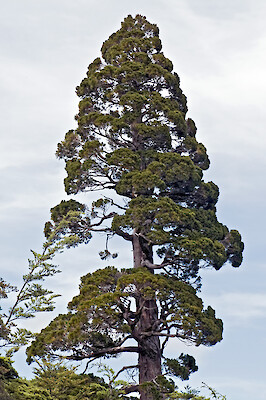
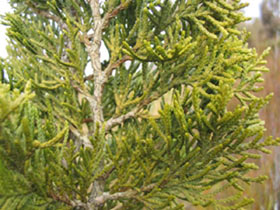
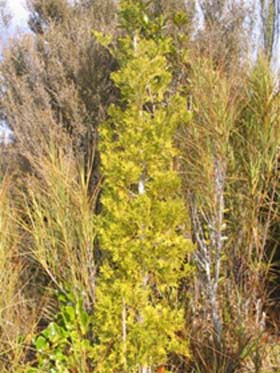
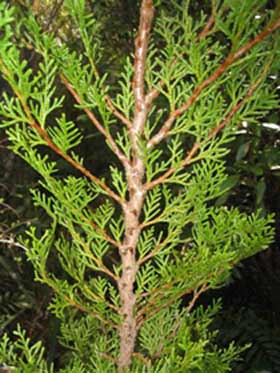
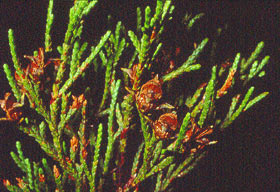
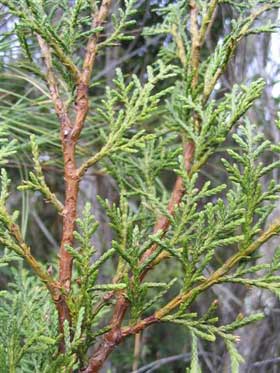
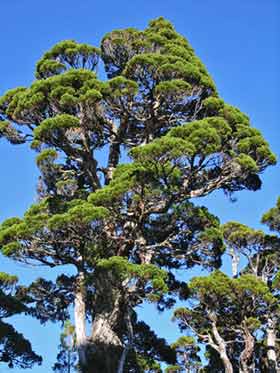
Tree 25–(30) m tall and 1.0–1.5 m d.b.h., or a shrub in open conditions, evergreen, monoecious. Bark thin, scaly, greyish-brown, exfoliating in longitudinal strips. Branches long, spreading or ascending, arranged in dense tufts above each other, forming a pyramidal crown in young trees, conical or irregular with a clear bole in old trees. Foliage flattened sprays in young trees, in old trees more irregular and ascending, ultimate branchlets subopposite to alternate, 5–40 mm long, entirely covered with leaves, changing with age of plant from flattened to ± quadrangular, persistent. Leaves decussate, on lateral branchlets, short, decurrent, imbricate, dimorphic in young trees, facials small, rhombic, 1.5–2.0 × 1.0 mm, apiculate to acute, appressed, partly covered at base by larger 2.0–6.0 × 1.5–2.5 mm, divergent, bilaterally flattened, slightly curved laterals with entire margins and free apices, leaves on mature trees smaller, nearly monomorphic; amphistomatic, stomata on facials at base, on laterals much reduced on adaxial side, abaxially in a short, conspicuous band of irregularly but densely arranged stomata, adaxially dull dark green or yellow-green with whitish-green stomatal band, bearing a single resin cavity, eglandular. Pollen cones terminal, solitary, 2.5–5.0 mm, subglobose to ovoid, yellowish-green maturing light brown; microsporophylls decussate, 8–14, peltate, margins entire, bearing 4 abaxial yellow, microsporangia containing spherical pollen. Seed cones terminal on branchlets with monomorphic leaves of equal size, initially consisting of 2 decussate pairs of acute, 3–4 mm long, spreading bracts subtended by 4–5 similar but gradually smaller leaf pairs, the upper pair developing within one growing season to become thinly woody, together forming a cone 8–12 mm long. Bract-scale complexes 7–10 mm long, ± finely rugose, recurved in upper half above the abaxially exserting bract, subtended by the lower, smaller (3–4 mm long) less modified pair. Ovules 4, erect. alternating with each fertile bract. Seeds 2–4, 2–3 mm long, ovoid, flattened, with an acute apex, brown, with a whitish hilum and 2 opposite, thin, unequal, membranous wings, smaller 1 mm wide, larger, irregularly oval-oblong, 4–5 × 2.3 mm, yellowish brown. Cotyledons 2, juveniles leaves only on seedlings, ± acicular, on lower stem in whorls of 4 but soon decussate, bilaterally flattened, acuminate, the facials only slightly smaller, transitional leaves prevalent through much of life of young trees.
Similar taxa
Easily distinguished from kawaka (Libocedrus plumosa) by the ultimate branches ± quadrangular rather than flattened, by the facial leaves only slightly smaller than lateral leaves (< ½ the size of the laterals in L. plumosa); and by the free part of the bract ⅓ the size of the cone scale beyond which it does not extend, rather than half the size of the cone scale and exceeding beyond it.
Distribution
Endemic. New Zealand: North Island (from Te Moehau, Te Aroha and Mt Pirongia south) and South Island.
Habitat
Montane to subalpine (250–1200 m.a.s.l.) but exclusively upper montane in northern part of range. Usually in mixed cloud forest, often at the margins where forest grades into subalpine scrub or wetlands. This species seems to prefer regions of moderate to high rainfall and long periods of cloud cover.
Detailed taxonomy
Genus
Family
Synonyms
None
Endemic taxon
Yes
Endemic genus
No
Endemic family
No
Ecology
Flowering
August–November
Fruiting
August–July
Propagation technique
Easily grown from fresh seed. Can be grown from hard wood cuttings but these are often slow to take and results variable. Does best in a deep, well mulched, moist, fertile soil. Makes an excellent specimen tree. Libocedrus bidwillii is however, better suited to cooler climates. It does not like drought or humidity.
Wetland plant indicator status rating
Information derived from the revised national wetland plant list prepared to assist councils in delineating and monitoring wetlands (Clarkson et al., 2021 Manaaki Whenua – Landcare Research Contract Report LC3975 for Hawke’s Bay Regional Council). The national plant list categorises plants by the extent to which they are found in wetlands and not ‘drylands’. The indicator status ratings are OBL (obligate wetland), FACW (facultative wetland), FAC (facultative), FACU (facultative upland), and UPL (obligate upland). If you have suggestions for the Wetland Indicator Status Rating, please contact: [Enable JavaScript to view protected content]
FAC: Facultative
Commonly occurs as either a hydrophyte or non-hydrophyte (non-wetlands).
Other information
Etymology
libocedrus: Frankincense cedar
bidwillii: Named after the botanist - John Carne Bidwill (born 1815 and died 16 March 1853)
NVS code
The National Vegetation Survey (NVS) Databank is a physical archive and electronic databank containing records of over 94,000 vegetation survey plots - including data from over 19,000 permanent plots. NVS maintains a standard set of species code abbreviations that correspond to standard scientific plant names from the Ngä Tipu o Aotearoa - New Zealand Plants database.
LIBBID
Chromosome number
2n = 22
Previous conservation statuses
The conservation status of all known New Zealand vascular plant taxa at the rank of species and below were reassessed in 2022-2023 using the New Zealand Threat Classification System (NZTCS) – more information about this can be found on the NZTCS website. This report includes replaces all previous NZTCS lists for vascular plants. Previous assessments can be found here.
- Conservation status of vascular plants in Aotearoa New Zealand, 2023. 2024. Peter J. de Lange, Jane Gosden, Shannel P. Courtney, Alexander J. Fergus, John W. Barkla, Sarah M. Beadel, Paul D. Champion, Rowan Hindmarsh-Walls, Troy Makan and Pascale Michel Department of Conservation. Source: NZTCS and licensed by DOC for reuse under the Creative Commons Attribution 4.0 International licence.
2017 | Not Threatened
2012 | Not Threatened
2009 | Not Threatened
2004 | Not Threatened
Regional conservation statuses
Otago: 2025 | Regionally Not Threatened
Current regional threat status assessments prepared according to Crisp et al. (2025) are displayed when available. The Otago conservation status information is sourced from the “Conservation Status of Indigenous Vascular Plants in Otago, 2025” Jarvie S et al. (2025) report.
Referencing and citations
References and further reading
Farjon A. 2005. A monograph of Cupressaceae and Sciadopitys. Royal Botanic Gardens, Kew, UK. ISBN 1842460684. 643 p.
Attribution
Fact sheet prepared for NZPCN by P.J. de Lange (13 January 2012).Description adapted from Farjon (2005).
NZPCN Fact Sheet citation
Please cite as: de Lange, P.J. (Year at time of access): Libocedrus bidwillii Fact Sheet (content continuously updated). New Zealand Plant Conservation Network. https://www.nzpcn.org.nz/flora/species/libocedrus-bidwillii/ (Date website was queried)