
Acaena dumicola

Common names
bidibid, piripiri
Biostatus
Native – Endemic taxon
Current conservation status
The conservation status of all known New Zealand vascular plant taxa at the rank of species and below were reassessed in 2022-2023 using the New Zealand Threat Classification System (NZTCS) – more information about this can be found on the NZTCS website. This report includes replaces all previous NZTCS lists for vascular plants. Previous assessments can be found here.
- Conservation status of vascular plants in Aotearoa New Zealand, 2023. 2024. Peter J. de Lange, Jane Gosden, Shannel P. Courtney, Alexander J. Fergus, John W. Barkla, Sarah M. Beadel, Paul D. Champion, Rowan Hindmarsh-Walls, Troy Makan and Pascale Michel Department of Conservation. Source: NZTCS and licensed by DOC for reuse under the Creative Commons Attribution 4.0 International licence.
2023 | Not Threatened
Category
Vascular
Structural class
Herbs - Dicotyledons other than Composites
Simplified description
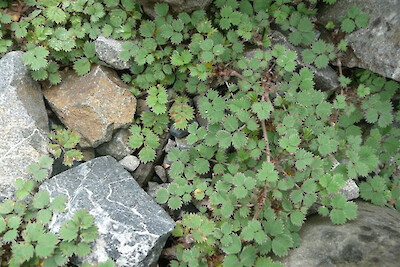
An evergreen pale blue-green or dull green herb, which spreads up to almost a metre across and about 5 cm in height. The odd-pinnate leaves are delicate and toothed, and may have a bronze, contrasting coloured margin. The globe shaped flower balls are white and grow into a cluster of hooked spikes, which when ripe brown off, become firm and may stick to your socks or laces when brushed past in order to disperse.
Flower colours
Green, White
Detailed description
Stoloniferous, prostrate, trailing perennial herb, forming a loose mat up to 0.8 metre in diameter depending on constraints of habitat. Stems 1 mm diameter, sparsely hairy, up to 30 cm long, and/or 5 cm high, rooting at nodes; Stipules entire to pentafid; Leaves odd-pinnate, between 15-70 mm long with 7-11 leaflets; Leaflets profoundly reduced below 3 distal obovate-orbicular leaflets, lower leaflets almost wedge-shaped, sharply serrated toothed margin, 11-15 teeth per leaflet not hair-tipped, dull green to bluish-green green on both surfaces, teeth sharply pointed discoloured to bronze, upper surface flat sparsely hairy, lower surface moderately hairy; Inflorescence scape up to 100 mm, hairy; Capitulum of about 40 florets, each floret has 4 sepals, 2 stamen, white anthers, 1 white style, 1 achene; Fruit roughly cone-shaped, each having 4 barb-tipped spines, up to 4 mm long, which mature dry, pale brown when ripe, enabling attachment to passing hairy/feathered surfaces as vector, and/or to aid wind dispersal.
Similar taxa
Acaena emittens, is quite a similar species, distribution does mean that neither grow together as A. emittens is only found in the North Island, and A. dumicola is only found in the South Island. The differences include A. emittens being more pale green than blue-green in colour, and the leaflets being hairless on the upper surface. The leaflet teeth are also less abundant 7-9 (compared to 11-15) and are blunt compared to sharp.
Acaena fissistipula, is very similar in appearance at first glance. The differences between the two species are that the leaflets of this species reduce evenly from distal to proximal, compared to the 3 distal leaflets of A. dumicola being orbicular and those below being dramatically reduced in size and shape; the anthers of A. fissistipula are red/maroon compared to white in A. dumicola. The scape is 12-20 cm in A. fissistipula compared to up to 10 cm in A. dumicola.
Distribution
Endemic. Eastern South Island. Awatere Valley to Eyre Mountains.
Habitat
Montane to low alpine (300-1200 m.a.s.l.), shady sites (beneath shrubs, beside rocks) in grasslands.
Detailed taxonomy
Genus
Family
Endemic taxon
Yes
Endemic genus
No
Endemic family
No
Ecology
Flowering
November-December
Fruiting
(December-)January-February
Life cycle and dispersal
Spiny hypanthia are dispersed by attaching to fur, feathers and clothing and possibly also dispersed by wind and granivory (Thorsen et al., 2009).
Other information
Etymology
acaena: From the Greek ‘akanthos’ thorn, referring to the spiny calyx that many species have
dumicola: In thickets or shrubs
NVS code
The National Vegetation Survey (NVS) Databank is a physical archive and electronic databank containing records of over 94,000 vegetation survey plots - including data from over 19,000 permanent plots. NVS maintains a standard set of species code abbreviations that correspond to standard scientific plant names from the Ngä Tipu o Aotearoa - New Zealand Plants database.
ACADUM
Chromosome number
2n = 42
Previous conservation statuses
The conservation status of all known New Zealand vascular plant taxa at the rank of species and below were reassessed in 2022-2023 using the New Zealand Threat Classification System (NZTCS) – more information about this can be found on the NZTCS website. This report includes replaces all previous NZTCS lists for vascular plants. Previous assessments can be found here.
- Conservation status of vascular plants in Aotearoa New Zealand, 2023. 2024. Peter J. de Lange, Jane Gosden, Shannel P. Courtney, Alexander J. Fergus, John W. Barkla, Sarah M. Beadel, Paul D. Champion, Rowan Hindmarsh-Walls, Troy Makan and Pascale Michel Department of Conservation. Source: NZTCS and licensed by DOC for reuse under the Creative Commons Attribution 4.0 International licence.
2017 | Not Threatened
2012 | Not Threatened
2009 | Not Threatened
2004 | Not Threatened
Regional conservation statuses
Otago: 2025 | Regionally At Risk – Regionally Naturally Uncommon | Qualifiers: DPS, DPT, NStr, Sp
Current regional threat status assessments prepared according to Crisp et al. (2025) are displayed when available. The Otago conservation status information is sourced from the “Conservation Status of Indigenous Vascular Plants in Otago, 2025” Jarvie S et al. (2025) report.
Referencing and citations
References and further reading
Lloyd K. 2001. A Key and notes for Acaena (Rosaceae) in New Zealand. Botanical Society of Otago Newsletter 25. Pgs.10-14.
Macmillan BH. 1985 Acaena dumicola (Rosaceae)— a new species from New Zealand. New Zealand Journal of Botany, 23(2): pp. 337-340.
Thorsen MJ, Dickinson KJM, Seddon PJ. 2009. Seed dispersal systems in the New Zealand flora. Perspectives in Plant Ecology, Evolution and Systematics 11: 285–309. https://doi.org/10.1016/j.ppees.2009.06.001.
Webb CJ, Sykes WR, Garnock-Jones PJ. 1988. Flora of New Zealand, Volume IV. Naturalised Pteridophytes, Gymnosperms, Dicotyledons. Botany Division, Department of Scientific and Industrial Research, Christchurch, NZ. Pp. 1055, 1059-1060.
Attribution
Fact sheet prepared for NZPCN by MD Ward (August 29th 2025). Description adapted from Lloyd (2001), Webb et. al. (1988).
Some of this factsheet information is derived from Flora of New Zealand Online and is used under a Creative Commons Attribution 3.0 New Zealand licence.