
Acromastigum verticale
Common names
Liverwort
Biostatus
Native
Current conservation status
The conservation status of the New Zealand hornwort and liverwort flora is reassessed using the New Zealand Threat Classification System (NZTCS). A full list is presented, along with a statistical summary and brief notes on the most important changes. This list replaces all previous NZTCS lists for New Zealand hornworts and liverworts which previously had been part of a generic bryophyte conservation status assessment that included mosses. Authors: P.J. de Lange, D. Glenny, K. Frogley, M.A.M. Renner, M. von Konrat, J.J. Engel, C. Reeb and J.R. Rolfe.
Source: NZTCS and licensed by DOC for reuse under the Creative Commons Attribution 4.0 International licence.
2020 | Threatened – Nationally Vulnerable | Qualifiers: DP, PD, RR
Category
Non-vascular
Structural class
Liverworts
Detailed description
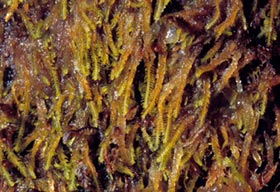
Plants usually occurring as isolated stems admixed with other bryophytes, more rarely as discrete plants. Stems mostly unbranched, to 7 mm. long, 0·2 mm. thick, flagella mostly one on each stem, usually short, with minute, distant, retuse or entire leaves, becoming smaller and more distant towards the apex. Leaves ovate-triangular, squarrose or with the upwards part of the leaf curved upwards, or even hamate, transverse attachment, 0·6 mm. long. 0·4 mm. wide at the widest part, concave, apices variable. obtuse or bluntly acute, shortly bifid with divergent lobes or curiously curved backwards towards the ventral margin. Cells 30–40 micrometre, still larger in the basal part, walls sinuous to stellate, caused by the very large trigones with bulging sides. Stipules, the width of the stem or a little more, 0·3 mm. tall, ovate-rotund, mostly entire, rarely very shortly bifid, more regular in shape than the leaves. Perianth 3·5 mm. long, 0·5 mm. broad at the base, narrowed to the apex, mouth piliferous, hair-points to 0·3 mm. long, crooked and entangled, a little toothed and in one instance branched. Seta as long as the perianth. Innermost pair of involucral leaves reaching almost 1/3 up the perianth, with narrow apices, shortly bifid reflexed. Second pair reaching half-way tip the innermost, with similar apices.
Distribution
Indigenous. North, South and Stewart Islands.
Substrate details
Terricolous on silt, sand and peaty ground. In the coal country of the western South Island it is found either partially submerged in streams or on the surrounding dripping wet, deeply incised, canyon like walls
Threats
Known from very few recent sites and at most of these it is seriously threatened by coal mining
Detailed taxonomy
Genus
Family
Synonyms
Mastigobryum verticale Steph.; Acromastigum martinii E.A.Hodgs.
Endemic genus
No
Endemic family
No
Ecology
Fruiting
Although fruit has been seen insufficient information exists to provide any details on the timing of fruiting
Other information
NVS code
The National Vegetation Survey (NVS) Databank is a physical archive and electronic databank containing records of over 94,000 vegetation survey plots - including data from over 19,000 permanent plots. NVS maintains a standard set of species code abbreviations that correspond to standard scientific plant names from the Ngä Tipu o Aotearoa - New Zealand Plants database.
ACRVER
Previous conservation statuses
The conservation status of the New Zealand hornwort and liverwort flora is reassessed using the New Zealand Threat Classification System (NZTCS). A full list is presented, along with a statistical summary and brief notes on the most important changes. This list replaces all previous NZTCS lists for New Zealand hornworts and liverworts which previously had been part of a generic bryophyte conservation status assessment that included mosses. Authors: P.J. de Lange, D. Glenny, K. Frogley, M.A.M. Renner, M. von Konrat, J.J. Engel, C. Reeb and J.R. Rolfe.
Source: NZTCS and licensed by DOC for reuse under the Creative Commons Attribution 4.0 International licence.
2009 | Threatened – Nationally Vulnerable
2004 | Threatened – Nationally Critical