
Brachyglottis arborescens
Common names
Three Kings rangiora
Biostatus
Native – Endemic taxon
Current conservation status
The conservation status of all known New Zealand vascular plant taxa at the rank of species and below were reassessed in 2022-2023 using the New Zealand Threat Classification System (NZTCS) – more information about this can be found on the NZTCS website. This report includes replaces all previous NZTCS lists for vascular plants. Previous assessments can be found here.
- Conservation status of vascular plants in Aotearoa New Zealand, 2023. 2024. Peter J. de Lange, Jane Gosden, Shannel P. Courtney, Alexander J. Fergus, John W. Barkla, Sarah M. Beadel, Paul D. Champion, Rowan Hindmarsh-Walls, Troy Makan and Pascale Michel Department of Conservation. Source: NZTCS and licensed by DOC for reuse under the Creative Commons Attribution 4.0 International licence.
2023 | At Risk – Naturally Uncommon | Qualifiers: CD, IE
Category
Vascular
Structural class
Trees & Shrubs - Dicotyledons
Simplified description
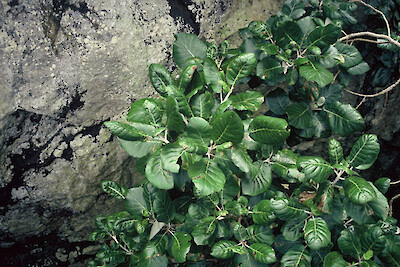
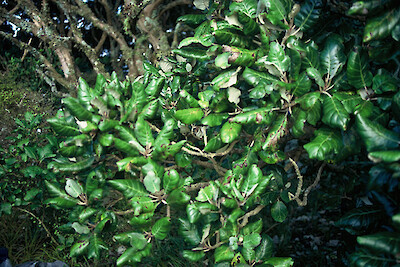
Canopy tree of the Three Kings Islands. Bark stringy. Leaves curled, large, dark glossy green and white underneath. Flowers in clusters of small white flowers. Seeds small, with a tuft of white hairs.
Flower colours
Yellow, Green
Detailed description
Shrub, small tree up to 8 m high. Trunk up to 30 cm or more diameter at base. Bark thick, in corky ridges. Leaves very glossy, bullate, obovate in outline, very shallowly lobed to sinuate. Inflorescence capitula small, panicle sparingly branched. Flowers lack ray florets, approximately 5 mm diameter, disc florets perfect, tubular-campanulate, dark greenish-yellow to sulphur yellow. Achene pappus-hairs longer than 3 mm, distinctly barbellate.
Distribution
Endemic. Three Kings Islands, present on all the main islands and also Hinemoa Rock within the Princes chain of islets and rock stacks.
Habitat
Meryta sinclairii forest and in coastal scrub. Sometimes found as an understorey shrub within the dense kanuka (Kunzea aff. ericoides) forest which dominates Great (Manawa Tawhi) Island.
Detailed taxonomy
Genus
Family
Synonyms
Brachyglottis repanda var. arborescens (W.R.B.Oliv.) Allan
Taxonomic notes
The large-leaved forms of North Auckland, Mayor and other coastal islands need further study.
Endemic taxon
Yes
Endemic genus
No
Endemic family
No
Ecology
Flowering
November-February
Fruiting
January-March
Life cycle and dispersal
Pappate achenes are dispersed by wind (Thorsen et al., 2009).
Propagation technique
Easy from fresh seed and cuttings. However, difficult to maintain as it is extremely susecptible to phytophora and verticillium wilt.
Other information
Cultivation
Occasionally available from specialist native plant nurseries.
Etymology
brachyglottis: Name comes from the Greek words brachus meaning “short” and glottis meaning “the vocal apparatus of the larynx”
arborescens: Becoming a tree
NVS code
The National Vegetation Survey (NVS) Databank is a physical archive and electronic databank containing records of over 94,000 vegetation survey plots - including data from over 19,000 permanent plots. NVS maintains a standard set of species code abbreviations that correspond to standard scientific plant names from the Ngä Tipu o Aotearoa - New Zealand Plants database.
BRAARB
Chromosome number
2n = 60
Previous conservation statuses
The conservation status of all known New Zealand vascular plant taxa at the rank of species and below were reassessed in 2022-2023 using the New Zealand Threat Classification System (NZTCS) – more information about this can be found on the NZTCS website. This report includes replaces all previous NZTCS lists for vascular plants. Previous assessments can be found here.
- Conservation status of vascular plants in Aotearoa New Zealand, 2023. 2024. Peter J. de Lange, Jane Gosden, Shannel P. Courtney, Alexander J. Fergus, John W. Barkla, Sarah M. Beadel, Paul D. Champion, Rowan Hindmarsh-Walls, Troy Makan and Pascale Michel Department of Conservation. Source: NZTCS and licensed by DOC for reuse under the Creative Commons Attribution 4.0 International licence.
2017 | At Risk – Naturally Uncommon | Qualifiers: CD, IE
2012 | At Risk – Naturally Uncommon | Qualifiers: CD, IE
2009 | At Risk – Naturally Uncommon | Qualifiers: IE
2004 | Range Restricted
Regional conservation statuses
Northland: 2026 | Regionally At Risk – Regionally Naturally Uncommon
Current regional threat status assessments prepared according to Crisp et al. (2025) are displayed when available. The Northland conservation status information is sourced from the “Conservation status of indigenous vascular plants in Northland | Taitokerau” Ford et al. 2026 report.
Referencing and citations
References and further reading
Allan HH. 1961. Flora of New Zealand, Volume I. Indigenous Tracheophyta: Psilopsida, Lycopsida, Filicopsida, Gymnospermae, Dicotyledones. Government Printer, Wellington, NZ. 1085 p; pp. 757-758.
Dawson J, Lucas R, Connor J, & Brownsey PJ. 2011. New Zealand’s Native Trees. Nelson: Craig Potton. pg. 160.
Thorsen MJ, Dickinson KJM, Seddon PJ. 2009. Seed dispersal systems in the New Zealand flora. Perspectives in Plant Ecology, Evolution and Systematics 11: 285–309. https://doi.org/10.1016/j.ppees.2009.06.001.
Attribution
Description adapted by M. Ward from Allan (1961) and Dawson et al. (2011).
Some of this factsheet information is derived from Flora of New Zealand Online and is used under a Creative Commons Attribution 3.0 New Zealand licence.