
Canavalia rosea
Common names
Canavalia
Biostatus
Native
Current conservation status
The conservation status of all known New Zealand vascular plant taxa at the rank of species and below were reassessed in 2022-2023 using the New Zealand Threat Classification System (NZTCS) – more information about this can be found on the NZTCS website. This report includes replaces all previous NZTCS lists for vascular plants. Previous assessments can be found here.
- Conservation status of vascular plants in Aotearoa New Zealand, 2023. 2024. Peter J. de Lange, Jane Gosden, Shannel P. Courtney, Alexander J. Fergus, John W. Barkla, Sarah M. Beadel, Paul D. Champion, Rowan Hindmarsh-Walls, Troy Makan and Pascale Michel Department of Conservation. Source: NZTCS and licensed by DOC for reuse under the Creative Commons Attribution 4.0 International licence.
2023 | At Risk – Naturally Uncommon | Qualifiers: OL, SO
Category
Vascular
Structural class
Lianes & Related Trailing Plants - Dicotyledons
Flower colours
Red/Pink
Detailed description
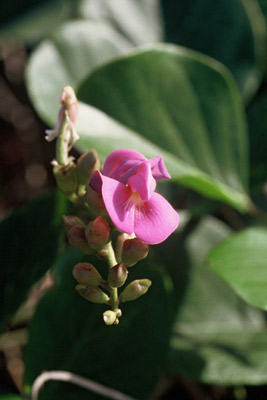
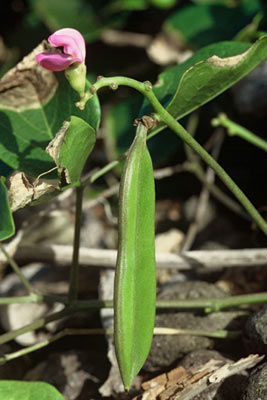
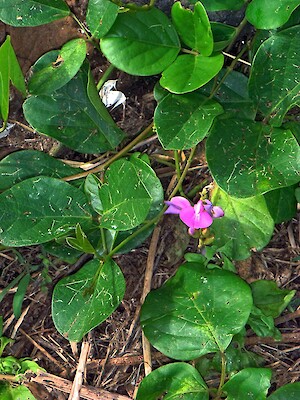
Perennial herb, procumbent and creeping or subscandent to lianoid. Stems up to 3 m, trailing, pubescent with appressed-pilose hairs when young. Leaflets 40-120 × 35-80 mm, dark green above, paler beneath, broad-obovate, broad elliptic, orbicular to obovate, apex rounded or emarginate, pilose-hairy when young, especially below, glabrescent. Inflorescences erect, racemose, few-flowered, peduncles stout, 50-300 mm long. Flowers clustered toward apex of rachis; pedicels 2-6 mm long. Calyx 8 mm long, upper lip 4 mm long, pilose. Petals dark pink; standard broadly elliptic-orbicular to orbicular, c.30 mm, rounded; wings and keel oblanceolate. Ovary silky-hairy; ovules c.7. Pods linear-oblong, initially dark green drying brownish-black, 70-140 × 25-30 mm, glabrescent, with a double rib dorsally and a single ventral rib. Seeds 15-20 mm, brown, often with dark markings, ellipsoid, somewhat flattened.
Similar taxa
None in New Zealand. A distinctive strand species which cannot be confused with any other plant growing in a similar habitat within the New Zealand Botanical Region.
Distribution
Indigenous. In New Zealand known only from the Kermadec Islands where it is not very common. Found throughout the warmer parts of the Pacific and Indian Oceans
Habitat
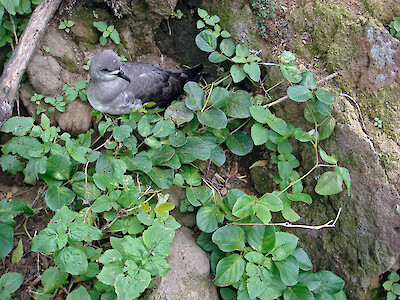
In New Zealand found on boulder beaches and sand dunes on the Kermadec Islands. This is a common beach strand plant of the Pacific Islands, where it usually grows with Lepturus repens (G.Forst.) R.Br., Ipomoea pes-caprae subsp. brasiliensis (L.) Ooststr., and Vignea marina (Burm.) Merr.
Threats
Not threatened. However very uncommon reaching its world southern limit in the New Zealand Botanical Region. Because it occupies such a narrow geographic area it is listed as Range Restricted.
Detailed taxonomy
Genus
Family
Synonyms
Canavalia maritima Thouars, Canavalia obtusifolius (Lam.) DC.
Endemic taxon
No
Endemic genus
No
Endemic family
No
Ecology
Flowering
Throughout the year
Fruiting
Throughout the year
Life cycle and dispersal
Seeds are dispersed by water (Thorsen et al., 2009).
Propagation technique
Easy from fresh seed. However extremely cold sensitive. Various attempts to cultivate it in New Zealand have so far failed because plants die during the winter months.
Other information
Etymology
canavalia: This is a latinized form of kanavali a Malabar vernacular and the name for this genus of climbing herbs.
NVS code
The National Vegetation Survey (NVS) Databank is a physical archive and electronic databank containing records of over 94,000 vegetation survey plots - including data from over 19,000 permanent plots. NVS maintains a standard set of species code abbreviations that correspond to standard scientific plant names from the Ngä Tipu o Aotearoa - New Zealand Plants database.
CANROS
Chromosome number
2n = 22
Previous conservation statuses
The conservation status of all known New Zealand vascular plant taxa at the rank of species and below were reassessed in 2022-2023 using the New Zealand Threat Classification System (NZTCS) – more information about this can be found on the NZTCS website. This report includes replaces all previous NZTCS lists for vascular plants. Previous assessments can be found here.
- Conservation status of vascular plants in Aotearoa New Zealand, 2023. 2024. Peter J. de Lange, Jane Gosden, Shannel P. Courtney, Alexander J. Fergus, John W. Barkla, Sarah M. Beadel, Paul D. Champion, Rowan Hindmarsh-Walls, Troy Makan and Pascale Michel Department of Conservation. Source: NZTCS and licensed by DOC for reuse under the Creative Commons Attribution 4.0 International licence.
2017 | At Risk – Naturally Uncommon | Qualifiers: OL, SO
2012 | At Risk – Naturally Uncommon | Qualifiers: OL, SO
2009 | At Risk – Naturally Uncommon | Qualifiers: DC. SO, OL
2004 | Range Restricted
Referencing and citations
References and further reading
Thorsen, M. J.; Dickinson, K. J. M.; Seddon, P. J. 2009. Seed dispersal systems in the New Zealand flora. Perspectives in Plant Ecology, Evolution and Systematics 2009 Vol. 11 No. 4 pp. 285-309
Attribution
Description based on herbarium specimens held at AK and observations of cultivated material and plants seen in the wild on Raoul, Norfolk and Rarotonga.
NZPCN Fact Sheet citation
Please cite as: de Lange, P.J. (Year at time of access): Canavalia rosea Fact Sheet (content continuously updated). New Zealand Plant Conservation Network. https://www.nzpcn.org.nz/flora/species/canavalia-rosea/ (Date website was queried)