
Craspedia rugosa


Common names
Lake Heron woollyhead
Biostatus
Native – Endemic taxon
Current conservation status
The conservation status of all known New Zealand vascular plant taxa at the rank of species and below were reassessed in 2022-2023 using the New Zealand Threat Classification System (NZTCS) – more information about this can be found on the NZTCS website. This report includes replaces all previous NZTCS lists for vascular plants. Previous assessments can be found here.
- Conservation status of vascular plants in Aotearoa New Zealand, 2023. 2024. Peter J. de Lange, Jane Gosden, Shannel P. Courtney, Alexander J. Fergus, John W. Barkla, Sarah M. Beadel, Paul D. Champion, Rowan Hindmarsh-Walls, Troy Makan and Pascale Michel Department of Conservation. Source: NZTCS and licensed by DOC for reuse under the Creative Commons Attribution 4.0 International licence.
2023 | Threatened – Nationally Critical | Qualifiers: DPT, OL
Category
Vascular
Structural class
Herbs - Dicotyledonous composites
Simplified description
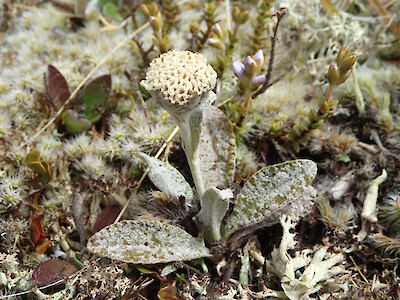
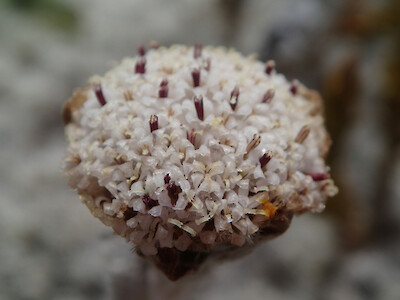
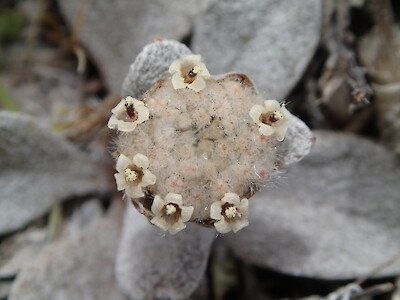
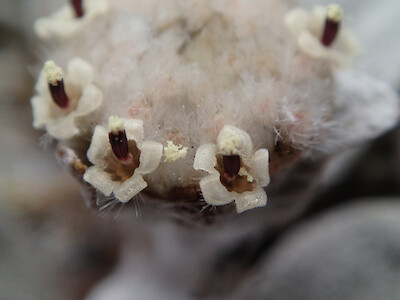
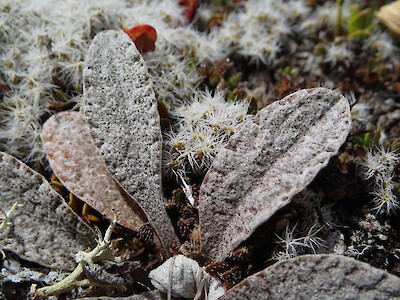
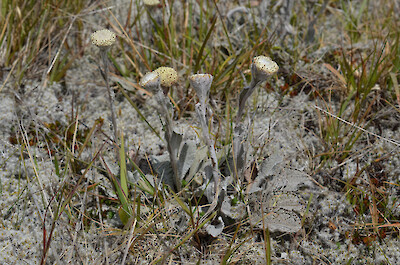
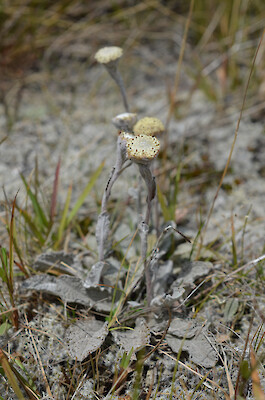
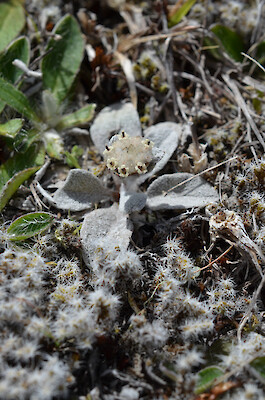
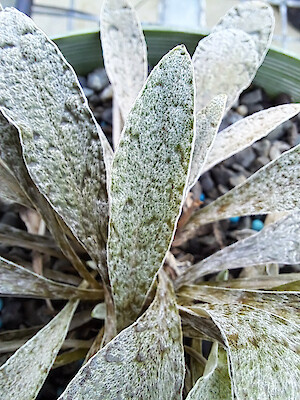
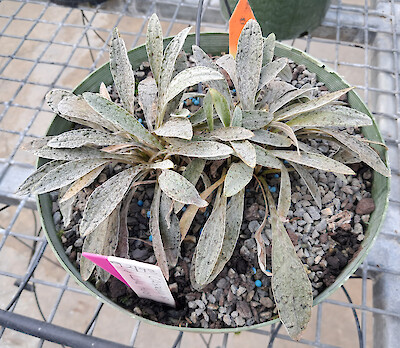
Rosette-forming herb with elliptic, narrowly elliptic, obovate, spatulate to oblanceolate, rugose dark-red mottled leaves which are covered by a thin to moderately dense, appressed, hairy covering. The flower stems are up to 76 mm tall, and the flower heads (capitula) are pale yellow with dark red-purple anthers.
Flower colours
White, Yellow
Similar taxa
Allied to Craspedia lanata from which it differs by the rugose rosette leaves which are shorter than 50 mm, dark-red mottled, and covered with a thin to moderately dense, appressed, lanate indumentum. The florets also differ in that they have a pale yellow corolla with dark red-purple anthers (Breitwieser & Ford 2022).
Distribution
Endemic. New Zealand: South Island (Canterbury Plains). Currently known from one site at Ōtūwharekai / Ashburton Lakes wetland (Lake Heron). Probably once more widespread on the plains as there is an historic collection from Oxford (Breitwieser & Ford 2022).
Habitat
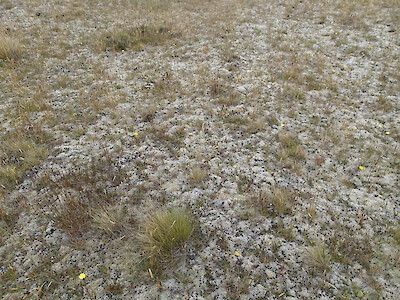
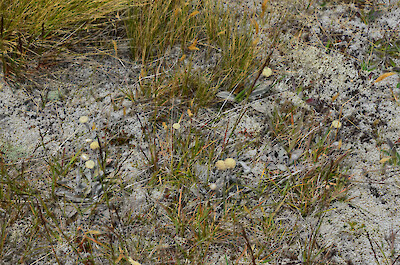
Known only from dry, short tussockland on a stable upper fan surface at 720 m a.s.l. Associating in habitats dominated by Racomitrium geronticum Müll.Hal. (incorrectly referred to in New Zealand by the name Racomitrium lanuginosum (Hedw.) Brid., Juan B. Larraín pers. comm. 6 June 2022), where it is also found growing with Festuca novae-zelandiae, and sweet vernal (Anthoxanthum odoratum) (Breitwieser & Ford 2022).
Threats
Craspedia rugosa as Craspedia (j) (CHR 516302; Lake Heron)] was assessed as ‘Threatened-Nationally Critical’ (Criteria A1, Population <250 mature individuals, with a decline rate of 10–30%), qualified ‘DP’ (Data Poor), ‘OL’ (One Location) by the New Zealand Indigenous Vascular Plant Threat Listing Panel (de Lange et al. 2018).
Detailed taxonomy
Genus
Family
Synonyms
None - first described in 2022.
Endemic taxon
Yes
Endemic genus
No
Endemic family
No
Ecology
Flowering
Early January – early February
Fruiting
Late January – late February
Other information
Extra information
See brief article in July 2022 Trilepidea Four new species of woollyhead (Craspedia) described from the eastern South Island (p. 2)
Etymology
craspedia: Craspedia is named for the Greek ‘Kraspedon’, meaning an edge, hem or border, because of the woolly fringes of the leaves of the type species.
rugosa: Wrinkled
Previous conservation status
The conservation status of all known New Zealand vascular plant taxa at the rank of species and below were reassessed in 2022-2023 using the New Zealand Threat Classification System (NZTCS) – more information about this can be found on the NZTCS website. This report includes replaces all previous NZTCS lists for vascular plants. Previous assessments can be found here.
- Conservation status of vascular plants in Aotearoa New Zealand, 2023. 2024. Peter J. de Lange, Jane Gosden, Shannel P. Courtney, Alexander J. Fergus, John W. Barkla, Sarah M. Beadel, Paul D. Champion, Rowan Hindmarsh-Walls, Troy Makan and Pascale Michel Department of Conservation. Source: NZTCS and licensed by DOC for reuse under the Creative Commons Attribution 4.0 International licence.
2017 | Threatened – Nationally Critical | Qualifiers: DP, OL
Referencing and citations
References and further reading
Breitwieser I, Ford KA. 2022. Four new species of Craspedia (Compositae/Asteraceae, Gnaphalieae) from the South Island of New Zealand, all characterised by dark red-purple anthers. New Zealand Journal of Botany. https://doi.org/10.1080/0028825X.2022.2095919
de Lange PJ, Rolfe JR, Barkla JW, Courtney SP, Champion PD, Perrie LR, Beadel SM, Ford KA, Breitwieser I, Schönberger I, Hindmarsh-Walls R, Heenan PB, Ladley K. 2018. Conservation status of New Zealand indigenous vascular plants, 2017. New Zealand Threat Classification Series 22. Department of Conservation, Wellington, NZ. 82 p. https://www.doc.govt.nz/globalassets/documents/science-and-technical/nztcs22entire.pdf
Attribution
Fact Sheet prepared for NZPCN by P.J. de Lange 17 July 2022.