
Craspedia thinicola
Common names
Kaitorete Spit woollyhead
Biostatus
Native – Endemic taxon
Current conservation status
The conservation status of all known New Zealand vascular plant taxa at the rank of species and below were reassessed in 2022-2023 using the New Zealand Threat Classification System (NZTCS) – more information about this can be found on the NZTCS website. This report includes replaces all previous NZTCS lists for vascular plants. Previous assessments can be found here.
- Conservation status of vascular plants in Aotearoa New Zealand, 2023. 2024. Peter J. de Lange, Jane Gosden, Shannel P. Courtney, Alexander J. Fergus, John W. Barkla, Sarah M. Beadel, Paul D. Champion, Rowan Hindmarsh-Walls, Troy Makan and Pascale Michel Department of Conservation. Source: NZTCS and licensed by DOC for reuse under the Creative Commons Attribution 4.0 International licence.
2023 | Threatened – Nationally Endangered | Qualifiers: CI, CD, OL
Category
Vascular
Structural class
Herbs - Dicotyledonous composites
Simplified description
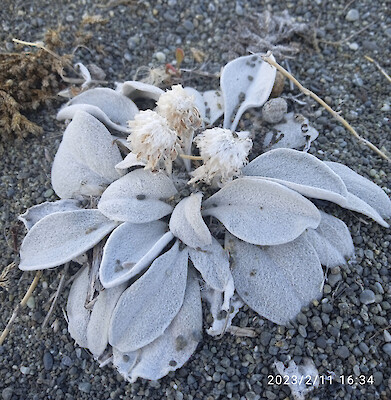
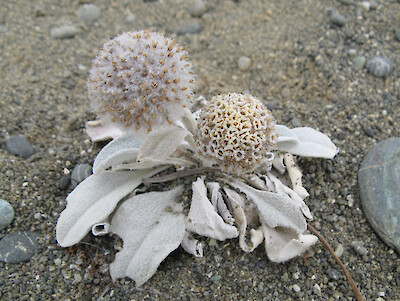
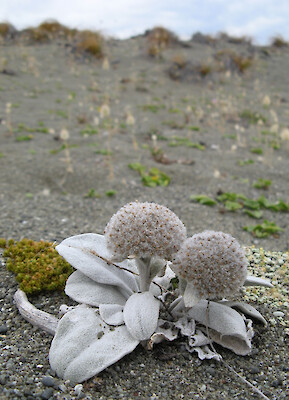
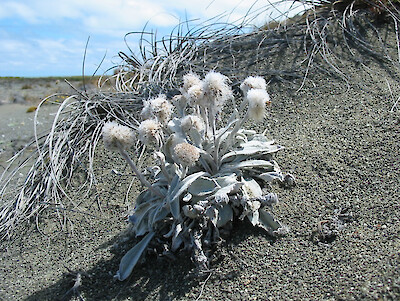
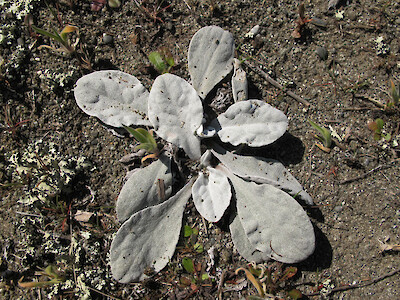
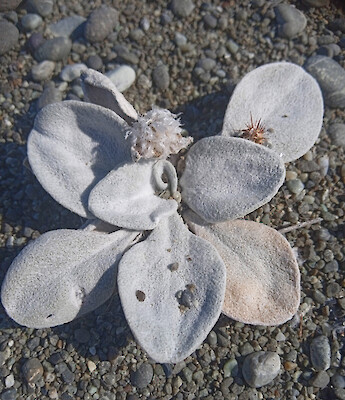
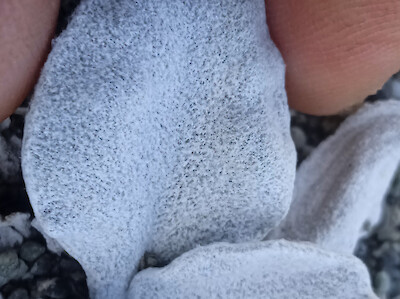
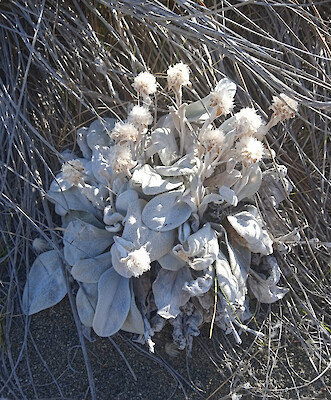
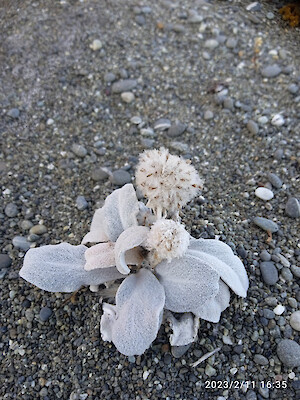
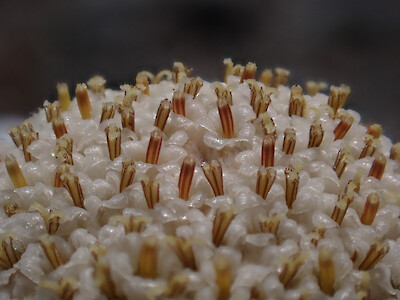
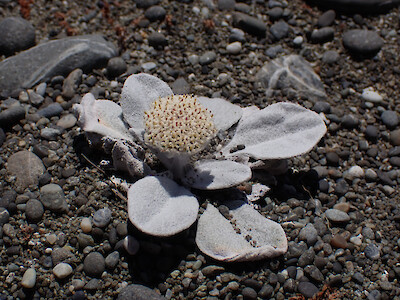
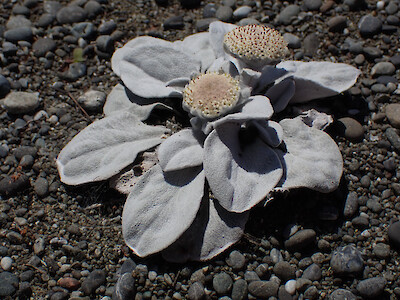
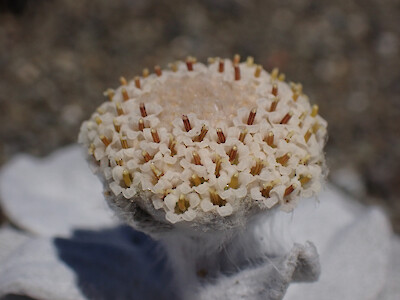
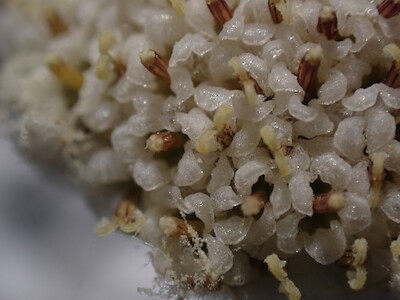
Rosette-forming herb with silvery grey, elliptic, obovate to oblanceolate leaves held flat to ground. Leaf hairs arranged in a felted in a granular pattern. Flowers heads on stems up to 130 mm tall. Flower head (capitula) white or yellow with dark red-purple anthers.
Flower colours
White, Yellow
Similar taxa
Allied to Craspedia lanata from which it differs by the rosette leaves which have dense, appressed, lanate indumentum, arranged in a felted granular pattern, and whose florets have white or yellowish corolla, and dark red-purple anthers (Breitwieser & Ford 2022).
Distribution
Endemic. New Zealand, Canterbury, Kaitorete Spit.
Habitat
Craspedia thinicola is endemic to stable deflation hollows, where it grows in association with Ficinia spiralis, Hypochaeris radicata, Rumex acetosella, and Raoulia australis (Breitwieser & Ford 2022).
Threats
Craspedia thinicola, as Craspedia (c) CHR 529115; Kaitorete] has been assessed as ‘Threatened/Nationally Endangered’ (Criteria A2, Population ≤5 subpopulations, ≤300 mature individuals in the largest subpopulation, with a decline rate of 10%–50%), qualified ‘OL’ (One Location) by de Lange et al. (2018). Breitwieser & Ford (2022) offer no adjustments to that threat status.
Detailed taxonomy
Genus
Family
Synonyms
None - first described in 2022.
Endemic taxon
Yes
Endemic genus
No
Endemic family
No
Ecology
Flowering
Mid-November to mid-December.
Fruiting
Late November to late December.
Other information
Extra information
See brief article in July 2022 Trilepidea Four new species of woollyhead (Craspedia) described from the eastern South Island (p. 2)
Etymology
craspedia: Craspedia is named for the Greek ‘Kraspedon’, meaning an edge, hem or border, because of the woolly fringes of the leaves of the type species.
thinicola: Derived from Latin, for ‘dune’ and ‘dweller’, referring to the area of sand dunes where this species grows (Breitwieser & Ford 2022)
Chromosome number
2n = 22 (CHR 483546; Dawson 1995)
Previous conservation statuses
The conservation status of all known New Zealand vascular plant taxa at the rank of species and below were reassessed in 2022-2023 using the New Zealand Threat Classification System (NZTCS) – more information about this can be found on the NZTCS website. This report includes replaces all previous NZTCS lists for vascular plants. Previous assessments can be found here.
- Conservation status of vascular plants in Aotearoa New Zealand, 2023. 2024. Peter J. de Lange, Jane Gosden, Shannel P. Courtney, Alexander J. Fergus, John W. Barkla, Sarah M. Beadel, Paul D. Champion, Rowan Hindmarsh-Walls, Troy Makan and Pascale Michel Department of Conservation. Source: NZTCS and licensed by DOC for reuse under the Creative Commons Attribution 4.0 International licence.
2022 | Threatened – Nationally Endangered | Qualifiers: OL
2017 | Threatened – Nationally Endangered | Qualifiers: OL
Referencing and citations
References and further reading
Breitwieser, I.; Ford, K.A. 2022: Four new species of Craspedia (Compositae/Asteraceae, Gnaphalieae) from the South Island of New Zealand, all characterised by dark red-purple anthers. New Zealand Journal of Botany. DOI: 10.1080/0028825X.2022.2095919
Dawson, M.I. 1995: Contributions to a chromosome atlas of the New Zealand flora – 33. Miscellaneous species. New Zealand Journal of Botany 33: 477–787.
de Lange, P.J.; Rolfe, J.R.; Barkla, J.W.; Courtney, S.P.; Champion, P.D.; Perrie, L.R.; Beadel, S.M.; Ford, K.A.; Breitwieser, I.; Schönberger, I.; Hindmarsh-Walls, R.; Heenan, P.B.; Ladley, K. 2018: Conservation status of New Zealand indigenous vascular plants. 2017. New Zealand Threat Classification Series 22: 1–82. Department of Conservation, Wellington.
Attribution
Fact Sheet prepared for NZPCN by P.J. de Lange 17 July 2022.