
Hampeella pallens
Common names
moss
Biostatus
Native
Current conservation status
This is the first complete assessment of all known species of mosses found in the wild in Aotearoa New Zealand with a total of 560 species being assessed. The conservation status of mosses, published in the NZTCS database, replaces all previous assessments of mosses. Data supporting the 2025 NZTCS assessment of mosses has been published on the NZTCS database at https://nztcs.org.nz/reports/1155.
Source: NZTCS and licensed by DOC for reuse under the Creative Commons Attribution 4.0 International licence.
2025 | Threatened – Nationally Critical | Qualifiers: DPS, DPT, S?O
Category
Non-vascular
Structural class
Mosses
Detailed description
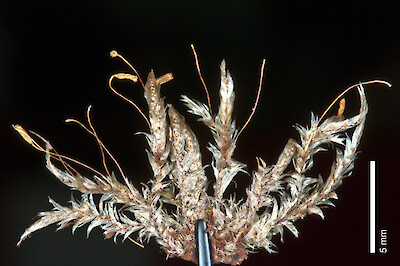
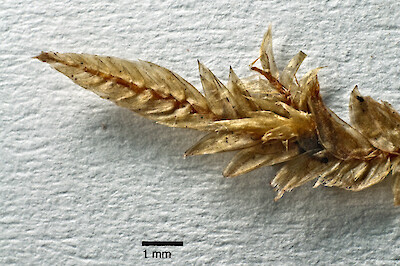
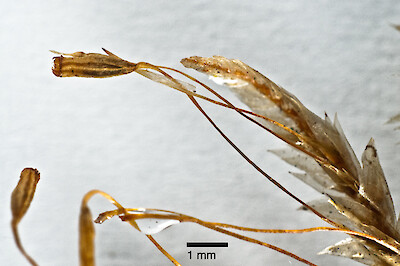
Plants corticolous, slender, tufted, green, glossy. Primary stems very short. Secondary stems to 20 mm tall, closely tufted, densely radiculose at the base, mostly simple, flattened and almost distichously foliate. leaves to 2 mm long, somewhat rugose, decurrent; dorsal and ventral leaves distinctly nearly erect and appressed and almost symmetrical; lateral leaves distinctly asymmetrical,ovate-lanceolate, acuminate, with the margin incurved on one side at the base; distantly and sharply denticulate in the upper half. Leaves at the base and apex of the stem symmetrical and much smaller. Nerve very thin-walled, linear-rhomboid, smaller at the apex and widened at the base; occasionally coloured and incrassate at the angles. Long brood-filaments produced from axials of the upper leaves. Perichaetia large, sheathing. Seta 6-9 mm long, lateral on secondary stems, slightly curved, reddish or yellow. Capsule 2.0-2.5 mm long, usually suberect, oblong or nearly cylindrical, sharply 8-ribbed; exothecial cells collenchymatous; annulus not differentiated. Operculum conico-rostrate, with a long oblique beak. Peristome double, inserted on the rim; outer teeth not conjoined at the base, lanceolate, quickly narrowed above, hyaline-margined, transparent on the median line so as to appear to be divided, striolate and red-brown below, hyaline and papillose above; ventral lamellae projecting internally and laterally; basal membrane of endostome yellow, almost smooth processes nearly half the height of the teeth, entire. Cilia lacking. Spores 14-32 µm, irregular in size and shape, brown. Autoicous; male inflorescence, lateral, gemmiform.
Distribution
Indigenous. New Zealand: North Island (Kaimai Ranges, Tuhua (Mayor Island), Lake Rotoehu Forest)
Habitat
Corticolous on trees and vines (especially supplejack (Ripogonum scandens) and bush lawyer (Rubus cissoides)) in lowland to lower montane mixed podocarp - broadleaved forest.
Threats
Hampeella appears to be genuinely scarce in New Zealand and it is known from very few specimens and sites. It is not clear what threatens it.
Detailed taxonomy
Genus
Family
Synonyms
Cladomnion pallens Sande Lac., Hampeella pallens (Sande Lac.) M.Fleisch. var. pallens
Endemic taxon
No
Endemic genus
No
Endemic family
No
Ecology
Fruiting
Fruiting material is known from New Zealand specimens but there is insufficient data available to determine the exact season they are likely to be seen
Other information
Etymology
pallens: Pale, pallid
NVS code
The National Vegetation Survey (NVS) Databank is a physical archive and electronic databank containing records of over 94,000 vegetation survey plots - including data from over 19,000 permanent plots. NVS maintains a standard set of species code abbreviations that correspond to standard scientific plant names from the Ngä Tipu o Aotearoa - New Zealand Plants database.
HAMPAL
Previous conservation statuses
This is the first complete assessment of all known species of mosses found in the wild in Aotearoa New Zealand with a total of 560 species being assessed. The conservation status of mosses, published in the NZTCS database, replaces all previous assessments of mosses. Data supporting the 2025 NZTCS assessment of mosses has been published on the NZTCS database at https://nztcs.org.nz/reports/1155.
Source: NZTCS and licensed by DOC for reuse under the Creative Commons Attribution 4.0 International licence.
2014 | Threatened – Nationally Critical | Qualifiers: DP, DPS, DPT
2009 | Threatened – Nationally Critical | Qualifiers: DP, RR, ?SO
2004 | Threatened – Nationally Critical
Referencing and citations
References and further reading
Sainsbury, G.O.K. 1955: A handbook of the New Zealand mosses. Royal Society of New Zealand Bulletin 5.
Fact Sheet Prepared for NZPCN by: P.J. de Lange 25 October 2011. Description from Sainsbury (1955).