
Melicytus obovatus

Biostatus
Native – Endemic taxon
Current conservation status
The conservation status of all known New Zealand vascular plant taxa at the rank of species and below were reassessed in 2022-2023 using the New Zealand Threat Classification System (NZTCS) – more information about this can be found on the NZTCS website. This report includes replaces all previous NZTCS lists for vascular plants. Previous assessments can be found here.
- Conservation status of vascular plants in Aotearoa New Zealand, 2023. 2024. Peter J. de Lange, Jane Gosden, Shannel P. Courtney, Alexander J. Fergus, John W. Barkla, Sarah M. Beadel, Paul D. Champion, Rowan Hindmarsh-Walls, Troy Makan and Pascale Michel Department of Conservation. Source: NZTCS and licensed by DOC for reuse under the Creative Commons Attribution 4.0 International licence.
2023 | At Risk – Declining | Qualifiers: Sp, DPS, DPT, RR
Category
Vascular
Structural class
Trees & Shrubs - Dicotyledons
Simplified description
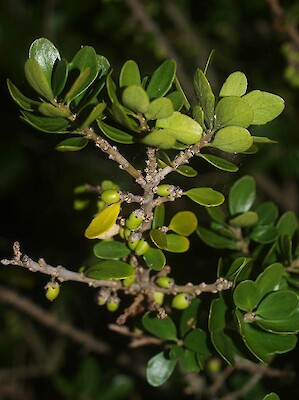
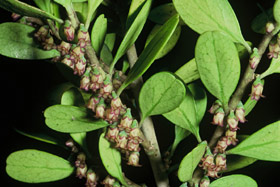
A shrub with leaves that vary depending on location and age of plant inhabiting the Cook Strait and Takaka regions. Twigs speckled. Leaves to 5 cm long, network of veins more visible on the paler underside, edges either smooth or wavy. Flowers small, bell-shaped, hanging. Fruit white blotched with purple.
Flower colours
White, Cream, Purple, Green
Detailed description
Dioecious. Erect to spreading shrub up to 4 metres tall, occasionally becoming tree up to 6.5 metres tall. Trunk(s) up to 20 cm diameter. Bark smooth, grey. Branchlets light-green to grey-green, glabrous to pubescent when young. Petioles 1.5-10.0 mm long. Leaves dimorphic, younger and shaded leaves are larger than mature foliage especially if mature leaves are in an exposed situation; adult leaves (12-)35-110 × (6-)9-23 mm, mid-green to dark-green, dull to satin surface, elliptic-oblong or narrowly obovate-oblong to narrowly obovate, margin 1-2 serrate teeth towards distal end, tip slightly notched, lower surface has stomata present. Inflorescence 1-4 arising from old leaves or petiole scars. Flowers solitary or in fascicle of 2, male flower borne decurved pedicel 1-2.5 mm long, sepals 5, triangular, purple margin, corolla barrel shaped, 3.5-4.5 × 2.5-4.5 mm, petals 4-5, up to 4 mm long, obovate-oblong, cream – pale orange-yellow, margin distinctly purple, anther 1-1.5 mm long, pollen pale yellow; female flower borne decurved pedicel 1.5-1.7 mm long, sepals 5, triangular, purple margin, corolla barrel shaped, 3.0-4.7 × 2.7-5 mm, petals 4-5, up to 3.9 mm long, obovate-oblong, pale yellow to lemon yellow, margin distinctly purple, white at base, barren anther 0.6-0.7 mm long, stigmas 2, spreading, off white or greenish white, ovary 1.2-1.8 mm long, greenish-white. Fruit 6-7.5 × 5.3-7 mm, ovoid, starting green maturing white and mottled with grey blue-black. Seeds 1 or 2, ovoid to elliptic depending on number per fruit, grey or dark grey with black markings.
Similar taxa
Most similar to Melicytus orarius, which is usually a smaller shrub usually 2.5 metres tall, occasionally up to 4 metres tall. The leaves M. orarius (compared to M. obovatus) are usually not as long in M. orarius 16-52mm (compared to 35-110mm), have 1 tooth per margin (compared to 1-2), and the leaf tip is distinctly notched (compared to slightly notched). The flower are similar in each species, though those of M. orarius are hermaphrodite not dioecious.
Melicytus improceras can be differentiated from M. obovatus by the smaller and denser habit up to 1.2 metres tall. The leaves are smaller, with a noticeably notched tip. The flowers lack a distinctly purple margin on the petals.
Melicytus venosus can be differentiated from M. obovatus by the taller more open up to 6 metres tall, with stems which have corky collars. The leaves are broadly elliptic and may have as many as 6 teeth. The flower petals also lack a purple margin.
Distribution
Endemic. Te Waipounamu | South Island, almost exclusive to Tasman District, Mt Burnett south to Mt Owen, to Maungakura | Red Hill.
Habitat
Near Coastal to Montane (20 - 950 m.a.s.l.). Prefers calcareous derived substrates, often seen growing on bluffs and overhangs, as well and cracks and fissures in rocks.
Detailed taxonomy
Genus
Family
Synonyms
Hymenanthera obovata Kirk
Taxonomic notes
Until the Heenan et. al. 2017 paper was published separating three new species from it, this species was thought to be quite variable. This variability was suggested to be either a result of having several growth forms, or being the result of plants being influenced by habitat and circumstance in which the specimens existed.
Endemic taxon
Yes
Endemic genus
No
Endemic family
No
Ecology
Flowering
August - November
Fruiting
November - April
Other information
Etymology
melicytus: From the Greek meli (honey) and kytos (hollow container), referring to the staminal nectaries of the flowers. Literally “honey-cave”
obovatus: From the Latin prefix ob- (‘reverse’) and the adjective ovatus ‘egg-shaped’. Thus obovatus means ‘reverse egg-shaped, i.e. the broadest part above the middle’.
NVS code
The National Vegetation Survey (NVS) Databank is a physical archive and electronic databank containing records of over 94,000 vegetation survey plots - including data from over 19,000 permanent plots. NVS maintains a standard set of species code abbreviations that correspond to standard scientific plant names from the Ngä Tipu o Aotearoa - New Zealand Plants database.
MELOBO
Chromosome number
2n = 32
Previous conservation statuses
The conservation status of all known New Zealand vascular plant taxa at the rank of species and below were reassessed in 2022-2023 using the New Zealand Threat Classification System (NZTCS) – more information about this can be found on the NZTCS website. This report includes replaces all previous NZTCS lists for vascular plants. Previous assessments can be found here.
- Conservation status of vascular plants in Aotearoa New Zealand, 2023. 2024. Peter J. de Lange, Jane Gosden, Shannel P. Courtney, Alexander J. Fergus, John W. Barkla, Sarah M. Beadel, Paul D. Champion, Rowan Hindmarsh-Walls, Troy Makan and Pascale Michel Department of Conservation. Source: NZTCS and licensed by DOC for reuse under the Creative Commons Attribution 4.0 International licence.
2017 | At Risk – Relict | Qualifiers: DP, RR, Sp, St
2012 | At Risk – Naturally Uncommon | Qualifiers: RR, Sp
2009 | At Risk – Naturally Uncommon
2004 | Range Restricted
Referencing and citations
References and further reading
Allan HH. 1961. Flora of New Zealand, Volume I. Indigenous Tracheophyta: Psilopsida, Lycopsida, Filicopsida, Gymnospermae, Dicotyledones. Government Printer, Wellington, NZ. 1085 p.
Heenan PB, Courtney SP, de Lange PJ & Molloy BPJ. 2017. Three new Melicytus species from central New Zealand and a revised circumscription of Melicytus obovatus (Violaceae), New Zealand Journal of Botany, 56(1), pp. 51-83. DOI:10.1080/0028825X.2017.1387156
Attribution
Description prepared for NZPCN by M. Ward adapted from Allan (1961) & Heenan et. al. (2017).
Some of this factsheet information is derived from Flora of New Zealand Online and is used under a Creative Commons Attribution 3.0 New Zealand licence.