
Zoysia minima
Common names
prickly couch, zoysia
Biostatus
Native – Endemic taxon
Current conservation status
The conservation status of all known New Zealand vascular plant taxa at the rank of species and below were reassessed in 2022-2023 using the New Zealand Threat Classification System (NZTCS) – more information about this can be found on the NZTCS website. This report includes replaces all previous NZTCS lists for vascular plants. Previous assessments can be found here.
- Conservation status of vascular plants in Aotearoa New Zealand, 2023. 2024. Peter J. de Lange, Jane Gosden, Shannel P. Courtney, Alexander J. Fergus, John W. Barkla, Sarah M. Beadel, Paul D. Champion, Rowan Hindmarsh-Walls, Troy Makan and Pascale Michel Department of Conservation. Source: NZTCS and licensed by DOC for reuse under the Creative Commons Attribution 4.0 International licence.
2023 | At Risk – Declining | Qualifiers: DPS, DPT
Category
Vascular
Structural class
Grasses
Simplified description
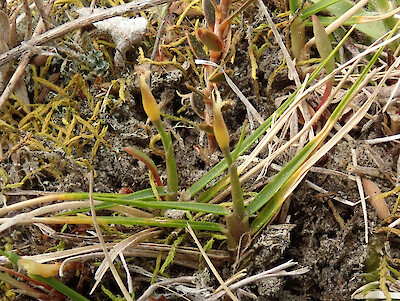
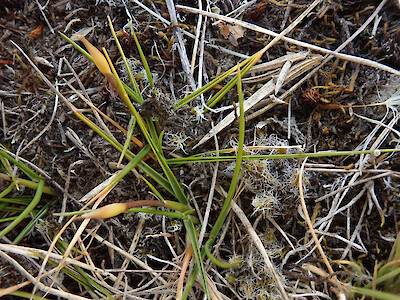
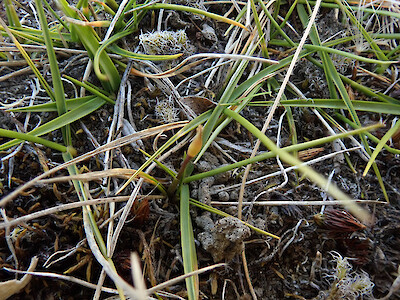
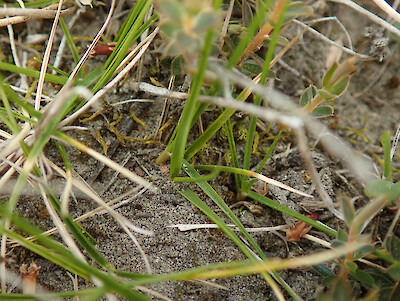
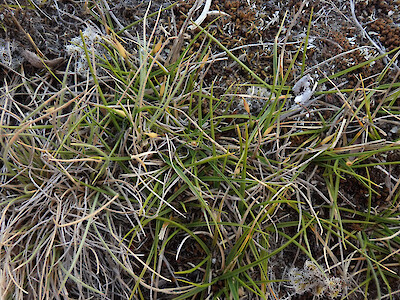
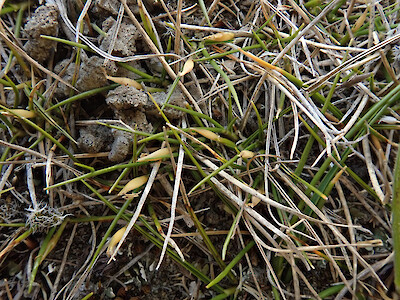
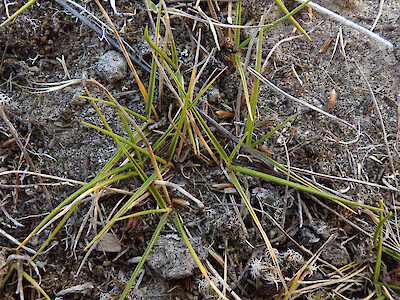
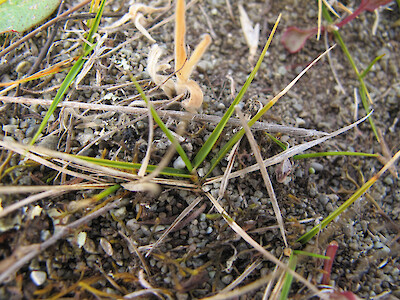
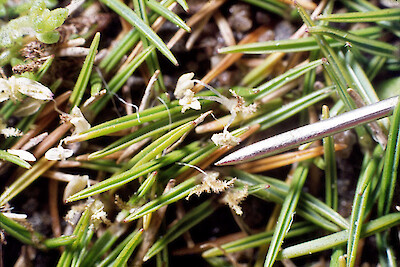
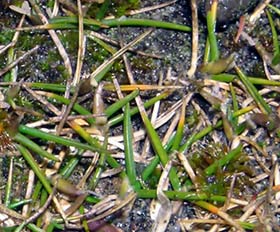
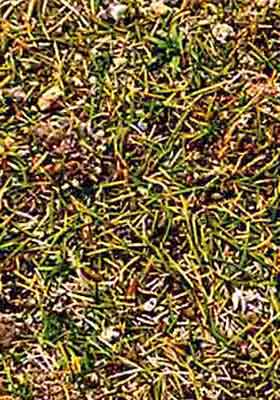
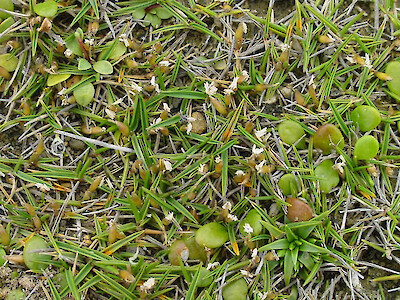
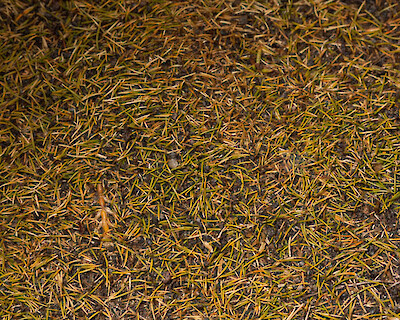
A small robust grass almost sharp to the touch, found on sandy or gravelly ground often in coastal situations. The leaves are rich green to yellow green forming widespread dense carpets of growth. The seed spikes are inconspicuous cream to pale brown with one seed.
Detailed description
Rhizomatous mat-forming turf grass. Rhizome stout, long, to 1.5 mm diameter, whitish, smooth; cataphylls smooth, grey or whitish; shoots to 50-(100) mm, branching several times intravaginally at or above ground. Leaf-sheath shining white below, purplish above, striate, margins membranous, wide, glabrous. Ligule 0.1-0.2 mm, ciliate. Collar glabrous, swollen, recurved, very rarely with 1-2 long hairs. Leaf-blade 5-30 mm, distinctly divergent, folded, abaxially smooth, adaxially scabrid on ribs; margins incurved, thickened and scabrid. Culm to 20 mm, terete to usually laterally compressed, ridged, usually scabrid on ridges below spikelet otherwise glabrous, bearing 1 leaf or leaf reduced to sheath, and often a minute bract above. Spikelet 1, occasionally 2-3, peduncles narrowly ovate, lanceolate, approximately 1 mm wide. Glumes indurated, lower usually absent, if present much reduced, occasionally complete and awned, to about 4.5 mm, upper glume 3-7 mm, minutely scabrid above and on margins, generally golden to golden-brown, nerves 7-9, very weak; awn 0.2-2.5 mm, scabrid. Lemma 3-4.5 mm, ovate-lanceolate, 1-nerved, firm-hyaline, shallowly bifid, glabrous. Palea 3-4 mm. Anthers approximately 2 mm. Gynoecium: ovary 0.5-0.75 mm; stigma-styles 7-7.5 mm. Caryopsis 1.5-1.75 mm; embryo 0.75 mm; pericarp detaching with 0.25-0.35 mm beak. Protogynous.
Similar taxa
Zoysia pauciflora, a larger in general species with leaves which are much larger, thinner and softer, not prickly to the touch.
Distribution
Endemic. Aotearoa | New Zealand: Te Ika-a-Māui | North Island (south from Auckland and Coromandel), Te Waipounamu | South Island (scattered from Nelson, Marlborough south to Central Otago).
Habitat
Coastal to inland on sand dunes (0-600 m.a.s.l.), sandy ground, and gravel.
Detailed taxonomy
Genus
Family
Synonyms
Gaimardia minima Colenso
Endemic taxon
Yes
Endemic genus
No
Endemic family
No
Ecology
Propagation technique
Eaasy from rooted pieces. Fresh seed should germinate well. A mat-forming species ideal for high traffic areas such as lawns, and well suited to dry sites and free-draining soils.
Other information
Where To Buy
Not commercially available.
Etymology
zoysia: Named for Karl von Zois (or Zoys), 18th century Austrian botanist
minima: Very small
Manaaki Whenua Online Interactive Key
NVS code
The National Vegetation Survey (NVS) Databank is a physical archive and electronic databank containing records of over 94,000 vegetation survey plots - including data from over 19,000 permanent plots. NVS maintains a standard set of species code abbreviations that correspond to standard scientific plant names from the Ngä Tipu o Aotearoa - New Zealand Plants database.
ZOYMIN
Chromosome number
2n = 40
Previous conservation statuses
The conservation status of all known New Zealand vascular plant taxa at the rank of species and below were reassessed in 2022-2023 using the New Zealand Threat Classification System (NZTCS) – more information about this can be found on the NZTCS website. This report includes replaces all previous NZTCS lists for vascular plants. Previous assessments can be found here.
- Conservation status of vascular plants in Aotearoa New Zealand, 2023. 2024. Peter J. de Lange, Jane Gosden, Shannel P. Courtney, Alexander J. Fergus, John W. Barkla, Sarah M. Beadel, Paul D. Champion, Rowan Hindmarsh-Walls, Troy Makan and Pascale Michel Department of Conservation. Source: NZTCS and licensed by DOC for reuse under the Creative Commons Attribution 4.0 International licence.
2017 | At Risk – Declining | Qualifiers: DP
2012 | Not Threatened
2009 | Not Threatened
2004 | Not Threatened
Regional conservation statuses
Northland: 2026 | Regionally Data Deficient | Qualifiers: DPR DPS DPT
Current regional threat status assessments prepared according to Crisp et al. (2025) are displayed when available. The Northland conservation status information is sourced from the “Conservation status of indigenous vascular plants in Northland | Taitokerau” Ford et al. 2026 report.
Auckland: 2025 | Regionally Threatened – Regionally Endangered | Qualifiers: DPR, DPS, DPT, PF, RR
Current regional threat status assessments prepared according to Crisp et al. (2025) are displayed when available. The Auckland conservation status information is sourced from the “Conservation status of vascular plant species in Tāmaki Makaurau / Auckland” Simpkins E et al. 2025 report.
Otago: 2025 | Regionally Data Deficient
Current regional threat status assessments prepared according to Crisp et al. (2025) are displayed when available. The Otago conservation status information is sourced from the “Conservation Status of Indigenous Vascular Plants in Otago, 2025” Jarvie S et al. (2025) report.
Wellington: 2025 | Regionally Threatened – Regionally Endangered
Current regional threat status assessments prepared according to Crisp et al. (2025) are displayed when available. The Wellington conservation status information is sourced from the “Conservation status of indigenous vascular plants in the Wellington region” Enright P et al. 2025 report.
Referencing and citations
References and further reading
Edgar E, Connor HE. 2000. Flora of New Zealand. Vol. V. Grasses. Manaaki Whenua Press, Christchurch, NZ. 650 p.
Attribution
Fact sheet prepared for NZPCN by MD Ward (March 2nd 2026). Description from Edgar & Connor (2000).
Some of this factsheet information is derived from Flora of New Zealand Online and is used under a Creative Commons Attribution 3.0 New Zealand licence.