
Ageratum houstonianum


Environmental Weed (2024)
Common names
Blue billy goat weed
Biostatus
Exotic
Conservation status
Not applicable
Category
Vascular
Structural class
Herbs - Dicotyledonous composites
Flower colours
Blue
Detailed description
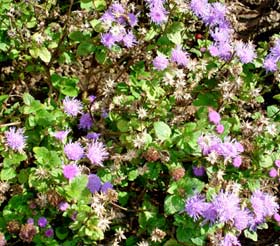
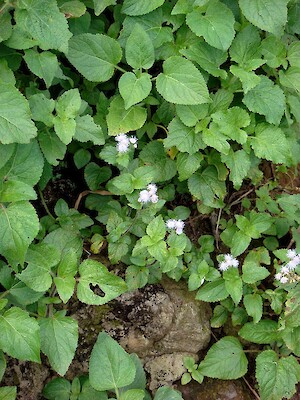
Erect or ascending annual herb, up to 1 m tall somewhat woody toward base. leaves on a short petiole up to 20 mm long. Leaves hairy and glandular especially on lower surface, ovate with crenate-serrate margins up to about 50 x 60 m. Blue flowers in dense clusters. Seeds sparsely hairy, black up to 1.8 mm long.
Similar taxa
Is distinctive within the Asteracea due to the blue flowers, and petiolate, hairy leaves with toothed margins.
Habitat
Terrestrial. Prefers open sunny spots along forest edges.
Detailed taxonomy
Genus
Family
Endemic family
No
Ecology
Flowering
January, February, March, April, May, June, July, August, September, October, November, December
Year naturalised
1888
Origin
Mexico, C. and tropical America
Reason for introduction
Ornamental
Life cycle and dispersal
Annual. Produces small dry seed, sparsely hairy at one end. Dispersed by people and the wind.
Other information
Etymology
ageratum: From the Greek a- ‘without’ and geras ‘old’, meaning not aging, possibly referring to the fact that the flowers do not wither readily
houstonianum: Named after the genus Houstonia, which is named after the English botanist Dr William Houston.
Environmental Weed (2024)
This plant is named in a list of 386 environmental weeds in New Zealand 2024 prepared by DOC. 759 candidate species were considered for inclusion on this new comprehensive list of environmental weeds in New Zealand. The species considered were drawn from published lists of weed species, lists of plants that must be reported or managed by law if observed, existing national and regional programmes and agreements for pest management, and species already managed by the Department of Conservation (DOC). Candidate species were then assessed to see if they were fully naturalised and whether they have more than minor impacts in natural ecosystems. Read the full report here.
Referencing and citations
References and further reading
Johnson, A. T. and Smith, H. A (1986). Plant Names Simplified: Their pronunciation, derivation and meaning. Landsman Bookshop Ltd: Buckenhill, UK.