
Asplenium hookerianum var. colensoi


Common names
Colenso’s spleenwort
Biostatus
Native – Endemic taxon
Current conservation status
The conservation status of all known New Zealand vascular plant taxa at the rank of species and below were reassessed in 2022-2023 using the New Zealand Threat Classification System (NZTCS) – more information about this can be found on the NZTCS website. This report includes replaces all previous NZTCS lists for vascular plants. Previous assessments can be found here.
- Conservation status of vascular plants in Aotearoa New Zealand, 2023. 2024. Peter J. de Lange, Jane Gosden, Shannel P. Courtney, Alexander J. Fergus, John W. Barkla, Sarah M. Beadel, Paul D. Champion, Rowan Hindmarsh-Walls, Troy Makan and Pascale Michel Department of Conservation. Source: NZTCS and licensed by DOC for reuse under the Creative Commons Attribution 4.0 International licence.
2023 | Not Assessed
Category
Vascular
Structural class
Ferns
Detailed description
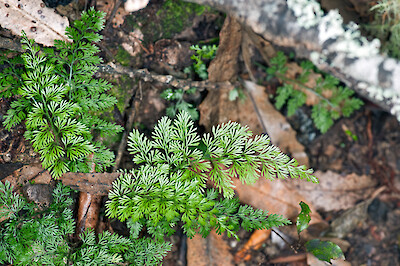
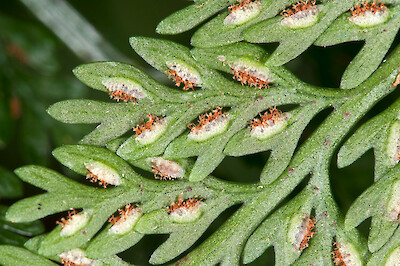
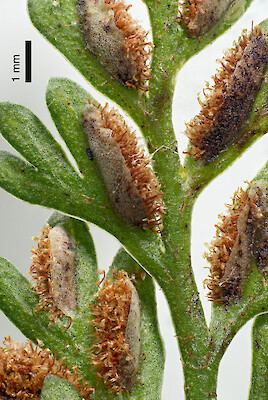
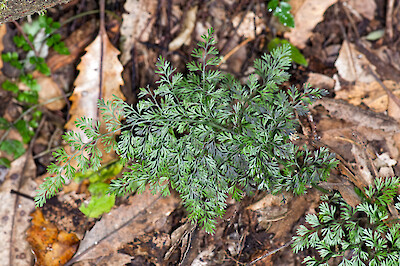
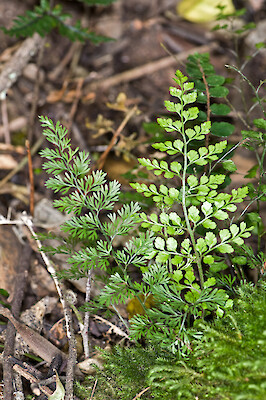
Rhizome short, erect, bearing numerous brown, ovate, acuminate scales up to 10 × 2 mm. Stipes 20–100 mm long, pale brown below, green above, densely covered in small, subulate to narrowly ovate scales with filiform apices. Laminae lanceolate to rhombic, 40–250 × 10–150 mm, dark green, thin, bipinnate to tripinnate in well-grown specimens. Raches green, slender, and very scaly. Pinnae 5–15 pairs, very narrowly ovate, acuminate, long-stalked, 10–80 × 5–20 mm, basal pair pointing upwards when fresh. Pinnules stalked, 3–10 pairs, linear, crenate to deeply incised (or almost pinnate), 3–12 × 3–10 mm, tending to lie at 90° to plane of frond in well-grown specimens. Sori sub-marginal on narrow pinnules, remote from margins on broad segments, 1–3 mm long.
Similar taxa
Closely allied to A. hookerianum Colenso var. hookerianum from which it differs only by its much narrower, linear pinnules. This variety is always found in association with A. hookerianum var. hookerianum.
Distribution
Endemic. New Zealand: North Island, South Island, Stewart Island/Rakiura, Chatham Islands.
Habitat
Coastal to alpine. Usually on shaded clay banks or rocky outcrops in scrub and open forest, or on the ground in disturbed forest remnants.
Detailed taxonomy
Genus
Family
Synonyms
Asplenium colensoi Hook.f.; Asplenium adiantoides var. colensoi Hook. f.; Asplenium richardii var. colensoi Hook.
Taxonomic notes
Asplenium hookerianum var. colensoi is not upheld by Brownsey (1977) who argues that it is merely a state of A. hookerianum var. hookerianum. For the time being the variety is maintained because despite that view many people regard it as distinct. Asplenium hookerianum var. colensoi may perhaps be better treated at the rank of forma.
Endemic taxon
Yes
Endemic genus
No
Endemic family
No
Ecology
Life cycle and dispersal
Minute spores are wind dispersed (Thorsen et al., 2009).
Propagation technique
Easily grown, and an excellent pot plant. However, rather slow growing, and as with all asplenia prone to infestations of scale and mealy bugs.
Other information
Etymology
asplenium: From the Greek a- ‘without’ and splene ‘spleen’, a northern hemisphere species, the black spleenwort (Asplenium adiantum-nigrum), was once believed to be a cure for diseases of the spleen.
hookerianum: Named after Sir Joseph Dalton Hooker (born 1817) - a world famous botanist who travelled on the Antarctic expedition of 1839 under the command of Sir James Ross and wrote “Handbook of New Zealand Flora” published in 1864-67 describing many specimens sent to Kew by collectors. He died in 1911 and has a memorial stone at Westminster Abbey London.
colensoi: Named after William Colenso (7 November 1811 - 10 February 1899) who was a Cornish Christian missionary to New Zealand, and also a printer, botanist, explorer and politician.
NVS code
The National Vegetation Survey (NVS) Databank is a physical archive and electronic databank containing records of over 94,000 vegetation survey plots - including data from over 19,000 permanent plots. NVS maintains a standard set of species code abbreviations that correspond to standard scientific plant names from the Ngä Tipu o Aotearoa - New Zealand Plants database.
ASPHVC
Chromosome number
2n = 144
Previous conservation statuses
The conservation status of all known New Zealand vascular plant taxa at the rank of species and below were reassessed in 2022-2023 using the New Zealand Threat Classification System (NZTCS) – more information about this can be found on the NZTCS website. This report includes replaces all previous NZTCS lists for vascular plants. Previous assessments can be found here.
- Conservation status of vascular plants in Aotearoa New Zealand, 2023. 2024. Peter J. de Lange, Jane Gosden, Shannel P. Courtney, Alexander J. Fergus, John W. Barkla, Sarah M. Beadel, Paul D. Champion, Rowan Hindmarsh-Walls, Troy Makan and Pascale Michel Department of Conservation. Source: NZTCS and licensed by DOC for reuse under the Creative Commons Attribution 4.0 International licence.
2017 | Not Threatened
2012 | Not Threatened
2009 | Not Threatened
2004 | Not Threatened
Regional conservation statuses
Northland: 2026 | Regionally At Risk – Regionally Naturally Uncommon
Current regional threat status assessments prepared according to Crisp et al. (2025) are displayed when available. The Northland conservation status information is sourced from the “Conservation status of indigenous vascular plants in Northland | Taitokerau” Ford et al. 2026 report.
Referencing and citations
References and further reading
Brownsey PJ. 1977. A taxonomic revision of the New Zealand species of Asplenium. New Zealand Journal of Botany 15(1): 39–86. https://doi.org/10.1080/0028825X.1977.10429618.
Attribution
Fact Sheet prepared by P.J. de Lange (6 June 2007). Description based on Brownsey (1977) supplemented with observations of fresh specimens and herbarium material.
NZPCN Fact Sheet citation
Please cite as: de Lange, P.J. (Year at time of access): Asplenium hookerianum var. colensoi Fact Sheet (content continuously updated). New Zealand Plant Conservation Network. https://www.nzpcn.org.nz/flora/species/asplenium-hookerianum-var-colensoi/ (Date website was queried)