
Carex auceps
Common names
Chatham Island bastard grass
Biostatus
Native – Endemic taxon
Current conservation status
The conservation status of all known New Zealand vascular plant taxa at the rank of species and below were reassessed in 2022-2023 using the New Zealand Threat Classification System (NZTCS) – more information about this can be found on the NZTCS website. This report includes replaces all previous NZTCS lists for vascular plants. Previous assessments can be found here.
- Conservation status of vascular plants in Aotearoa New Zealand, 2023. 2024. Peter J. de Lange, Jane Gosden, Shannel P. Courtney, Alexander J. Fergus, John W. Barkla, Sarah M. Beadel, Paul D. Champion, Rowan Hindmarsh-Walls, Troy Makan and Pascale Michel Department of Conservation. Source: NZTCS and licensed by DOC for reuse under the Creative Commons Attribution 4.0 International licence.
2023 | At Risk – Naturally Uncommon | Qualifiers: IE, PD
Category
Vascular
Structural class
Sedges
Simplified description
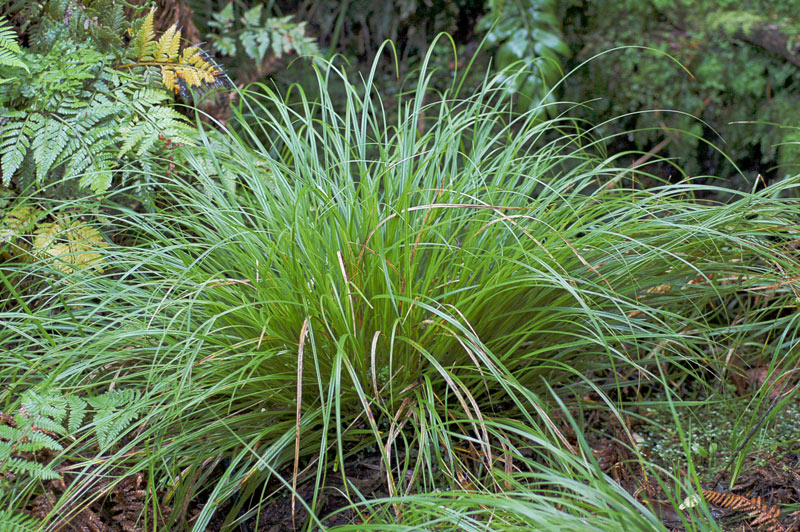
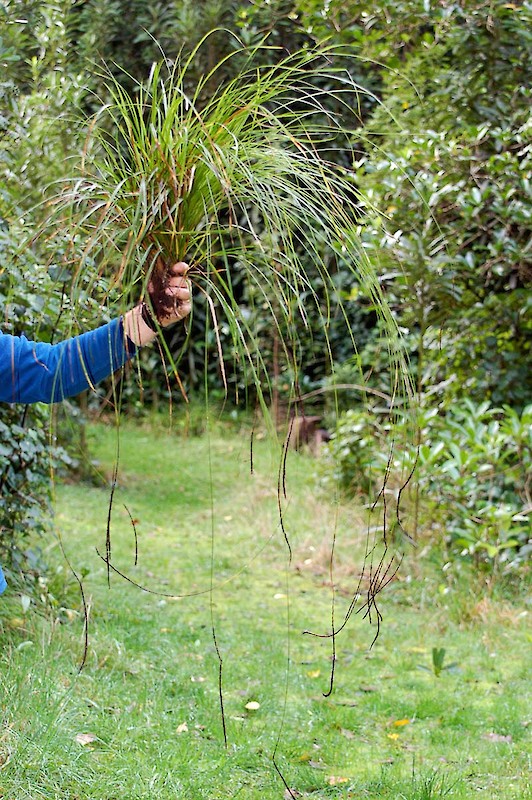
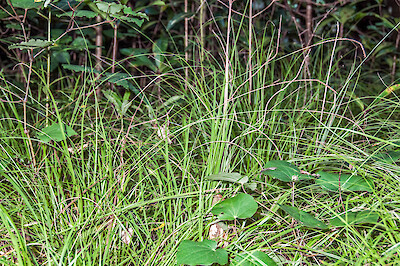
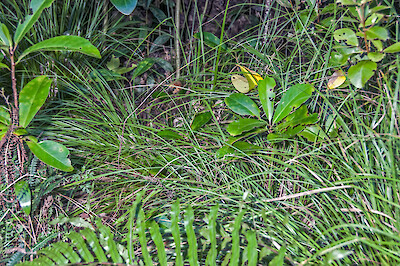
Tufted, tussock-forming, leafy sedge. Fruiting stems when mature, greatly elongated, drooping and long trailing. Inflorescences in many-flowered spikes, mature fruits hooked, basal portion obscured by dark brown scales.
Detailed description
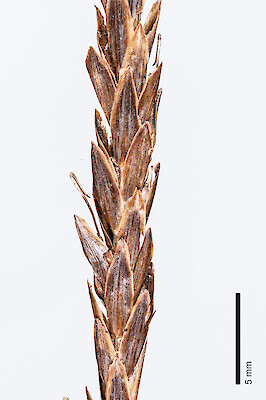
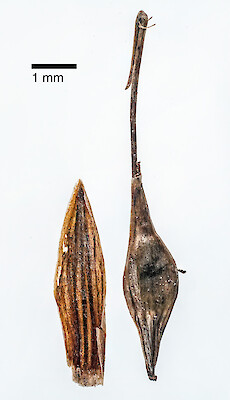
Large, caespitose plants, with shortly spreading, erect rhizomes. Mature culms (0.8)–1.2–2.0 m long, (0.6)–0.8–1.0 mm wide, glabrous, trigonous, greatly exceeding leaves, trailing; leaf sheaths up to 60 mm long, dark brown, prominently and deeply nerved, nerves concolorous with sheath. Leaves 4–12 per culm, 0.48–83 m long, 4.3–6.2 mm wide, deeply channelled, upright to spreading, curved, dark green; adaxial surface scabrid in distal portion, otherwise glabrous; abaxial surface keeled, keel ± scabrid, often diffusely so, sometimes nearly glabrous, rest of surface glabrous margin scabrid, apex acute, trigonous, scabrid. Spikes 90–400 mm long, 3–6 mm wide, linear, often curved and twisted; female florets proximal, 80–420 per spike; internodes up to 7 mm long at base, decreasing to 0.4 mm long (or sometimes less) above; male florets distal, 60–100 or more, imbricate. Spike sometimes subtended by a foliose bract; bract 90–112 mm long, 0.2–1.2 mm wide, capillary, channeled, margins and abaxial midrib scabrid, apex trigonous. Glumes persistent. Male glumes, imbricate, 3.0–5.1 mm long, 1.0–1.8 mm wide, lanceolate, elliptic-lanceolate to narrowly elliptic, dark to light lustrous brown at maturity, midrib prominent, stramineous, with 1 central nerve, apex acute, margins membranous, entire, apices sometimes scabrid to ± lacerate. Filaments 3.6–5.0 mm long, pale brown; anthers, 1.2–1.8 mm long, yellow. Female glumes 3.4–5.3 mm long, 1.0–2.0 mm wide, ± equal in length to utricles, elliptic-lanceolate to narrowly elliptic, dark to light lustrous brown at maturity, midrib prominent, with 1 central nerve, usually concolorous with rest of glume, sometimes stramineous, especially at distal portion of spike, apex acute to subacute, margins membranous, entire; lowest 1–2 glumes sometimes bearing foliose, slender (almost capillary), filiform awns up to 60 mm long, these mostly entire except for scabrid upper abaxial midrib and apex, apex trigonous. Utricles scarcely spreading when ripe, 4.8–5.3 mm long, 1.2–1.4 mm wide, plano-convex to convex, ovoid, glabrous, lustrous brown to dark brown, lateral nerves ± prominent, though not conspicuous, stipe and beak narrow, each 1.0–1.5 mm long; rachilla 7.0–9.2 mm long. Nuts 2.2–2.4 mm long, 1.0–1.2 mm wide, ovoid, light grey to silvery grey, papillate.
Similar taxa
Carex auceps is allied to C. uncinata from which it differs by the greater number of female flowers (up to 400 cf. 120 in C. uncinata), by the persistent glumes persistent, which are equal to or greater in length than utricles, and lastly by the mature fruiting culms which are drooping, and trailing along the ground sometimes up to 2 m from the plant.
Distribution
Endemic. Chatham Islands (Rekohu, Rangiauria, Rangatira).
Habitat
Coastal to lowland forest.
Threats
Although widespread and common in forested areas on the main islands of the Chatham group, the species is only secure within reserved areas. Outside reserves, as forest remnants degrade conditions for the Carex auceps become suboptimal and if this continues then overtime Carex auceps will become less common. Already this is happening in the northern part of Rekohu (Chatham Island) and over much of Rangiauria (Pitt Island). It is for this reason that Carex auceps has been listed as Declining.
Detailed taxonomy
Genus
Family
Synonyms
Uncinia auceps de Lange et Heenan
Endemic taxon
Yes
Endemic genus
No
Endemic family
No
Ecology
Flowering
August–October
Fruiting
January–November
Propagation technique
Easily grown from fresh seed.
Other information
Etymology
carex: Latin name for a species of sedge, now applied to the whole group.
auceps: Derived from the Latin noun for a ‘bird catcher’
Manaaki Whenua Online Interactive Key
NVS code
The National Vegetation Survey (NVS) Databank is a physical archive and electronic databank containing records of over 94,000 vegetation survey plots - including data from over 19,000 permanent plots. NVS maintains a standard set of species code abbreviations that correspond to standard scientific plant names from the Ngä Tipu o Aotearoa - New Zealand Plants database.
CARAUC
Chromosome number
2n = 88
Previous conservation statuses
The conservation status of all known New Zealand vascular plant taxa at the rank of species and below were reassessed in 2022-2023 using the New Zealand Threat Classification System (NZTCS) – more information about this can be found on the NZTCS website. This report includes replaces all previous NZTCS lists for vascular plants. Previous assessments can be found here.
- Conservation status of vascular plants in Aotearoa New Zealand, 2023. 2024. Peter J. de Lange, Jane Gosden, Shannel P. Courtney, Alexander J. Fergus, John W. Barkla, Sarah M. Beadel, Paul D. Champion, Rowan Hindmarsh-Walls, Troy Makan and Pascale Michel Department of Conservation. Source: NZTCS and licensed by DOC for reuse under the Creative Commons Attribution 4.0 International licence.
2017 | At Risk – Declining | Qualifiers: IE, PD
2012 | At Risk – Declining | Qualifiers: IE, PD
Referencing and citations
References and further reading
de Lange PJ, Heenan PB, Rolfe JR. 2013. Uncinia auceps(Cyperaceae): a new endemic hooked sedge for the Chatham Islands. Phytotaxa 104 (1): 12–20. doi: 10.11646/phytotaxa.104.12
Attribution
P.J. de Lange (14 August 2013). Description from de Lange et al. (2013).
NZPCN Fact Sheet citation
Please cite as: de Lange, P.J. (Year at time of access): Carex auceps Fact Sheet (content continuously updated). New Zealand Plant Conservation Network. https://www.nzpcn.org.nz/flora/species/carex-auceps/ (Date website was queried)