
Celmisia major var. brevis
Common names
Egmont mountain daisy
Biostatus
Native – Endemic taxon
Current conservation status
The conservation status of all known New Zealand vascular plant taxa at the rank of species and below were reassessed in 2022-2023 using the New Zealand Threat Classification System (NZTCS) – more information about this can be found on the NZTCS website. This report includes replaces all previous NZTCS lists for vascular plants. Previous assessments can be found here.
- Conservation status of vascular plants in Aotearoa New Zealand, 2023. 2024. Peter J. de Lange, Jane Gosden, Shannel P. Courtney, Alexander J. Fergus, John W. Barkla, Sarah M. Beadel, Paul D. Champion, Rowan Hindmarsh-Walls, Troy Makan and Pascale Michel Department of Conservation. Source: NZTCS and licensed by DOC for reuse under the Creative Commons Attribution 4.0 International licence.
2023 | At Risk – Naturally Uncommon | Qualifiers: OL
Category
Vascular
Structural class
Herbs - Dicotyledonous composites
Flower colours
White, Yellow
Detailed description
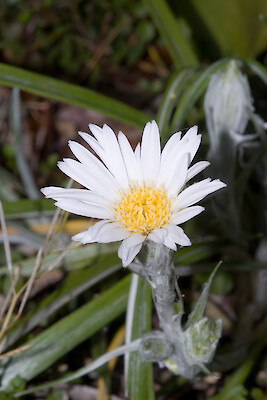
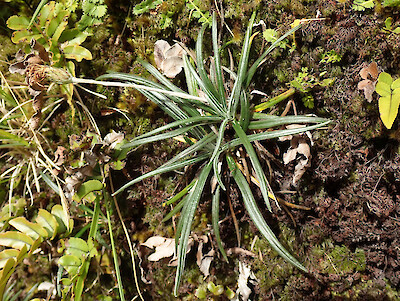
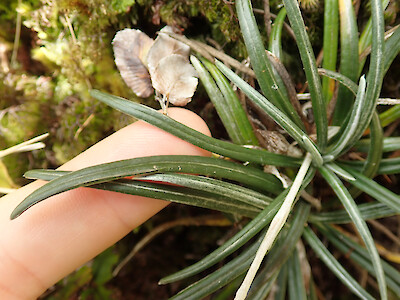
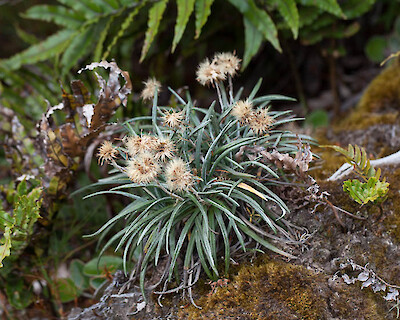
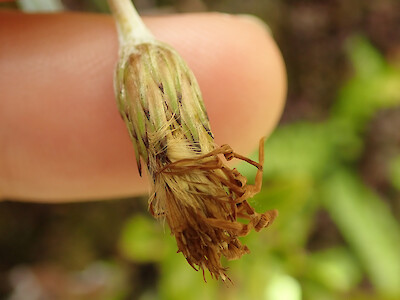
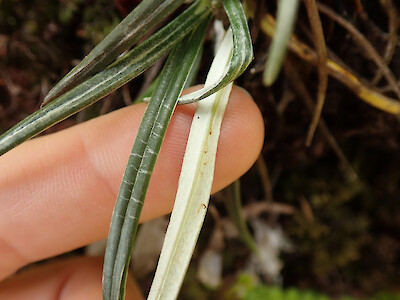
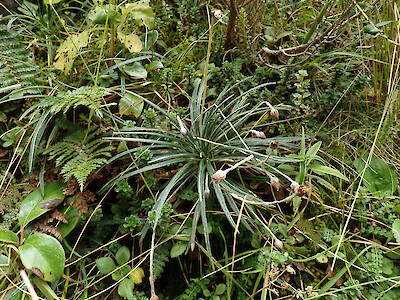
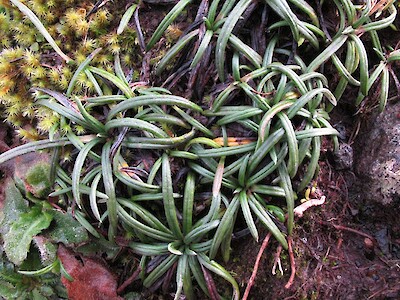
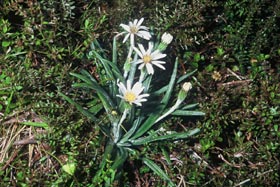
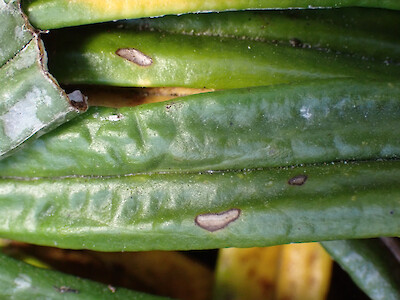
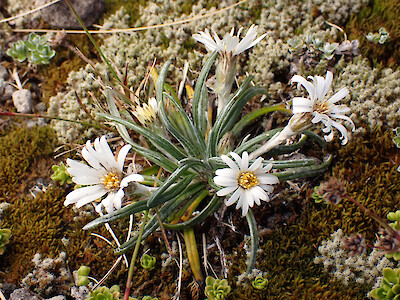
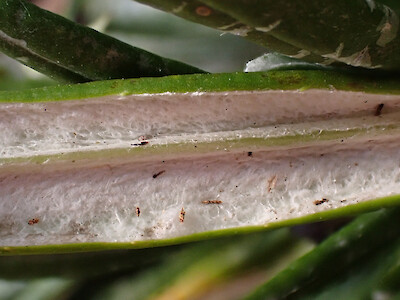
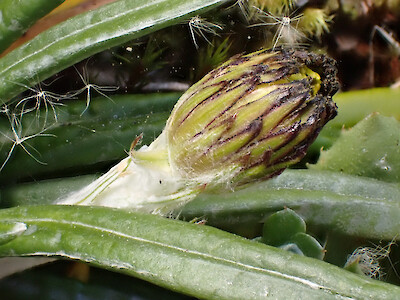
Herb with tufted leaves arising from simple to multicipital stock, pseudo-stem ± 300 mm long. Lamina 100-150 × 5-16 mm; narrow-linear tapering regularly from sheath to acute apex, coriaceous; upper surface dark silvery green to grey-green clad in thin pellicle (thicker towards base), sulcate; lower densely clad in silvery white satiny appressed tomentum, midrib evident; margins distinctly recurved. Sheath pale, thin, c. 30 mm long, nerves evident, margins ± densely clad in floccose hairs in upper part. Scape stout up to ± 200 mm long, pellicled to subfloccose; bracts ascending, lamina almost filiform up to 25 mm long, tomentum as in leaves; uppermost bracts on weakly developed into a pseudo-involucre. Capitula 20-40 mm diameter; involucral bracts linear-subulate acuminate, ciliate, glabrous on surfaces, 8.9-10.8 mm long with dark apices. Ray-florets numerous, up to 13 mm long, tube very slender, limb gradually widening to apex. Disk-florets narrow-funnelform, c. 7 mm long, teeth narrow-triangular. Achenes narrow-cylindric, grooved, glab. or very nearly so, c. 6-7 mm long. Pappus-hairs white, very slender, hardly barbellate, up to 7 mm long.
Similar taxa
Part of a widespread complex of ill-resolved taxa that seem to grade between Celmisia graclienta at one end and C. graminifolia at the other. Celmisia graclienta var. brevis differs from var. major by its smaller over all size, more open and more weakly developed pseudo-involucre, and its restriction to subalpine and alpine habitats on Mt Egmont. See comments for Celmisia adamsii var. adamsii, C. adamsii var. rugulosa and C. major var. major.
Distribution
Endemic. North Island: Mt Egmont (Taranaki).
Habitat
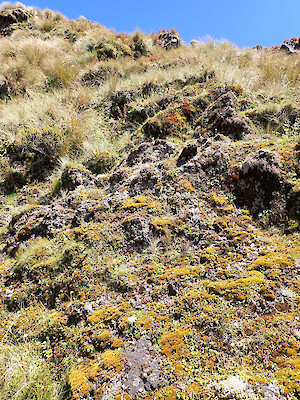
Subalpine and alpine herbfield.
Threats
A naturally uncommon, range restricted plant that is abundant within its only known location of Mt Egmont National Park.
Detailed taxonomy
Genus
Family
Synonyms
None (described in 1961)
Endemic taxon
Yes
Endemic genus
No
Endemic family
No
Ecology
Flowering
October - February
Fruiting
November - April
Propagation technique
Easily grown from fresh seed. One of the few Celmisia that adapts well to cultivation. Does best in a semi-shaded site in a moist, free draining soil. Dislikes humidity and inclined to be short-lived.
Other information
Where To Buy
Not commercially available.
Etymology
celmisia: Apparently named after Kelmis, one of Idaean Dactyls, a group of skilled mythical beings associated with the Mother Goddess Rhea in Greek mythology. Kelmis, whose name means ‘casting’, was a blacksmith and childhood friend of Zeus, son of Rhea and later king of the gods. In Ovid’s ‘Metamorphoses’, Kelmis is described as offending Zeus who turned him into adamant so he was as hard as a tempered blade
major: Greater
brevis: Short
Manaaki Whenua Online Interactive Key
NVS code
The National Vegetation Survey (NVS) Databank is a physical archive and electronic databank containing records of over 94,000 vegetation survey plots - including data from over 19,000 permanent plots. NVS maintains a standard set of species code abbreviations that correspond to standard scientific plant names from the Ngä Tipu o Aotearoa - New Zealand Plants database.
CELMVB
Chromosome number
2n = 108
Previous conservation statuses
The conservation status of all known New Zealand vascular plant taxa at the rank of species and below were reassessed in 2022-2023 using the New Zealand Threat Classification System (NZTCS) – more information about this can be found on the NZTCS website. This report includes replaces all previous NZTCS lists for vascular plants. Previous assessments can be found here.
- Conservation status of vascular plants in Aotearoa New Zealand, 2023. 2024. Peter J. de Lange, Jane Gosden, Shannel P. Courtney, Alexander J. Fergus, John W. Barkla, Sarah M. Beadel, Paul D. Champion, Rowan Hindmarsh-Walls, Troy Makan and Pascale Michel Department of Conservation. Source: NZTCS and licensed by DOC for reuse under the Creative Commons Attribution 4.0 International licence.
2017 | At Risk – Naturally Uncommon | Qualifiers: OL
2012 | At Risk – Naturally Uncommon | Qualifiers: OL
2009 | At Risk – Naturally Uncommon | Qualifiers: OL
2004 | Range Restricted
Referencing and citations
References and further reading
Allan HH. 1961. Flora of New Zealand, Volume I. Indigenous Tracheophyta: Psilopsida, Lycopsida, Filicopsida, Gymnospermae, Dicotyledones. Government Printer, Wellington, NZ. 1085 p.
Attribution
Fact Sheet prepared by P.J. de Lange (1 February 2009). Description adapted from Allan (1961).
Some of this factsheet information is derived from Flora of New Zealand Online and is used under a Creative Commons Attribution 3.0 New Zealand licence.