
Coprosma macrocarpa subsp. macrocarpa


Common names
large-seeded coprosma
Biostatus
Native – Endemic taxon
Current conservation status
The conservation status of all known New Zealand vascular plant taxa at the rank of species and below were reassessed in 2022-2023 using the New Zealand Threat Classification System (NZTCS) – more information about this can be found on the NZTCS website. This report includes replaces all previous NZTCS lists for vascular plants. Previous assessments can be found here.
- Conservation status of vascular plants in Aotearoa New Zealand, 2023. 2024. Peter J. de Lange, Jane Gosden, Shannel P. Courtney, Alexander J. Fergus, John W. Barkla, Sarah M. Beadel, Paul D. Champion, Rowan Hindmarsh-Walls, Troy Makan and Pascale Michel Department of Conservation. Source: NZTCS and licensed by DOC for reuse under the Creative Commons Attribution 4.0 International licence.
2023 | At Risk – Naturally Uncommon | Qualifiers: CD, IE
Category
Vascular
Structural class
Trees & Shrubs - Dicotyledons
Simplified description
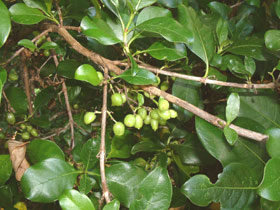
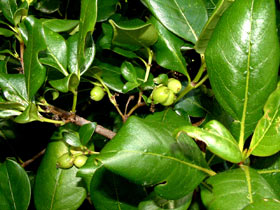
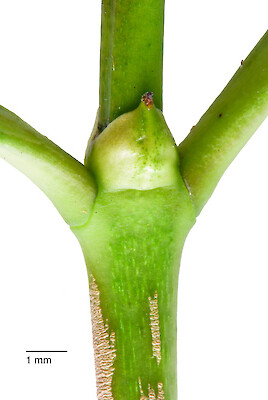
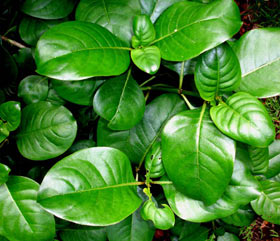
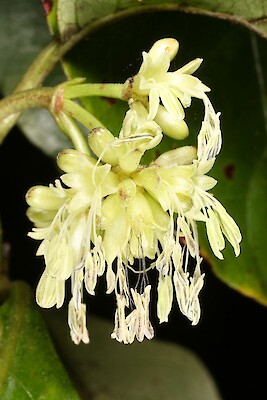
Large shrub with pairs of glossy dark green leaves inhabiting the Three Kings Islands. Leaves large, 9-13cm long, leaf surface bulging. Small papery sheath on stem between the base of the pairs of leaves. Fruit orange, clustered on short stems.
Flower colours
Green
Detailed description
Dioecious. Shrub or tree up to 5-(10) metres tall. Branches and branchlets stout, glabrous. Petioles stout more or less 12-25 mm long. Stipules connate into broad membranous sheath tipped by long sharp denticle. Leaves approximately 90-130 × 40-80 mm, subcoriaceous, broad- to elliptic-ovate, obtuse or subacute to mucronulate, midrib prominent, secondary veins and reticulations evident. Male flowers in compound glomerules on axillary peduncles 10-15 mm long, calyx-teeth minute, corolla approximately 9 mm long, subcampanulate, lobes ovate-triangular, acute, shorter than corolla tube. Female flowers 2-5 together, on simple or branched peduncles 20-70 mm. long, calyx-teeth acute, corolla tubular, widening above, lobes acute 1.3mm long, shorter than corolla tube, 4.5 mm long, stigma 14 × 0.6 mm, ovary 1.3mm diameter. Drupe orange-red, 17 × 12 mm, oblong. Seeds 2, pyrene, 9 × 6 mm, in cross-section roughly semilunar with distinctive undulating curved surface which includes longitudinal ridges.
Similar taxa
Most similar to Coprosma macrocarpa ssp. minor, in which the leaves are very similar but are papery (chartaceous) versus leathery(coriaceous). The female flowers if present may be differentiated (from C. macrocarpa ssp. macrocarpa) as they have several differences ovary 3 mm diameter (1.3 mm), corolla lobe 3 mm (1.3 mm), if present the fruit can also be used 7 × 6 mm (17 × 12 mm), pyrene 6.5 × 3.5 mm (9 × 6 mm). C. macrocarpa ssp. minor is not naturally found on the Manawatāwhi | Three Kings Islands.
Distribution
Endemic. Confined to the Three Kings Islands. A single specimen found on Aorangi Island (Poor Knights) may be a recent introduction from the adjacent mainland, as this plant is now commonly cultivated in northern New Zealand. Naturalised in Auckland and around Wellington cities
Habitat
Forest to scrub, gullies, above streams.
Threats
A local endemic, common on but confined to the Three Kings Islands. A single record from the Poor Knights Islands is probably a chance naturalisation from the nearby mainland where it is now commonly cultivated
Detailed taxonomy
Genus
Family
Endemic taxon
Yes
Endemic genus
No
Endemic family
No
Ecology
Flowering
May? – July(-September?)
Fruiting
August? – February?
Life cycle and dispersal
Fleshy drupes are dispersed by frugivory (Thorsen et al., 2009).
Other information
Where To Buy
Commonly sold by most retail plant nurseries
Etymology
coprosma: From the Greek kopros ‘dung’ and osme ‘smell’, referring to the foul smell of the species, literally ‘dung smell’
macrocarpa: Large fruit
Manaaki Whenua Online Interactive Key
NVS code
The National Vegetation Survey (NVS) Databank is a physical archive and electronic databank containing records of over 94,000 vegetation survey plots - including data from over 19,000 permanent plots. NVS maintains a standard set of species code abbreviations that correspond to standard scientific plant names from the Ngä Tipu o Aotearoa - New Zealand Plants database.
COPMCM
Chromosome number
2n = 44
Previous conservation statuses
The conservation status of all known New Zealand vascular plant taxa at the rank of species and below were reassessed in 2022-2023 using the New Zealand Threat Classification System (NZTCS) – more information about this can be found on the NZTCS website. This report includes replaces all previous NZTCS lists for vascular plants. Previous assessments can be found here.
- Conservation status of vascular plants in Aotearoa New Zealand, 2023. 2024. Peter J. de Lange, Jane Gosden, Shannel P. Courtney, Alexander J. Fergus, John W. Barkla, Sarah M. Beadel, Paul D. Champion, Rowan Hindmarsh-Walls, Troy Makan and Pascale Michel Department of Conservation. Source: NZTCS and licensed by DOC for reuse under the Creative Commons Attribution 4.0 International licence.
2017 | At Risk – Naturally Uncommon | Qualifiers: CD, IE
2012 | At Risk – Naturally Uncommon | Qualifiers: CD, IE
2009 | At Risk – Naturally Uncommon | Qualifiers: IE
2004 | Range Restricted
Regional conservation statuses
Northland: 2026 | Regionally At Risk – Regionally Naturally Uncommon
Current regional threat status assessments prepared according to Crisp et al. (2025) are displayed when available. The Northland conservation status information is sourced from the “Conservation status of indigenous vascular plants in Northland | Taitokerau” Ford et al. 2026 report.
Referencing and citations
References and further reading
Thorsen, M. J.; Dickinson, K. J. M.; Seddon, P. J. 2009. Seed dispersal systems in the New Zealand flora. Perspectives in Plant Ecology, Evolution and Systematics 11: 285-309
Allan HH. 1961. Flora of New Zealand, Volume I. Indigenous Tracheophyta: Psilopsida, Lycopsida, Filicopsida, Gymnospermae, Dicotyledones. Government Printer, Wellington, NZ. 1085 p.
Cheeseman TF. 1887. notes on the Three Kings Islands. Transactions and Proceedings of the Royal Society of New Zealand, Volume 20, 141-150.
Gardner R. & Heads M. 2003. Coprosma macrocarpa subsp. minor (Rubiaceae), a new subspecies from northern New Zealand. New Zealand Natural Sciences Journal, 28:67-80.
Attribution
Fact sheet prepared for NZPCN by MD Ward (December 17th 2025). Description adapted from Allan (1961) & Gardner 2003
Some of this factsheet information is derived from Flora of New Zealand Online and is used under a Creative Commons Attribution 3.0 New Zealand licence.