
Disphyma australe subsp. stricticaule
Common names
Kermadec Ice plant
Biostatus
Native – Endemic taxon
Current conservation status
The conservation status of all known New Zealand vascular plant taxa at the rank of species and below were reassessed in 2022-2023 using the New Zealand Threat Classification System (NZTCS) – more information about this can be found on the NZTCS website. This report includes replaces all previous NZTCS lists for vascular plants. Previous assessments can be found here.
- Conservation status of vascular plants in Aotearoa New Zealand, 2023. 2024. Peter J. de Lange, Jane Gosden, Shannel P. Courtney, Alexander J. Fergus, John W. Barkla, Sarah M. Beadel, Paul D. Champion, Rowan Hindmarsh-Walls, Troy Makan and Pascale Michel Department of Conservation. Source: NZTCS and licensed by DOC for reuse under the Creative Commons Attribution 4.0 International licence.
2023 | At Risk – Naturally Uncommon | Qualifiers: IE
Category
Vascular
Structural class
Herbs - Dicotyledons other than Composites
Flower colours
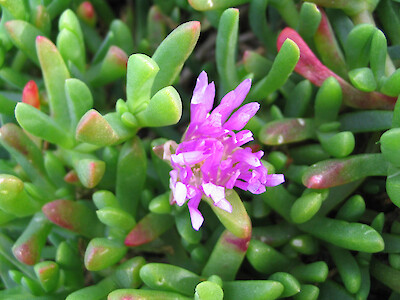
Violet/Purple, White
Detailed description
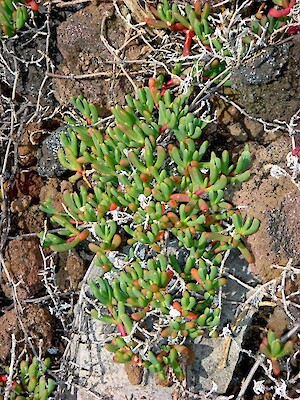
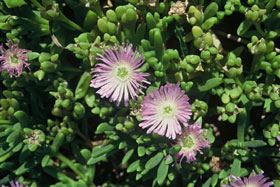
Trailing, succulent herb. Stem terete, glabrous. Short shoots erect or nearly so, rarely rooting at nodes. Leaves 3-angled, linear-lanceolate to oblong, acute, often mucronate, tapering to connate base, 6–40 × 4–9 mm; margins papillate. Flowers 20–40 cmm diameter. Sepal keel papillate. Petals uniformly white to deep pink, in 3–5 rows, 10–30 mm long. Stamens 4–6 mm long; inner filaments hairy at base. Stigmas (5)–6–8–(10). Capsule valves 5–(6), with parallel or ± divergent expanding keels; placental tubercle rounded or 0. Seeds brown, obovoid, rugose, c. 1 mm long.
Similar taxa
Distinguished from the other New Zealand species except the Chatham Island endemic D. papillatum Chinnock, by the leaf margin and sepal keel papillate, by the short shoots mostly ascending, rarely rooting at nodes, and by the 5 rarely 6 capsule valves. From D. papillatum it differs by its ascending short shoots, which rarely root at the nodes, terete rather than 2-angular, smooth rather than papillate stems, absence of a placental tubercle, and weakly rugose rather than papillate seeds.
Distribution
Endemic. New Zealand: Kermadec Islands.
Habitat
Coastal. On rock stacks, cliff faces, banks, cobble and boulder beaches, or in the vicinity of bird nesting grounds. Widespread and common.
Threats
Not threatened within its small geographic range
Detailed taxonomy
Genus
Family
Synonyms
None
Endemic taxon
Yes
Endemic genus
No
Endemic family
No
Ecology
Flowering
Throughout the year
Fruiting
Throughout the year
Propagation technique
Easy from rooted pieces. Does best in a well drained fertile soil in full sun.
Wetland plant indicator status rating
Information derived from the revised national wetland plant list prepared to assist councils in delineating and monitoring wetlands (Clarkson et al., 2021 Manaaki Whenua – Landcare Research Contract Report LC3975 for Hawke’s Bay Regional Council). The national plant list categorises plants by the extent to which they are found in wetlands and not ‘drylands’. The indicator status ratings are OBL (obligate wetland), FACW (facultative wetland), FAC (facultative), FACU (facultative upland), and UPL (obligate upland). If you have suggestions for the Wetland Indicator Status Rating, please contact: [Enable JavaScript to view protected content]
UPL: Obligate Upland
Rarely is a hydrophyte, almost always in uplands (non-wetlands).
Other information
Etymology
disphyma: Two-nodule
australe: Southern, from the Latin australis
NVS code
The National Vegetation Survey (NVS) Databank is a physical archive and electronic databank containing records of over 94,000 vegetation survey plots - including data from over 19,000 permanent plots. NVS maintains a standard set of species code abbreviations that correspond to standard scientific plant names from the Ngä Tipu o Aotearoa - New Zealand Plants database.
DISASS
Chromosome number
2n = 36
Previous conservation statuses
The conservation status of all known New Zealand vascular plant taxa at the rank of species and below were reassessed in 2022-2023 using the New Zealand Threat Classification System (NZTCS) – more information about this can be found on the NZTCS website. This report includes replaces all previous NZTCS lists for vascular plants. Previous assessments can be found here.
- Conservation status of vascular plants in Aotearoa New Zealand, 2023. 2024. Peter J. de Lange, Jane Gosden, Shannel P. Courtney, Alexander J. Fergus, John W. Barkla, Sarah M. Beadel, Paul D. Champion, Rowan Hindmarsh-Walls, Troy Makan and Pascale Michel Department of Conservation. Source: NZTCS and licensed by DOC for reuse under the Creative Commons Attribution 4.0 International licence.
2017 | At Risk – Naturally Uncommon | Qualifiers: IE
2012 | At Risk – Naturally Uncommon | Qualifiers: IE, RR
2009 | At Risk – Naturally Uncommon | Qualifiers: OL, IE
2004 | Range Restricted
Referencing and citations
References and further reading
Webb CJ, Sykes WR, Garnock-Jones PJ. 1988. Flora of New Zealand, Volume IV. Naturalised Pteridophytes, Gymnosperms, Dicotyledons. Botany Division, Department of Scientific and Industrial Research, Christchurch, NZ. 1365 p.
Attribution
Description modified from Webb et al. (1988)
Some of this factsheet information is derived from Flora of New Zealand Online and is used under a Creative Commons Attribution 3.0 New Zealand licence.