
Homalanthus polyandrus
Common names
Kermadec poplar
Biostatus
Native – Endemic taxon
Current conservation status
The conservation status of all known New Zealand vascular plant taxa at the rank of species and below were reassessed in 2022-2023 using the New Zealand Threat Classification System (NZTCS) – more information about this can be found on the NZTCS website. This report includes replaces all previous NZTCS lists for vascular plants. Previous assessments can be found here.
- Conservation status of vascular plants in Aotearoa New Zealand, 2023. 2024. Peter J. de Lange, Jane Gosden, Shannel P. Courtney, Alexander J. Fergus, John W. Barkla, Sarah M. Beadel, Paul D. Champion, Rowan Hindmarsh-Walls, Troy Makan and Pascale Michel Department of Conservation. Source: NZTCS and licensed by DOC for reuse under the Creative Commons Attribution 4.0 International licence.
2023 | At Risk – Naturally Uncommon | Qualifiers: IE
Category
Vascular
Structural class
Trees & Shrubs - Dicotyledons
Simplified description
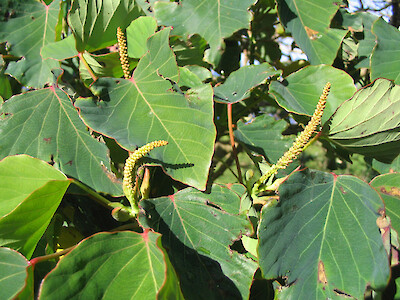
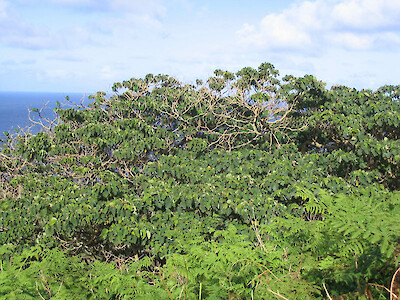
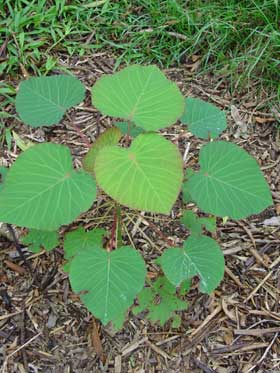
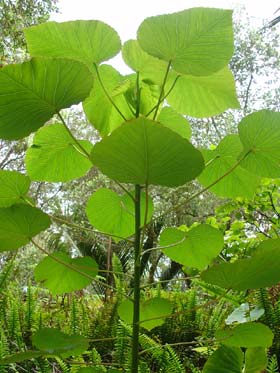
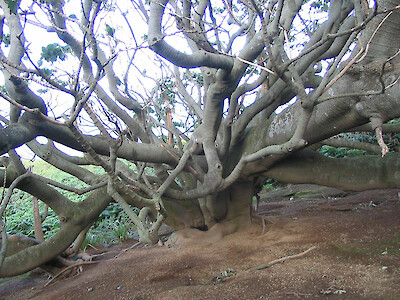
Broad small tree bearing thin wide triangular leaves inhabiting the Kermadec Islands. Twigs bleed white sap. Leaves 5-10cm long, as wide as long, on long stalk to 10cm long. Flowers in a green long spike. Fruit purple with white lines that split to reveal wrinkled yellow seeds.
Detailed description
Small, glabrous tree up to 10 m tall. Branches and branchlets slender, rather brittle, terete in cross-section, initially slightly ribbed, leaf-scars prominent. Leaves adaxially dark or bright-green to yellow-green above, sometimes suffused with red (especially new growth), abaxially subglaucous, membranous, stipulate, stipules } 20 mm long, caducous; juvenile lamina up to 300 mm diameter, broadly ovate, truncate or cordate at base, rarely perfoliate, adult lamina 30-200 diameter, usually rather broad-ovate to subrhombic, abruptly narrowed to acute or acuminate apex, cuneate to truncate at base; petioles > or } = to blade. Inflorescences terminal on new growth, racemose. Racemes slender up to 200 mm long, usually with a few solitary long-pedicellate Š flowers below or at base and many solitary short-pedicellate ‰ flowers above (racemes occasionally unisexual); each flower subtended by a caducous, glandular bract and 2 prominent glands at the base of the pedicel Male flowers bearing c.30-35 close-set stamens; perianth segments 1. Female flowers tri-locular with 3 styles, stigma capitate. Fruit } smooth, coriaceous, 3-angled, reddish, 10-12 mm diameter. Seed elliptic, oblong-elliptic or more irregular, terete or somewhat compressed, (2.3-)3.0 - 4.8 mm long, almost entirely covered with a yellowish aril.
Similar taxa
None in the wild. However has often been confused with the naturalised and very weedy Homalanthus populifolius Graham. From that species is differs by the male flowers which are solitary rather than clusters along the raceme, and female flowers which are tri rather than bi-locular and which have 3 rather than 2 styles.
Distribution
Endemic. Kermadec Island group, Raoul and Macauley Islands
Habitat
A successional species of coastal scrub, forest and upland forest, where it usually forms the understorey or is a sporadic emergent. Sometimes, as on old slip scars, it may form the main canopy.
Threats
Formerly seriously threatened with extinction due to feral goats and regarded as extinct on Macauley Island, this species has made a spectacular recovery following the successful goat eradication on Raoul Island (the last goat was shot there in 1986). Homalanthus is now widespread and no longer regarded as threatened. In 2006 it was rediscovered on Macauley Island - though whether this was the original tree seen by Cheeseman or a new arrival is unclear. The species is now listed only because it is still a naturally uncommon, range restricted endemic.
Detailed taxonomy
Genus
Family
Synonyms
Homalanthus polyandrus (Hook.f.) Cheeseman comb. et nom. superf.; Carumbium polyandrum Hook.f. ex Müll.Arg.; Carumbium polyandrum Hook.f. nom. inval.
Taxonomic notes
For the authority citation see Mueller (1864)
Endemic taxon
Yes
Endemic genus
No
Endemic family
No
Ecology
Flowering
Throughout the year
Fruiting
Throughout the year
Life cycle and dispersal
Arrilate seeds are dispersed by frugivory (Thorsen et al., 2009).
Propagation technique
Easily grown from fresh seed and cuttings, and often naturalises where it has been planted. However, extremely cold sensitive and will not tolerant even a slight frost. Best grown in a warm, sheltered site.
Other information
NVS code
The National Vegetation Survey (NVS) Databank is a physical archive and electronic databank containing records of over 94,000 vegetation survey plots - including data from over 19,000 permanent plots. NVS maintains a standard set of species code abbreviations that correspond to standard scientific plant names from the Ngä Tipu o Aotearoa - New Zealand Plants database.
HOMPOL
Chromosome number
2n = 64
Previous conservation statuses
The conservation status of all known New Zealand vascular plant taxa at the rank of species and below were reassessed in 2022-2023 using the New Zealand Threat Classification System (NZTCS) – more information about this can be found on the NZTCS website. This report includes replaces all previous NZTCS lists for vascular plants. Previous assessments can be found here.
- Conservation status of vascular plants in Aotearoa New Zealand, 2023. 2024. Peter J. de Lange, Jane Gosden, Shannel P. Courtney, Alexander J. Fergus, John W. Barkla, Sarah M. Beadel, Paul D. Champion, Rowan Hindmarsh-Walls, Troy Makan and Pascale Michel Department of Conservation. Source: NZTCS and licensed by DOC for reuse under the Creative Commons Attribution 4.0 International licence.
2017 | At Risk – Naturally Uncommon | Qualifiers: IE
2012 | At Risk – Naturally Uncommon | Qualifiers: IE, RR
2009 | At Risk – Naturally Uncommon | Qualifiers: OL
2004 | Range Restricted
Referencing and citations
References and further reading
Müller Argoviensis, J. 1864 (3. September): Neue Euphorbiaceen des Herbarium Hooker in Kew, auszugsweise vorläufig mitgeteilt aus dem Manuscript für De Candolles Prodromus. Flora, oder Allgemeine Botanische Zeitung 47(28): 433.
Thorsen, M. J.; Dickinson, K. J. M.; Seddon, P. J. 2009. Seed dispersal systems in the New Zealand flora. Perspectives in Plant Ecology, Evolution and Systematics 11: 285-309
Attribution
For the authority citation see Mueller (1864)
NZPCN Fact Sheet citation
Please cite as: de Lange, P.J. (Year at time of access): Homalanthus polyandrus Fact Sheet (content continuously updated). New Zealand Plant Conservation Network. https://www.nzpcn.org.nz/flora/species/homalanthus-polyandrus/ (Date website was queried)