
Macrothelypteris torresiana
Biostatus
Native
Current conservation status
The conservation status of all known New Zealand vascular plant taxa at the rank of species and below were reassessed in 2022-2023 using the New Zealand Threat Classification System (NZTCS) – more information about this can be found on the NZTCS website. This report includes replaces all previous NZTCS lists for vascular plants. Previous assessments can be found here.
- Conservation status of vascular plants in Aotearoa New Zealand, 2023. 2024. Peter J. de Lange, Jane Gosden, Shannel P. Courtney, Alexander J. Fergus, John W. Barkla, Sarah M. Beadel, Paul D. Champion, Rowan Hindmarsh-Walls, Troy Makan and Pascale Michel Department of Conservation. Source: NZTCS and licensed by DOC for reuse under the Creative Commons Attribution 4.0 International licence.
2023 | At Risk – Naturally Uncommon | Qualifiers: EF, SO, Sp
Category
Vascular
Structural class
Ferns
Detailed description
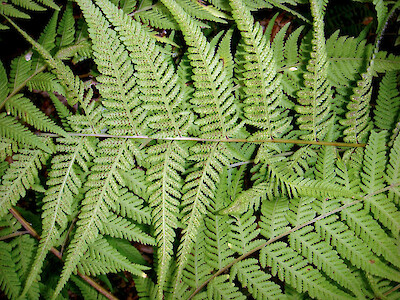
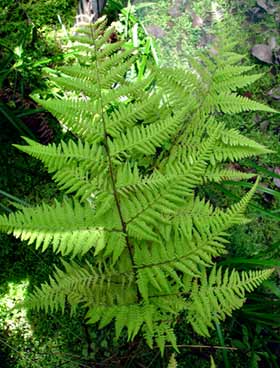
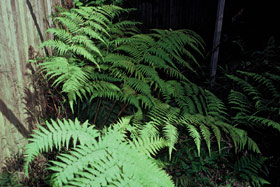
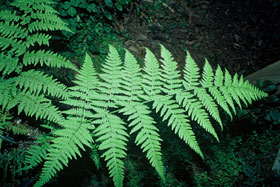
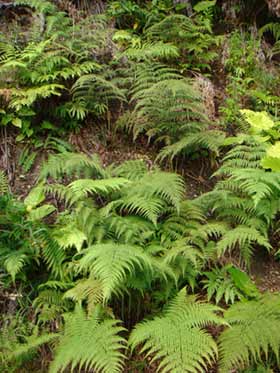
Tufted, often stout yellow-green to blue-green fern up to 2 m tall in good conditions. Stipes to 0.8 m, glaucescent when fresh, basally swollen and covered in scales, glabrate to glabrous otherwise. Frond laminae broadly ovate, 2–3-pinnate, up to 1.2 × 0.8 m, light green, yellow-green to blue-green and very soft when fresh. Primary pinnae 200–400 × 70–130 mm, tapering apices, shortly stalked. Ultmate segments oblong, obtuse, bearing numerous, fine, 1–1.2 mm long, non-glandular, whitish hairs. Indusia sparsely covered with short, glandular hairs.
Similar taxa
Very distinctive and unique within the Thelypetridaceae due to is 2–3-pinnate fronds covered in long non-glandular hairs. Within the New Zealand fern flora it is most likely to be confused with Hypolepis dicksonioides (Endl.) Hook., plants of which have a somewhat similar frond shape and growth habit but which can be distinguished immediately from M. torresiana by their green to yellow-green, never blue-green fronds copiously covered in glandular sticky hairs, and absence of an indusia.
Distribution
Indigenous. New Zealand: Kermadec Islands (Raoul Island), North Island (Hikurua / de Surville Cliffs, North Cape). Widespread in the old world tropics from Madagascar, northern and north-eastern Australia, across the Pacific to Hawaii and the Marquesas. New Zealand would appear to be its world southern limit.
Habitat
A weedy, short-lived, opportunistic species colonising recently disturbed ground such as slip scars, debris flows, landslides, the ground around tree falls, and exposed clay banks, roadside cuttings and the margins of ditches.
Threats
Not Threatened. This species reaches its world southern limit in New Zealand. On the Kermadec Islands it is known only from Raoul Island where its abundance depends largely on the presence of suitably disturbed habitats. This fern is a short-lived, somewhat weedy, opportunist which colonises recently disturbed ground. Provided such habitats are created it is usually present but its abundance always varies. Little is known about its status at the North Cape Scienitific Reserve, Te Paki.
Detailed taxonomy
Genus
Family
Synonyms
Thelypteris uliginosa (Kunze) Ching; Thelypteris torresiana (Gaudich.) Alston; Lastrea torresiana (Gaudich.) T.Moore; Nephrodium setigerum sensu Cheeseman; Polystichum torresianum Gaudich. in Freyc.; Aspidium uliginosum Kunze; Dryopteris setigera sensu Cheeseman; Dryopteris uliginosa (Kunze) C.Chr.
Endemic taxon
No
Endemic genus
No
Endemic family
No
Ecology
Propagation technique
Extremely easy from fresh spore and in ideal conditions it can be rather weedy, often self sowing and establishing itself within urban gardens. Plants tend to be short lived and are very cold sensitive. In Auckland plants have established in the grounds of the University of Auckland, usually on pots or in pots holding other plants. These plants die back in winter but if well established enough resprout when warmer conditions return.
Other information
Chromosome number
2n = 124
Previous conservation statuses
The conservation status of all known New Zealand vascular plant taxa at the rank of species and below were reassessed in 2022-2023 using the New Zealand Threat Classification System (NZTCS) – more information about this can be found on the NZTCS website. This report includes replaces all previous NZTCS lists for vascular plants. Previous assessments can be found here.
- Conservation status of vascular plants in Aotearoa New Zealand, 2023. 2024. Peter J. de Lange, Jane Gosden, Shannel P. Courtney, Alexander J. Fergus, John W. Barkla, Sarah M. Beadel, Paul D. Champion, Rowan Hindmarsh-Walls, Troy Makan and Pascale Michel Department of Conservation. Source: NZTCS and licensed by DOC for reuse under the Creative Commons Attribution 4.0 International licence.
2017 | At Risk – Naturally Uncommon | Qualifiers: EF, SO, Sp
2012 | At Risk – Naturally Uncommon | Qualifiers: EF, SO, Sp
2009 | At Risk – Naturally Uncommon | Qualifiers: SO, EF
2004 | Sparse
Regional conservation statuses
Northland: 2026 | Regionally Extirpated | Qualifiers: OL
Current regional threat status assessments prepared according to Crisp et al. (2025) are displayed when available. The Northland conservation status information is sourced from the “Conservation status of indigenous vascular plants in Northland | Taitokerau” Ford et al. 2026 report.
Referencing and citations
Attribution
Fact sheet prepared by P.J. de Lange for NZPCN (1 June 2013)
NZPCN Fact Sheet citation
Please cite as: de Lange, P.J. (Year at time of access): Macrothelypteris torresiana Fact Sheet (content continuously updated). New Zealand Plant Conservation Network. https://www.nzpcn.org.nz/flora/species/macrothelypteris-torresiana/ (Date website was queried)