
Myosotis bryonoma
Biostatus
Native – Endemic taxon
Current conservation status
The conservation status of all known New Zealand vascular plant taxa at the rank of species and below were reassessed in 2022-2023 using the New Zealand Threat Classification System (NZTCS) – more information about this can be found on the NZTCS website. This report includes replaces all previous NZTCS lists for vascular plants. Previous assessments can be found here.
- Conservation status of vascular plants in Aotearoa New Zealand, 2023. 2024. Peter J. de Lange, Jane Gosden, Shannel P. Courtney, Alexander J. Fergus, John W. Barkla, Sarah M. Beadel, Paul D. Champion, Rowan Hindmarsh-Walls, Troy Makan and Pascale Michel Department of Conservation. Source: NZTCS and licensed by DOC for reuse under the Creative Commons Attribution 4.0 International licence.
2023 | At Risk – Naturally Uncommon | Qualifiers: Sp, DPS, DPT, RR
Category
Vascular
Structural class
Herbs - Dicotyledons other than Composites
Simplified description
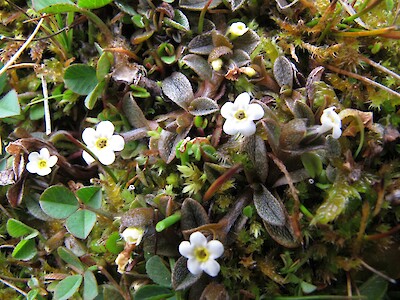
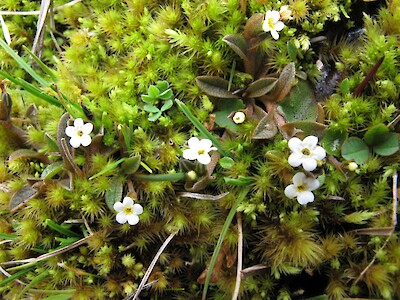
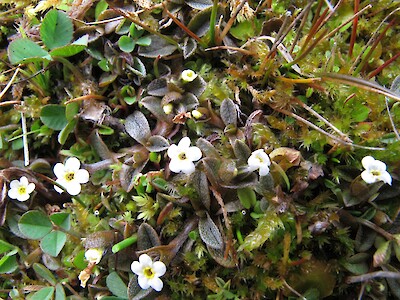
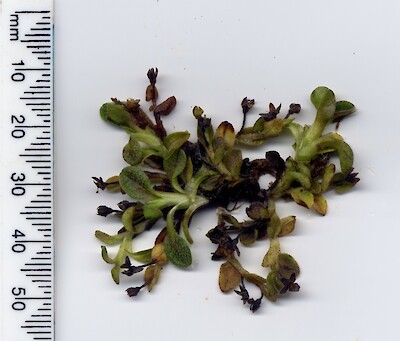
Minute herb of high-elevation bogs and wet places in mountain ranges of Otago, New Zealand. Rosette leaves fleshy, bearing hairs on the leaf underside orientated parallel to midrib. Inflorescences
Flower colours
White, Yellow
Detailed description
Single rosettes with fibrous roots. Rosette leaves 3–5, fleshy, petiolate; petioles sometimes wide, indistinct, not sheathing, 1.0–6.6 mm x 0.6–1.7 mm; lamina 2.5–7.4 mm x 1.5–4.5 mm, widest point usually at or above middle, rarely below middle, narrowly obovate to very broadly obovate, ovate to very broadly ovate, rarely narrowly elliptic, broadly elliptic, rotund, lanceolate, or oblanceolate; apex obtuse, with hydathode on abaxial side; trichomes 0.2–0.7 mm long, straight, antrorse, appressed, sparsely to densely distributed (but abaxially usually glabrous), adaxially and abaxially oriented parallel relative to the midrib. Inflorescences 1–5 per rosette, prostrate to ascending, unbranched (rarely once-branched), 10–45 mm long, wholly bracteate, with up to 3–7 cauline leaves per inflorescence (including all branches) and, of these, 1–3 associated with flowers and 2–4 not associated with flowers; adventitious roots lacking at tips; scape 0.4–1mm wide; trichomes 0.2–0.6 mmlong, straight, antrorse, appressed, sparsely to densely distributed, sometimes overlapping. Lowest cauline leaves generally petiolate; petioles 0.9–5.0 mm x 0.5–1.2 mm; lamina 2.7–6.9 mm x 1.6–3.3 mm, oblanceolate to narrowly obovate, rarely elliptic or obovate to broadly obovate; apex obtuse, with hydathode on abaxial side; trichomes as on rosette leaves. Uppermost cauline leaf sessile; lamina 2.5–6.0 mm x 0.9–2.6 mm, oblanceolate to narrowly obovate, lanceolate to ovate, or rarely elliptic or obovate; apex obtuse or acute, with hydathode on abaxial side. Flowers up to 1–3 per inflorescence (including all branches), each subtended by a cauline leaf. Internodes up to 0–1.6 mm long at flowering or 0–4.7 mm long at fruiting. Pedicels up to 0.4–1.1 mm long at flowering or 0.6–6.5 mm long at fruiting; trichomes 0.2–0.9 mm long, straight, antrorse, appressed to patent, densely distributed, sometimes overlapping. Calyx 1.1–3.3 mm long at flowering or 1.8–3.2 mm long at fruiting x 1.6–3.4 mm wide at the top at fruiting; calyx lobes 1.4–2.1 mm x 0.5–1.1 mm at fruiting, lobed to 0.5–0.9 the length of the calyx; trichomes 0.1–0.8 mm long, straight, antrorse, appressed, densely distributed, sometimes overlapping, and inside densely distributed and overlapping. Corolla 1.3–6.6 mm diameter, white with yellow faucal scales; corolla lobes 0.4–2.5 mm x 0.6–2.1 mm, obovate to very broadly obovate, rarely ovate or very broadly ovate); corolla tube 1.6–4.2 mm long from base to faucal scales, 0.5–2.2 mm wide at faucal scales. Stamens 1.7–4.8 mm long; filaments 0–0.3 mm long, attached to corolla tube below faucal scales, 1.0–3.8 mm above base of corolla tube; anthers 0.5–1.1 mm long, included, sometimes partially exserted, only tips reaching faucal scales. Style 1.1–5.9 mm long at flowering, 1.9–5.4 mm long at fruiting. Nutlets 4, 1.1–1.9 mm x 0.7–1.1 mm, ovoid, convex or keeled, winged or scarcely winged, smooth, shiny, light brown
Similar taxa
Differs from M. tenericaulis by the shorter and wider petioles, smaller and fleshier leaves, abaxially glabrous rosette leaves, appressed parallel-oriented trichomes on the rosette leaves adaxially, and few-flowered inflorescences that have shorter internodes. Differs from M. colensoi and M. cheesemanii by the shorter rosette leaf petioles, abaxially glabrous rosette leaves, and the shorter calyx and corolla tube. Differs from M. brevis and all other M. pygmaea species-group species by the larger corollas, shorter calyx trichomes, and (except for M. glauca) straight, appressed trichomes on the rosette leaves adaxially. Distinguished ecologically from other New Zealand Myosotis by being restricted to mountain bog habitats.
Distribution
Endemic. New Zealand, South Island, Otago
Habitat
In damp to saturated high-elevation (subalpine to alpine) bogs, seepages, flushes, hollows, swamps, wetlands, and snow-melt streams and banks; on silt, peat, schist, basalt in exposed, sunny, flat or gently sloping open areas of smooth, short mossy bog turf containing mixed bryophytes, cushions -plants and small herbs
Threats
Myosotis bryonoma was listed as M. aff. tenericaulis (AK 7570; Garvie), as Taxonomically Indeterminate At Risk–Naturally Uncommon RR, Sp (de Lange et al. 2013). Meudt & Prebble (2018) agreed with that assessment. The species though occupying a large area is never particularly common, biological sparse and tied to small areas of suitable alpine bog habitat.
Detailed taxonomy
Genus
Family
Synonyms
None - first described in 2018
Endemic taxon
Yes
Endemic genus
No
Endemic family
No
Ecology
Flowering
November - April
Fruiting
February - April
Propagation technique
Myosotis bryonoma is not known to have been successfully cultivated.
Other information
Etymology
myosotis: Mouse-eared
bryonoma: Meaning ‘dwelling in moss’ the epithet is derived from the Greek words ‘bryon’ (moss) and ‘nomos’ (place or condition for living).
Previous conservation status
The conservation status of all known New Zealand vascular plant taxa at the rank of species and below were reassessed in 2022-2023 using the New Zealand Threat Classification System (NZTCS) – more information about this can be found on the NZTCS website. This report includes replaces all previous NZTCS lists for vascular plants. Previous assessments can be found here.
- Conservation status of vascular plants in Aotearoa New Zealand, 2023. 2024. Peter J. de Lange, Jane Gosden, Shannel P. Courtney, Alexander J. Fergus, John W. Barkla, Sarah M. Beadel, Paul D. Champion, Rowan Hindmarsh-Walls, Troy Makan and Pascale Michel Department of Conservation. Source: NZTCS and licensed by DOC for reuse under the Creative Commons Attribution 4.0 International licence.
2017 | At Risk – Naturally Uncommon | Qualifiers: DP, RR, Sp
Regional conservation statuses
Otago: 2025 | Regionally At Risk – Regionally Naturally Uncommon | Qualifiers: DPR, DPS, DPT, NS, NStr, RE, RR, Sp, TL
Current regional threat status assessments prepared according to Crisp et al. (2025) are displayed when available. The Otago conservation status information is sourced from the “Conservation Status of Indigenous Vascular Plants in Otago, 2025” Jarvie S et al. (2025) report.
Referencing and citations
References and further reading
Meudt, H.M.; Prebble, J.M. 2018: Species limits and taxonomic revision of the bracteate-prostrate group of southern hemisphere forget-me-nots (Myosotis, Boraginaceae), including description of three new species endemic to New Zealand. Australian Systematic Botany 31: 48-105
Attribution
Fact sheet prepared for NZPCN by P.J. de Lange 3 June 2018. Description adapted from Meudt & Prebble (2018).