
Senecio australis
Biostatus
Native
Current conservation status
The conservation status of all known New Zealand vascular plant taxa at the rank of species and below were reassessed in 2022-2023 using the New Zealand Threat Classification System (NZTCS) – more information about this can be found on the NZTCS website. This report includes replaces all previous NZTCS lists for vascular plants. Previous assessments can be found here.
- Conservation status of vascular plants in Aotearoa New Zealand, 2023. 2024. Peter J. de Lange, Jane Gosden, Shannel P. Courtney, Alexander J. Fergus, John W. Barkla, Sarah M. Beadel, Paul D. Champion, Rowan Hindmarsh-Walls, Troy Makan and Pascale Michel Department of Conservation. Source: NZTCS and licensed by DOC for reuse under the Creative Commons Attribution 4.0 International licence.
2023 | Non-resident Native – Vagrant | Qualifiers: SO
Category
Vascular
Structural class
Herbs - Dicotyledonous composites
Simplified description
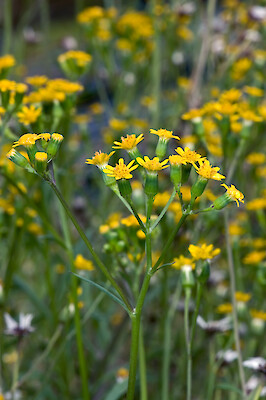
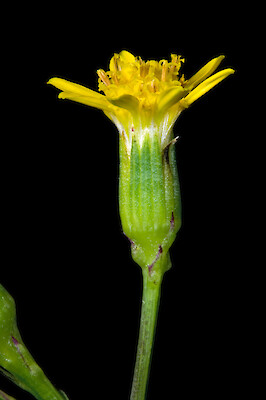
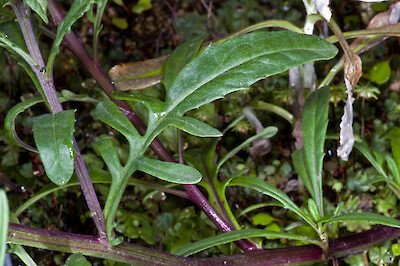
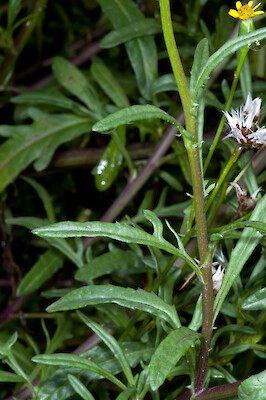
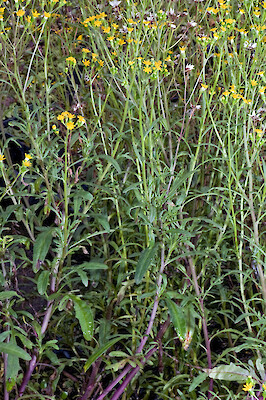
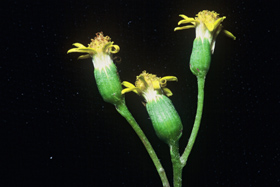
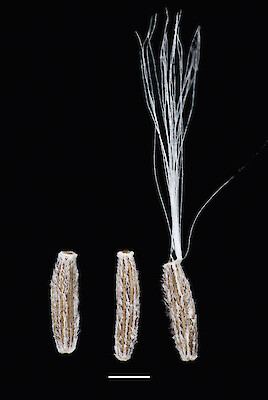
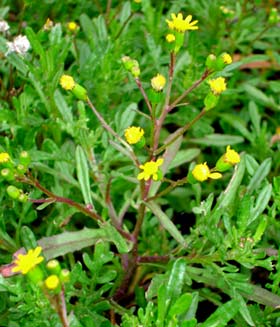
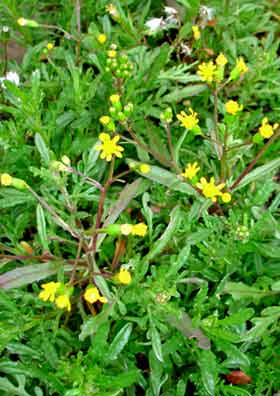
Herbaceous, short-lived or annual daisy. Leaves fleshy, dark green, variable (obovate, oblanceolate, lanceolate) deeply lobed or coarsely toothed. Flower heads (capitula) vase-shaped, involucral bracts 9-15, 5-6 mm long, ligules yellow, 1-5 × 1 mm, disc yellow, 4-5 mm diameter. Seeds 2.5-2.8 × 0.3-0.5 mm.
Flower colours
Yellow
Detailed description
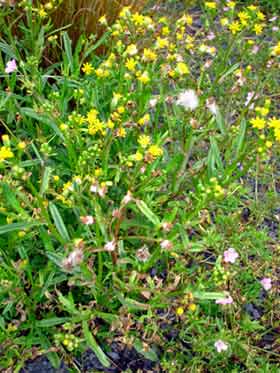
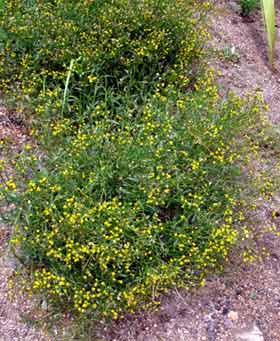
Erect to semi-erect, heavily branched and leafy, short-lived perennial herb, (0.2-)0.8-1 m tall. Stems dark purple. Foliage dark green, glabrescent and fleshy. Lower leaves 55-75 × 25-30 mm, dark green, shortly-petiolate, obovate to oblanceolate, entire, very rarely lobed 1-2 times, apex obtuse; mid-cauline leaves 50-140 × 20-45 mm, dark green, petiolate or amplexicaul, petioles up to 10-15 mm; lamina ovate, obovate to elliptic, rarely rhomboidal, entire, coarsely dentate, or lobed 2-3 times, leaf apices obtuse; uppermost leaves smaller, lanceolate to linear or linear-spathulate, lobulate or dentate, with obtuse apices. Inflorescence a lax cyme of 3-8 capitula. Capitula urceolate. Involucral bracts (9-)13(-15), dark green, lanceolate, 5-6 mm long. Ray florets (0-)9(-12); ligules yellow, 1-5 × 1 mm; blunt-ended. Disc 4-5 mm diameter, yellow. Cypsela elliptic to oblong-elliptic 2.5-2.8 × 0.3-0.5 mm.
Similar taxa
Senecio marotiri is superficially similar. From that species S. australis can be distinguished by its basal leaves which are lyrately-lobed, cob-webby arachnoid stem, leaf and involucral hairs, urceolate (vase-shaped) capitula, shorter and fewer involucral bracts, and shorter cypsela (seeds). It has a very different nrDNA ITS sequence placing it within the lautusoid Senecio group, whilst S. marotiri is the sister species of S. quadridentatus.
Distribution
Indigenous. Present on Motukino (Fanal Island), Mokohinau Islands and North Eastern Great Barrier Island. Otherwise only known from the Norfolk Island group
Habitat
In New Zealand. Offshore islands on rock ledges, in short grasses and coastal herbs growing amongst petrel and diving petrel burrows
Threats
In New Zealand it is known from only three small populations comprising a total of 10 or so plants. It is clearly a recent arrival at these locations and during these initial stages of colonisation it remains vulnerable to a range of natural stochastic events. This species is abundant and not threatened on Norfolk Island.
Detailed taxonomy
Genus
Family
Synonyms
None
Endemic taxon
No
Endemic genus
No
Endemic family
No
Ecology
Flowering
November - April
Fruiting
November - April
Propagation technique
Easy from fresh seed. A short-lived perennial which readily self sows in suitable habitats. Does best in a sunny, exposed location, within free draining fertile soil.
Other information
Etymology
senecio: From the Latin senex ‘old man’ (probably referring to the bearded seeds)
australis: Southern
Chromosome number
2n = 80
Previous conservation statuses
The conservation status of all known New Zealand vascular plant taxa at the rank of species and below were reassessed in 2022-2023 using the New Zealand Threat Classification System (NZTCS) – more information about this can be found on the NZTCS website. This report includes replaces all previous NZTCS lists for vascular plants. Previous assessments can be found here.
- Conservation status of vascular plants in Aotearoa New Zealand, 2023. 2024. Peter J. de Lange, Jane Gosden, Shannel P. Courtney, Alexander J. Fergus, John W. Barkla, Sarah M. Beadel, Paul D. Champion, Rowan Hindmarsh-Walls, Troy Makan and Pascale Michel Department of Conservation. Source: NZTCS and licensed by DOC for reuse under the Creative Commons Attribution 4.0 International licence.
2017 | Non-resident Native – Vagrant | Qualifiers: SO
2012 | Non-resident Native – Vagrant | Qualifiers: SO
2009 | Non-resident Native – Vagrant | Qualifiers: SO
2004 | Non-resident Native – Vagrant
Regional conservation statuses
Auckland: 2025 | Regional Non-Resident – Regional Vagrant | Qualifiers: SO
Current regional threat status assessments prepared according to Crisp et al. (2025) are displayed when available. The Auckland conservation status information is sourced from the “Conservation status of vascular plant species in Tāmaki Makaurau / Auckland” Simpkins E et al. 2025 report.
Referencing and citations
Attribution
Fact sheet prepared for NZPCN by P.J. de Lange (3 May 2004). Description by P.J. de Lange based on New Zealand material originally from Motukino ( Fanal Island), Mokohinau Islands group.
NZPCN Fact Sheet citation
Please cite as: de Lange, P.J. (Year at time of access): Senecio australis Fact Sheet (content continuously updated). New Zealand Plant Conservation Network. https://www.nzpcn.org.nz/flora/species/senecio-australis/ (Date website was queried)