
Veronica kellowiae
Common names
hebe
Biostatus
Native – Endemic taxon
Current conservation status
The conservation status of all known New Zealand vascular plant taxa at the rank of species and below were reassessed in 2022-2023 using the New Zealand Threat Classification System (NZTCS) – more information about this can be found on the NZTCS website. This report includes replaces all previous NZTCS lists for vascular plants. Previous assessments can be found here.
- Conservation status of vascular plants in Aotearoa New Zealand, 2023. 2024. Peter J. de Lange, Jane Gosden, Shannel P. Courtney, Alexander J. Fergus, John W. Barkla, Sarah M. Beadel, Paul D. Champion, Rowan Hindmarsh-Walls, Troy Makan and Pascale Michel Department of Conservation. Source: NZTCS and licensed by DOC for reuse under the Creative Commons Attribution 4.0 International licence.
2023 | At Risk – Naturally Uncommon | Qualifiers: Sp
Category
Vascular
Structural class
Trees & Shrubs - Dicotyledons
Simplified description
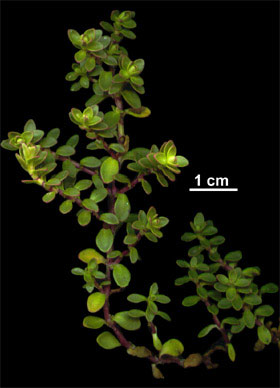
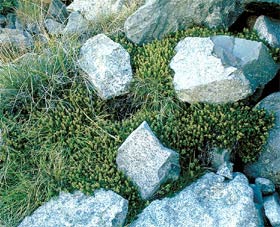
Low growing sprawling fleshy shrub bearing pairs of small dark green oval leaves on reddish branches inhabiting Marlborough mountains. Leaves 3.3-7.5mm long by 2-5.5mm wide, hardly narrowing to stalk. Flowers small, white, in short spikes to 2cm long at tips of twigs.
Flower colours
White
Detailed description
Subshrub or spreading low shrub to 0.15 m tall. Branches decumbent, old stems brown; branchlets redbrown or purplish or green, puberulent, hairs bifarious; internodes 0.9-5 (-7.5) mm; leaves not readily abscising, persistent along the stem for some distance. Leaf bud lightly surrounded by recently diverged leaves. Leaves decussate to subdistichous, connate (sometimes barely), erecto-patent to recurved; lamina elliptic to obovate (often narrowly), slightly fleshy, more or less flat or slightly concave, 3.3-7.5 (-9.5) x (1.5-) 2-5.5 mm; apex subacute to rounded (often dimpled at apex); midrib sometimes evident in fresh leaves, slightly thickened below; margin not cartilaginous, not thickened, glabrous or glandular-ciliate (sometimes minutely), sometimes tinged red, entire or shallowly toothed; upper surface green to dark green, dull or slightly glossy, with many stomata, glabrous; lower surface green to dark green, dull or slightly glossy; petiole hairy along margins. Inflorescences usually terminal and lateral (i.e. a pedunculate terminal spike subtended by 2 (-4) lateral spikes; more than 2 laterals are present only on Mount Lyford and Mount Terako specimens) or sometimes only terminal (and often with a few sterile bracts at base), unbranched, 0.8-1.7 (-2) cm; peduncle 0.15-0.4 cm; rachis 0.35-0.5 (-1.1) cm. Bracts opposite and decussate or lowermost pair opposite, then subopposite or alternate above, connate or free, elliptic to ovate or oblong, subacute to obtuse. Flowers hermaphrodite or female (on different plants). Pedicels absent. Calyx 2.5-4 mm; lobes elliptic to lanceolate or narrowly oblong, subacute (usually) or obtuse. Corolla tube glabrous; tube of hermaphrodite flowers 2.8-3.5 x 1.4-1.5 mm, cylindric, shorter than (usually) to longer than calyx; tube of female flowers approximately 3 x 1.5 mm, cylindric, equalling to shorter than calyx; lobes white at anthesis, ovate, obtuse, patent or becoming recurved, more or less equalling corolla tube. Stamen filaments remaining erect, 0.5-1 mm; anthers magenta, 1-1.2 mm; sterile anthers approximately 0.7 mm. Ovary ovoid (often very narrowly), approximately 2 mm; ovules 8-12 (-18) per locule; style 2-3.5 mm. Capsules acute to subacute, 3.7-4 x 1.8-2 mm, loculicidal split extending 1/4-way to base. Seeds flattened, ellipsoid, pale brown, 0.7-0.8 x 0.5-0.6 mm, micropylar rim 0.1-0.3 mm.
Similar taxa
The inflorescences of V. kellowiae distinguish it from other ”Connatae” The species is probably most closely related to V. macrocalyx, which some sterile specimens strongly resemble. It grows near V. epacridea at a range of localities, and probably co-occurs with V. haastii on Mt Terako (based on herbarium specimens only). Resemblance to V. petriei is suggested though each species is geographically disjunct, the corolla tube and calyx are marginally longer than V. kellowiae, and the bracts tend to be alternate. compared to opposite in V. kellowiae.
Distribution
South Island - mountains of east Marlborough, south-east Nelson and north Canterbury, where it occurs on the Inland and Seaward Kaikoura ranges, and near Mount Weld, Mount Terako and Mount Lyford.
Habitat
Alpine rocks and scree, often in moist places.
Detailed taxonomy
Genus
Family
Synonyms
Hebe ramosissima G.Simpson et J.S.Thomson, Leonohebe ramosissima (G.Simpson et J.S.Thomson) Heads
Endemic taxon
Yes
Endemic genus
No
Endemic family
No
Ecology
Flowering
December-February
Fruiting
(December-) February-March
Other information
Etymology
veronica: Named after Saint Veronica, who gave Jesus her veil to wipe his brow as he carried the cross through Jerusalem, perhaps because the common name of this plant is ‘speedwell’. The name Veronica is often believed to derive from the Latin vera ‘truth’ and iconica ‘image’, but it is actually derived from the Macedonian name Berenice which means ‘bearer of victory’.
kellowiae: Named after botanist Alison Kellow, co-author of “An illustrated guide to New Zealand Hebes.”
Chromosome number
2n = 40
Previous conservation statuses
The conservation status of all known New Zealand vascular plant taxa at the rank of species and below were reassessed in 2022-2023 using the New Zealand Threat Classification System (NZTCS) – more information about this can be found on the NZTCS website. This report includes replaces all previous NZTCS lists for vascular plants. Previous assessments can be found here.
- Conservation status of vascular plants in Aotearoa New Zealand, 2023. 2024. Peter J. de Lange, Jane Gosden, Shannel P. Courtney, Alexander J. Fergus, John W. Barkla, Sarah M. Beadel, Paul D. Champion, Rowan Hindmarsh-Walls, Troy Makan and Pascale Michel Department of Conservation. Source: NZTCS and licensed by DOC for reuse under the Creative Commons Attribution 4.0 International licence.
2017 | At Risk – Naturally Uncommon | Qualifiers: Sp
2012 | At Risk – Naturally Uncommon | Qualifiers: Sp
2009 | At Risk – Naturally Uncommon
2004 | Range Restricted
Referencing and citations
References and further reading
Bayly, M.J., Kellow, A.V. 2006. An illustrated guide to New Zealand Hebes. Wellington, N.Z.: Te Papa press pg. 118.
Attribution
Description adapted by M. Ward from Bayly & Kellow (2006).