
Corybas sanctigeorgianus
Common names
spider orchid
Biostatus
Native – Endemic taxon
Current conservation status
The conservation status of all known New Zealand vascular plant taxa at the rank of species and below were reassessed in 2022-2023 using the New Zealand Threat Classification System (NZTCS) – more information about this can be found on the NZTCS website. This report includes replaces all previous NZTCS lists for vascular plants. Previous assessments can be found here.
- Conservation status of vascular plants in Aotearoa New Zealand, 2023. 2024. Peter J. de Lange, Jane Gosden, Shannel P. Courtney, Alexander J. Fergus, John W. Barkla, Sarah M. Beadel, Paul D. Champion, Rowan Hindmarsh-Walls, Troy Makan and Pascale Michel Department of Conservation. Source: NZTCS and licensed by DOC for reuse under the Creative Commons Attribution 4.0 International licence.
2023 | Data Deficient
Category
Vascular
Structural class
Orchids
Simplified description
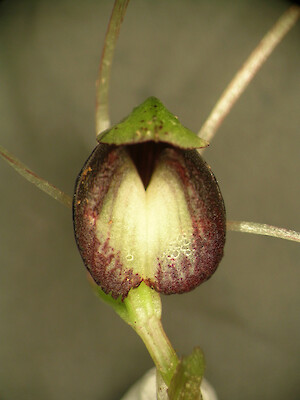
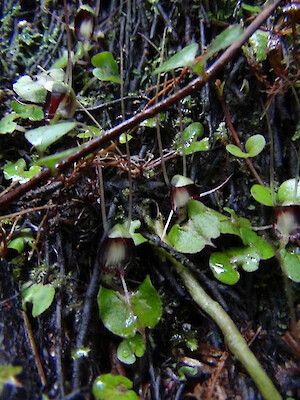
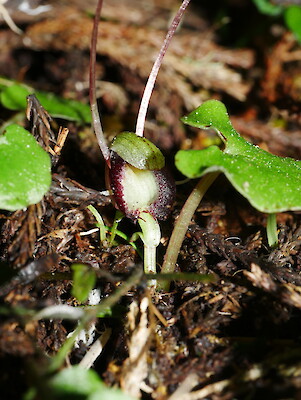
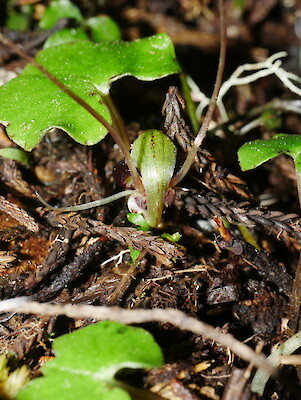
Terrestrial, seasonal orchid. Leaves solitary kidney-shaped to heart-shaped, distinctly acuminate. Flowers solitary, central portion white otherwise dark red towards the margins, surface of labellum covered with short trichomes.
Flower colours
White
Detailed description
Terrestrial herbs, 14–20 mm tall at flowering. Leaf distinctly petiolate, petiole 9.0–22.6 mm long; lamina reniform to cordiform, 8.5–13.8 × 12.6–20.3 mm; margin entire; apex acuminate 1.5–3.3 mm long. Flower solitary, held erect on a peduncle 2.5–4.4 mm long; floral bract ovate when flattened, 3.74–7.6 × 2.0–2.7 mm; dorsal sepal light green with a few blotches of dark red, arching over the labellum, concave to cucullate, narrow at the base and wide towards the tip, apex rounded or slightly mucronate; lateral sepals linear-filiform, white or translucent with dark red specks, 11.8–19.8 mm long; petals similar to the lateral sepals but longer, 32.8–53.3 mm long; labellum white in the centre, dark red towards the margins, and covered with short trichomes, auriculate at base; aperture 1.5–2.1 mm diameter; lamina deflexed, c. 5 mm wide, with a central groove formed by the inward folding of the lamina, extending downwards half way the lamina and sunken pit formed at the point where the lamina bends, lateral margins incurve, mostly entire, lower margin laciniate to finally denticulate. Ovary 3.3–5.3 mm long. Column 1.8 mm long, straight, with truncate column wings on both sides of the stigma.
Similar taxa
Corybas sanctigeorgianus is most similar to Corybas hypogaeus with respect to its flower and leaf shape but it can be distinguished from that species by its straight ovary, labellum with a white centre and dorsal sepal extending beyond the labellum. It differs from Corybas trilobus by its long dorsal sepal and the white centre of the labellum.
Distribution
Endemic. New Zealand: North Island (Hunua Ranges).
Habitat
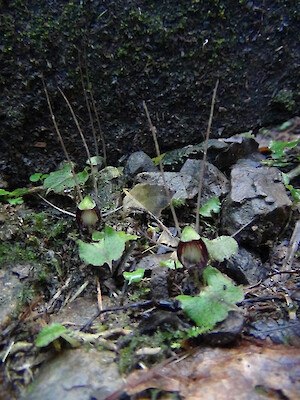
In lowland mixed broad-leaf / podocarp forest, growing in skeletal soils covered in leaf litter and on the trunk bases of tree ferns.
Threats
Lehnebach et al. (2016) assessed Corybas sanctigeorgianus using the New Zealand Threat Classification System (NZTCS) as ‘Threatened / Nationally Critical’ observing that it “is only known from the type locality where a population of about hundred individuals occurs”. It has subsequently been found at a second Hunua Range location. Based on this, and because it is a newly recognised taxon within a variable complex of poorly understood species, the NZTCS vascular plant panel assessed it as ‘Data Deficient’.
Detailed taxonomy
Genus
Family
Synonyms
Previously known by the tag name “trisept”.
Endemic taxon
Yes
Endemic genus
No
Endemic family
No
Ecology
Flowering
August–September
Fruiting
October–November
Propagation technique
Difficult–should not be removed from the wild
Other information
Etymology
corybas: Helmet flower
sanctigeorgianus: Named after Dr Ian St George, a New Zealand born and based medical practitioner, amateur orchidologist and botanical historian
Manaaki Whenua Online Interactive Key
Previous conservation status
The conservation status of all known New Zealand vascular plant taxa at the rank of species and below were reassessed in 2022-2023 using the New Zealand Threat Classification System (NZTCS) – more information about this can be found on the NZTCS website. This report includes replaces all previous NZTCS lists for vascular plants. Previous assessments can be found here.
- Conservation status of vascular plants in Aotearoa New Zealand, 2023. 2024. Peter J. de Lange, Jane Gosden, Shannel P. Courtney, Alexander J. Fergus, John W. Barkla, Sarah M. Beadel, Paul D. Champion, Rowan Hindmarsh-Walls, Troy Makan and Pascale Michel Department of Conservation. Source: NZTCS and licensed by DOC for reuse under the Creative Commons Attribution 4.0 International licence.
2017 | Data Deficient
Regional conservation statuses
Auckland: 2025 | Regionally Data Deficient | Qualifiers: DPS, DPT
Current regional threat status assessments prepared according to Crisp et al. (2025) are displayed when available. The Auckland conservation status information is sourced from the “Conservation status of vascular plant species in Tāmaki Makaurau / Auckland” Simpkins E et al. 2025 report.
Wellington: 2025 | Regionally Threatened – Regionally Critical | Qualifiers: DPT, OL
Current regional threat status assessments prepared according to Crisp et al. (2025) are displayed when available. The Wellington conservation status information is sourced from the “Conservation status of indigenous vascular plants in the Wellington region” Enright P et al. 2025 report.
Referencing and citations
References and further reading
Lehnebach CA, Zeller AJ, Frericks J, Ritchie P. 2016. Five new species of Corybas (Diurideae, Orchidaceae) endemic to New Zealand and phylogeny of the Nematoceras clade. Phytotaxa 270(1): 1–24. https://doi.org/10.11646/phytotaxa.270.1.1.
Attribution
Fact Sheet prepared for NZPCN by P.J. de Lange (13 August 2016). Description from Lehnebach et al. (2016)