
Apium leptophyllum
Common names
slender celery
Biostatus
Exotic
Conservation status
Not applicable
Category
Vascular
Structural class
Herbs - Dicotyledons other than Composites
Flower colours
White
Similar taxa
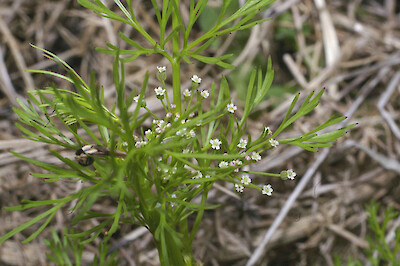
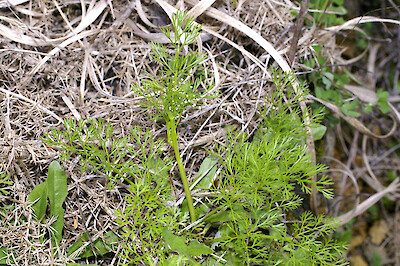
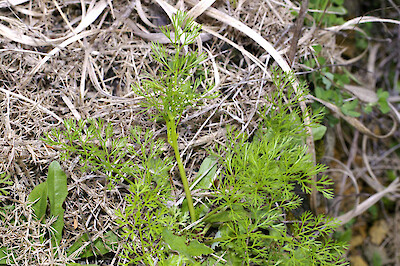
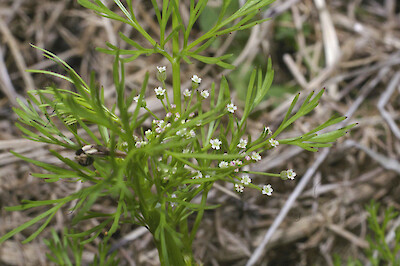
Erect, glabrous, annual terrestrial herb. Stems hollow, slightly grooved, striate, up to 50 cm high. Basal leaves 3-4 pinnate or ternate, petiolate; ultimate segments linear to filiform, entire, 2-15 mm long; stem leaves similar to basal but 2-3 ternate, shortly petiolate. Umbels 1-3 cm diameter, flowers 5-petalled, 1 mm diameter. Fruit broadly ovoid, 1.5-3 mm long, dark brown; ribs broad, thickened, pale brown. (Webb et al 1988)
Detailed taxonomy
Genus
Family
Synonyms
Ciclospermum leptophyllum (Pers.) Sprague ex Britton & P.Wilson (orth. var.), Cyclospermum leptophyllum (Pers.) Sprague ex Britton & P.Wilson
Endemic genus
No
Endemic family
No
Ecology
Flowering
July, August, September, October, November, December, January. February
Year naturalised
1869
Origin
N., C. and S. America
Life cycle and dispersal
Reproduces by seed. The seeds are fine balls that have deeply ribbed coverings. These break open when dry and shed their seed. The seed is then dispersed by the wind (Ermert and Clapp 1998).
Other information
Etymology
apium: The ancient Latin name for celery or parsley. Believed to be derived from the Celtic word apon ‘ditch’ and refers to the watery habitat of many species