
Baeomyces heteromorphus




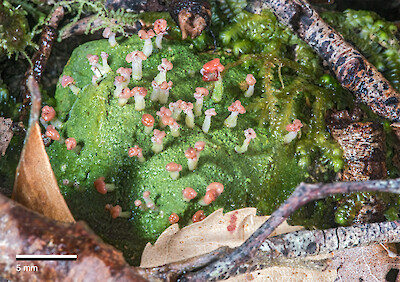
Biostatus
Native
Current conservation status
2018 | Not Threatened | Qualifiers: SO
Category
Lichen
Structural class
Lichens - Crustose
Lichen substrates
Corticolous (bark, wood), Terricolous (soil)
Substrate details
Terricolous (occasionally corticolous on old wood)
Detailed taxonomy
Genus
Family
Synonyms
Baeomyces cinnabarinus, Baeomyces cupreus, Baeomyces granosus, Baeomyces haemotropus, Cladoniopsis caespitosa
Endemic taxon
No
Endemic genus
No
Endemic family
No
Other information
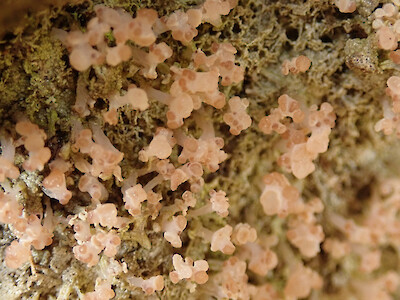
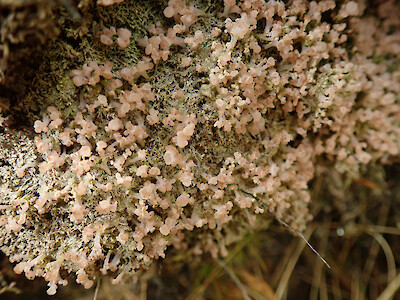
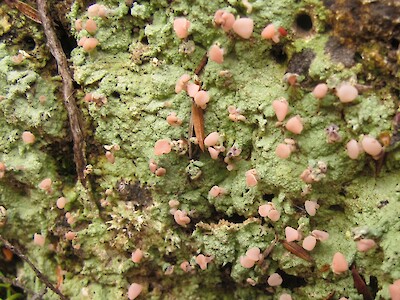
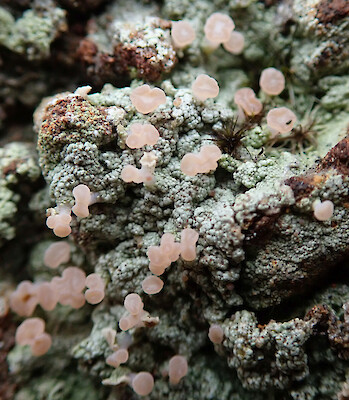
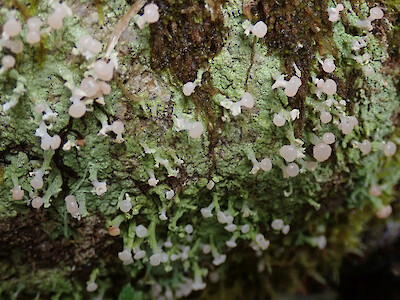
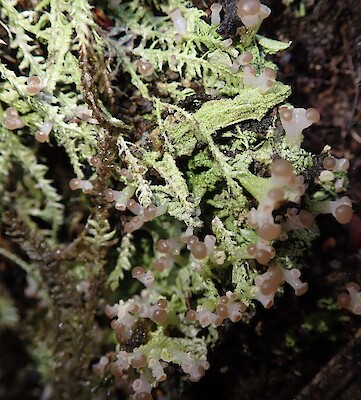
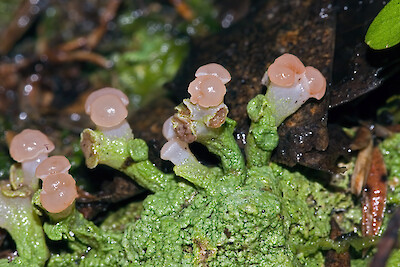
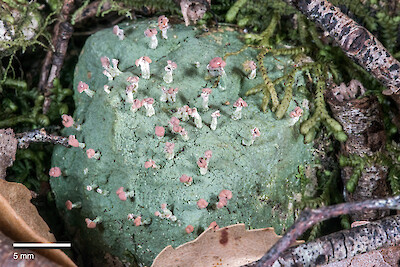
Baeomyces is a genus of c. 8 species included in the family Baeomycetaceae (Eriksson et al. 2004; Pennycook & Galloway 2004; Eriksson 2005). Taxa with pinkish apothecia, an amyloid reaction in the ascus, and containing baeomycesic and squamatic acids, and formerly included in Baeomyces, are now accommodated in the genus Dibaeis (q.v., Gierl & Kalb 1993) and placed in the family Icmadophilaceae (Eriksson 1999; Eriksson et al. 2004; Pennycook & Galloway 2004), a view that has received support from molecular studies (Platt & Spatafora 1999). One species is widespread in New Zealand (Galloway 1980), also occurring in Australia (McCarthy 2006).
The lichenicolous fungi *Arthrorhaphis grisea Th.Fr., and *Dactylospora athallina (Müll.Arg.) Hafellner that are widespread on Baomyces rufus in the Northern Hemisphere, occur on the thallus of B. heteromorphus in Tasmania (Kantvilas & Jarman 1999: 34) and should be looked for in New Zealand populations.
NVS code
The National Vegetation Survey (NVS) Databank is a physical archive and electronic databank containing records of over 94,000 vegetation survey plots - including data from over 19,000 permanent plots. NVS maintains a standard set of species code abbreviations that correspond to standard scientific plant names from the Ngä Tipu o Aotearoa - New Zealand Plants database.
BAEHET
Referencing and citations
References and further reading
Eriksson OE. (Ed.) 1999. Outline of the Ascomycota – 1999. Myconet 3: 1–88.
Eriksson OE. (Ed.) 2005. Outline of Ascomycota – 2005: Myconet 11: 1–113.
Eriksson OE, Baral H-O, Currah RS, Hansen K, Kurtzman CP, Rambold G, Laessøe T. 2004. Outline of Ascomycota – 2004. Myconet 10: 1–99.
Galloway DJ. 1980. Notes on the lichen genus Baeomyces in New Zealand. Botaniska Notiser 133: 77–83.
Galloway DJ. 1985. Flora of New Zealand Lichens. Government Printer, Wellington, NZ. 662 p.
Galloway DJ. 2007. Flora of New Zealand Lichens. Revised 2nd edition including lichen-forming and lichenicolous fungi. Manaaki Whenua Press, Lincoln, NZ. Two volumes: vol. 1 pp 1–1006; vol. 2 pp 1007–2261.
Gierl C, Kalb K. 1993. Die Flechtengattung Dibaeis. Eine Übersicht über die rosafrüchtigen Arten von Baeomyces sens lat. nebst Anmerkungen zu Phyllobaeis gen. nov. Herzogia 9: 593–645.
Kantvilas G, Jarman SJ. 1999. Lichens of rainforest in Tasmania and south-eastern Australia. Flora of Australia Supplementary Series 9: i–xi + 1–212.
McCarthy PM. 2006. Checklist of the lichens of Australia and its island territories. Australian Biological Resources Study, Canberra. Version 29 March 2006. https://www.anbg.gov.au/abrs/lichenlist/introduction.html
Pennycook SR, Galloway DJ. 2004. Checklist of New Zealand “Fungi”. In: McKenzie, EHC. (Ed.) Introduction to fungi of New Zealand. Fungi of New Zealand/Ngā Harore o Aoteroa Volume 1. Fungal Diversity Research Series 14: 401–488.
Platt JL, Spatafora JW. 1999. A re-examination of generic concepts of baeomycetoid lichens based on phylogenetic analysis of nuclear SSU and LSU ribosomal DNA. Lichenologist 31: 409–418. https://doi.org/10.1006/lich.1999.0230.