
Bidens tripartita
Common names
swamp beggar’s ticks
Biostatus
Exotic
Conservation status
Not applicable
Category
Vascular
Structural class
Herbs - Dicotyledonous composites
Simplified description
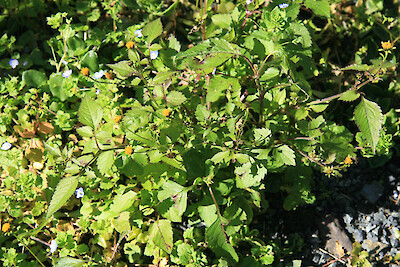
Tall upright annual, up to 80 cm tall, with divided leaves, small yellow button-like flowers and characteristic flat black seeds usually with three barbed teeth easily attaching to clothing and hair.
Flower colours
Yellow
Detailed description
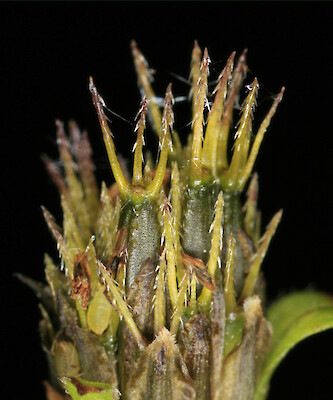
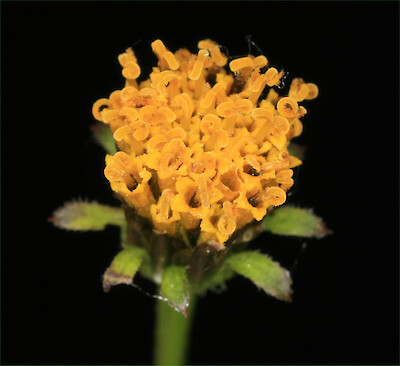
Erect, glabrous or almost glabrous annual, 10-80 cm tall. Stems angled, branched above to form infl. Leaves petiolate, usually simple and not lobed, sometimes deeply 1-pinnatisect with 3-5 segments, 3-10-(20) cm long; lamina or segments narrowly ovate-elliptic to lanceolate, coarsely and often unevenly serrate, acuminate. Upper cauline lvs becoming smaller, shortly petiolate or apetiolate, not lobed and less distinctly serrate. Capitula 4-10 mm diam. Outer involucral bracts 3-4, foliaceous, glabrous, linear, 6-12 mm long; inner bracts many, membranous, ovate-elliptic to ovate-triangular, 5-8 mm long, with dark lined centre and pale margins. Receptacular scales similar to inner bracts but narrower. Florets all hermaphrodite;, tubular, yellow-orange. Achenes flattened, ovate-cuneate to obtriangular, with 1 slender to prominent rib on each face, dark brown, ciliate and otherwise glabrous to sparsely hairy, 5-8 mm long; awns 2-4, often unequal, 0.5-2.7 mm long.
Similar taxa
Differs from the two other Bidens species found in New Zealand (B. frondosa, B. pilosa) by the lower simple lower cauline leaves rather than lower cauline leaves which are lobed or 1-pinnatisect; by the capitula being 4-10 mm diameter, and by the achenes which have 3-4 awns
Distribution
Naturalised. South Island, West Coast from Karamea to Hokitika.
Habitat
Water body margins and swamps.
Detailed taxonomy
Genus
Family
Endemic family
No
Ecology
Flowering
Summer
Fruiting
Autumn
Year naturalised
1975
Origin
Temperate Eurasia
Reason for introduction
Probably a seed or soil contaminan.
Control techniques
Can be controlled manually, mechanically or herbicidally depending on situation.
Life cycle and dispersal
Animal dispersed seed.
Wetland plant indicator status rating
Information derived from the revised national wetland plant list prepared to assist councils in delineating and monitoring wetlands (Clarkson et al., 2021 Manaaki Whenua – Landcare Research Contract Report LC3975 for Hawke’s Bay Regional Council). The national plant list categorises plants by the extent to which they are found in wetlands and not ‘drylands’. The indicator status ratings are OBL (obligate wetland), FACW (facultative wetland), FAC (facultative), FACU (facultative upland), and UPL (obligate upland). If you have suggestions for the Wetland Indicator Status Rating, please contact: [Enable JavaScript to view protected content]
FACW: Facultative Wetland
Usually is a hydrophyte but occasionally found in uplands (non-wetlands).
Other information
Etymology
bidens: From the Latin bi- ‘two’ and dens ‘teeth;, the seed having two tooth-like projections
Referencing and citations
References and further reading
Clapham, A.R.; Tutin, T.G.; Warburg, E.F. 1962: Flora of the British Isles. Cambridge University Press, Second Edition. 1269pp.
Johnson P.N.; Brooke P.A. 1989: Wetland plants in New Zealand. DSIR Field Guide, DSIR Publishing, Wellington. 319pp.
Popay et al (2010). An illustrated guide to common weeds of New Zealand, third edition. NZ Plant Protection Society Inc, 416pp.
Attribution
Fact Sheet prepared by Paul Champion and Deborah Hofstra (NIWA). Description from Webb et al. (1988)
Some of this factsheet information is derived from Flora of New Zealand Online and is used under a Creative Commons Attribution 3.0 New Zealand licence.