
Blindia lewinskyae
Common names
moss
Biostatus
Native – Endemic taxon
Current conservation status
This is the first complete assessment of all known species of mosses found in the wild in Aotearoa New Zealand with a total of 560 species being assessed. The conservation status of mosses, published in the NZTCS database, replaces all previous assessments of mosses. Data supporting the 2025 NZTCS assessment of mosses has been published on the NZTCS database at https://nztcs.org.nz/reports/1155.
Source: NZTCS and licensed by DOC for reuse under the Creative Commons Attribution 4.0 International licence.
2025 | Not Threatened | Qualifiers: DPS, DPT
Category
Non-vascular
Structural class
Mosses
Detailed description
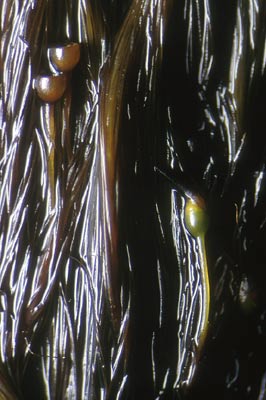
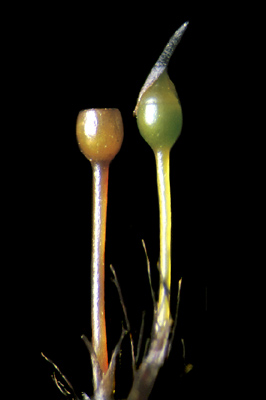
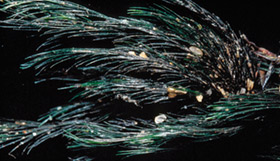
Autoicous moss up to 200 mm long, olive-green to black, with yellow-green to dark-green stem tips, forming dense, soft, flexuose tufts. Stems with outer cells thick-walled. leaves flexuose-secund when dry, similar when moist, 9.0-15.0 mm long, from an oblong-lanceolate base quickly narrowed to a flexuose, filiform subula, acute, lamina c.3 mm long, about 1/4 to 1/6 the subula length; margins entire. Nerve 60-120 x 6-10 microns, linear to elongate, walls 2-3 microns thick, thin-walled, those near nerve orange, more or less thick-walled, somewhat porose and straight. Alar cells 30-70 x 10-20 microns, somewhat larger than basal cells, gradually differentiated and forming a decurrent, thin-walled group, rectangular, some leaves with hyaline and more or less inflated cells. perichaetial leaves from a wide, ovate base quickly contracted to a long subula c.6-8x lamina length, concave, sheathing. Seta 4.0-7.0 mm long, rigid stout, straight (not twisted), erect. Capsules with urns 0.7-1.2 x 0.7-1.0 mm, exserted. Exothecial cells near mid urn 20-40 x 20-30 microns, irregularly rectangular to quadrate-rounded, moderately thick-walled, pachydermous, becoming smaller distally, rim cells elliptic to rounded, thinner-walled. Stomates not seen. Peristome reduced to a few, hyaline, rectangular cells. Operculum conic, stoutly rostrate, beak long, more or less bent. Spores 28-44 microns.
Distribution
Endemic. South Island, Westland where it is mainly found from Westport south to the Paparoa National Park
Substrate details
Mostly saxicolous on rocks in streams and rivers. A Semi-aquatic growing in flood zone of shaded streams, and rivers, often down stream of large rocks or partially submerged boulders.
Threats
Not Threatened. Listed because it is a naturally uncommon, range restricted species. However, some populations on the Stockton Plateau are at risk from coal mining
Detailed taxonomy
Genus
Family
Synonyms
None (first described in 1986)
Endemic taxon
Yes
Endemic genus
No
Endemic family
No
Ecology
Fruiting
Fruits may be found throughout the year
Other information
Previous conservation statuses
This is the first complete assessment of all known species of mosses found in the wild in Aotearoa New Zealand with a total of 560 species being assessed. The conservation status of mosses, published in the NZTCS database, replaces all previous assessments of mosses. Data supporting the 2025 NZTCS assessment of mosses has been published on the NZTCS database at https://nztcs.org.nz/reports/1155.
Source: NZTCS and licensed by DOC for reuse under the Creative Commons Attribution 4.0 International licence.
2014 | Not Threatened
2010 | Not Threatened
2005 | Range Restricted | Qualifiers: DP
Referencing and citations
References and further reading
Bartlett,J.K.; Vitt, D. H. 1986: A survey of the species in the genus Blindia (Bryopsida, Seligeriaceae). New Zealand Journal of Botany 24: 203-246.
Attribution
Fact Sheet Prepared for NZPCN by: P.J. de Lange 30 September 2007. Description adapted from Bartlett & Vitt (1986).