
Callitriche brutia var. hamulata
Common names
water starwort
Biostatus
Exotic
Conservation status
Not applicable
Category
Vascular
Structural class
Herbs - Dicotyledons other than Composites
Simplified description
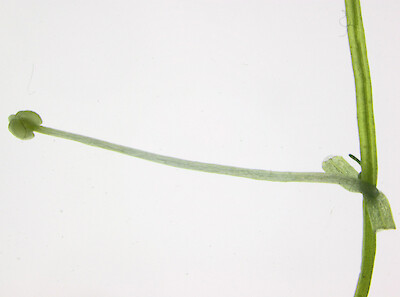
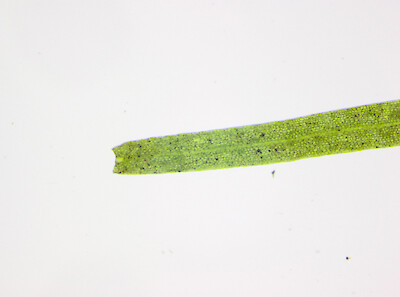
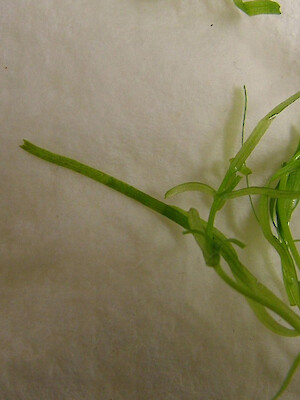
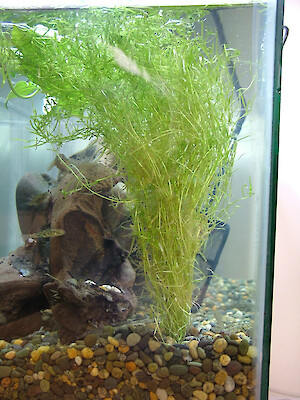
Aquatic linear underwater leaves, indented and often widened at apex, 8 to 20 mm long. Floating leaves in a rosette much broader. Flowers and fruit tiny, found at the leaf base.
Flower colours
Green
Detailed description
An aquatic glabrous (smooth/hairless) herb with submerged and floating leaves, or growing prostrate on damp mud. The submerged leaves are linear (single veined), 6 to 30 mm long and up to 1 mm wide, and deeply notched at the apex. The rosette forming, surface leaves are spathulate (spoon shaped) to ovate and have 3 veins. The flowers are solitary at the base of the leaves, without petals or seeals, and bract may be present (rarely). The fruit are sessile, pale green to dark grey/brown 1 to 1.4 mm wide with a very narrow wing running around the top and often the base.
Similar taxa
All Callitriche species are superficially similar and have variable vegetative parts (Lansdown 2008). Linear deeply notched submerged and circular fruit with reflexed styles and a very narrow wing are diagnostic for this plant.
Distribution
Kaipara Harbour and Marlborough.
Habitat
Shallow water of lake margins and drains.
Detailed taxonomy
Genus
Family
Synonyms
Callitriche hamulata
Endemic genus
No
Endemic family
No
Ecology
Flowering
Spring/summer
Fruiting
Summer to autumn
Year naturalised
1959
Origin
Europe and North Africa
Reason for introduction
Probably a soil seed contaminant or contaminant of ornamental pond plants.
Tolerances
The taxonomy of the four introduced Northern Hemisphere Callitriche requires further investigation in New Zealand.
Control techniques
Can be controlled manually, mechanically or herbicidally depending on situation.
Life cycle and dispersal
Plant fragments and seed.
Wetland plant indicator status rating
Information derived from the revised national wetland plant list prepared to assist councils in delineating and monitoring wetlands (Clarkson et al., 2021 Manaaki Whenua – Landcare Research Contract Report LC3975 for Hawke’s Bay Regional Council). The national plant list categorises plants by the extent to which they are found in wetlands and not ‘drylands’. The indicator status ratings are OBL (obligate wetland), FACW (facultative wetland), FAC (facultative), FACU (facultative upland), and UPL (obligate upland). If you have suggestions for the Wetland Indicator Status Rating, please contact: [Enable JavaScript to view protected content]
OBL: Obligate Wetland
Almost always is a hydrophyte, rarely in uplands (non-wetlands).
Other information
Etymology
callitriche: From the Greek kalli ‘beautiful’ and thrix ‘hair’, referring to the beautiful stems
Referencing and citations
References and further reading
Johnson PN, Brooke PA (1989). Wetland plants in New Zealand. DSIR Field Guide, DSIR Publishing, Wellington. 319pp.
Aston, H (1977). Aquatic plants of Australia. Melbourne University Press, 367pp.
Lansdown, R.V. (2008). Water-starworts (Callitriche of Europe) BSBI Handbook 2, London. 180 pp.
Attribution
Factsheet prepared by Paul Champion and Deborah Hofstra (NIWA).