
Cyclodictyon blumeanum
Common names
Moss
Biostatus
Native
Current conservation status
This is the first complete assessment of all known species of mosses found in the wild in Aotearoa New Zealand with a total of 560 species being assessed. The conservation status of mosses, published in the NZTCS database, replaces all previous assessments of mosses. Data supporting the 2025 NZTCS assessment of mosses has been published on the NZTCS database at https://nztcs.org.nz/reports/1155.
Source: NZTCS and licensed by DOC for reuse under the Creative Commons Attribution 4.0 International licence.
2025 | Threatened – Nationally Critical | Qualifiers: OL, SO, St
Category
Non-vascular
Structural class
Mosses
Detailed description
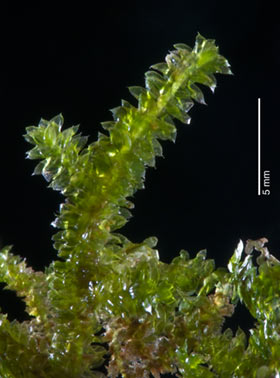
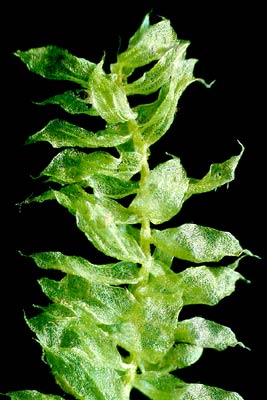
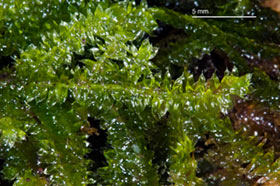
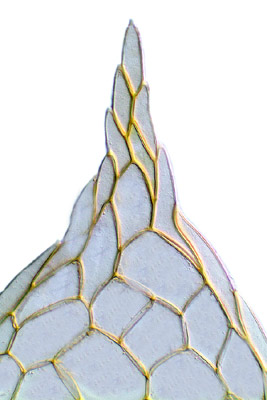
Synoicous or autoicous, light-green, irregularly branched moss of damp sites or waterways. Branches 2 cm long, to 2 mm wide with leaves; leaves weakly complanate, slightly distorted when dry, ovate to oblong-lingulate, 1.2-1.8 mm long, 0.6-0.9 mm wide, broadly acute to shortly acuminate, the apiculus 50-80 pm long; margins weakly toothed above near apex, plane below; border distinctly differentiated, with two rows of linear cells; costa reaching 4/5 the length of leaf, with several dorsal spines towards apex; cells large, 33-50 µm wide, irregularly hexagonal above, becoming rectangular towards base. Calyptra mitrate, covering operculum and capsule mouth when mature, smooth, yellowish, laciniate at base. Seta up to 1.6 cm high, reddish brown, smooth; capsule dark brown, suberect to cemuous, ovoid-cylindrical; urn 1.5 mm; mouth enlarged, mamillose.
Distribution
Indigenous. Sri Lanka, Sumatra, Java, Bali, Malaya, Borneo, Philippines, Taiwan, New Guinea, Fiji. New Zealand – Kermadec Islands, where it is known on Raoul Island from four sites (two permanent springs and on the margins of semi-permanent pools and in seepages at the bottom of steep ravines).
Habitat
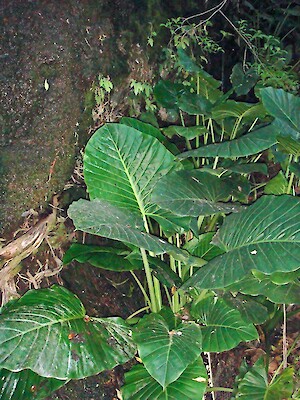
Corticolous, saxicolous, folicolous or terricolous (often aquatic) on wood, roots and rocks in moist ground, or in shady places such as within waterfalls, streams or springs. On Raoul it has also been found growing on a hose pipe, mesh, plastic bottles and taro.
Substrate details
Corticolous, saxicolous, folicolous or terricolous (often aquatic) on wood, roots and rocks in moist ground, or in shady places such as within waterfalls, streams or springs. On Raoul it has also been found growing on a hose pipe, mesh, plastic bottles and taro.
Threats
Probably at its world southern limit, on Raoul this moss is known only from two small permanent springs where it is very uncommon and also from small seepages in two ravine systems. Although probably more realistically judged as naturally uncommon, because this species is known from such a small area and so few plants it qualifies as Nationally Critical.
Detailed taxonomy
Genus
Family
Synonyms
Hookeria blumeana C.Müll.
Endemic taxon
No
Endemic genus
No
Endemic family
No
Ecology
Fruiting
Fruits not yet seen in New Zealand specimens
Other information
Previous conservation statuses
This is the first complete assessment of all known species of mosses found in the wild in Aotearoa New Zealand with a total of 560 species being assessed. The conservation status of mosses, published in the NZTCS database, replaces all previous assessments of mosses. Data supporting the 2025 NZTCS assessment of mosses has been published on the NZTCS database at https://nztcs.org.nz/reports/1155.
Source: NZTCS and licensed by DOC for reuse under the Creative Commons Attribution 4.0 International licence.
2009 | Threatened – Nationally Critical | Qualifiers: ST, SO, OL
2004 | Threatened – Nationally Critical
Referencing and citations
References and further reading
Tan, B.; Robinson, H. 1990: A review of Philippine Hookeriaceous taxa (Musci). Smithsonian Contributions to botany 75. 1-iv, 1-41.
Attribution
Fact Sheet Prepared for NZPCN by: P.J. de Lange (1 June 2007). Description adapted from Tan & Robinson (1990)