
Drosera capensis


NPPA pest plant
Common names
Cape sundew
Biostatus
Exotic
Conservation status
Not applicable
Category
Vascular
Structural class
Herbs - Dicotyledons other than Composites
Simplified description
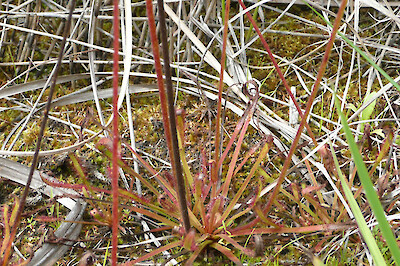
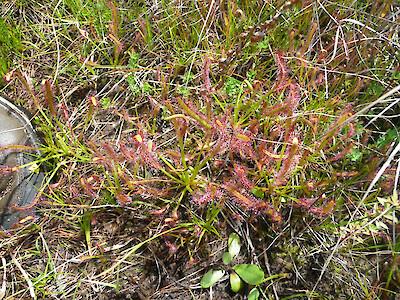
Low growing herb with distinctive strap-like leaves with sticky red hairs, each growing from a central axis (like a dandelion), with tall flower stems (up to 30 cm tall) with a number of bright pink flowers arranged at the tip of the flower stalk, the oldest flowers near the base.
Flower colours
Red/Pink, White
Detailed description
Rosette-forming perennial herb. Leaves bright green, petiolate with a linear ligulate lamina, 8-16 cm x 4-6 mm. Lamina clad in red stalked glandular hairs secreting a sticky mucilage to trap insects and other small invertebrates. Peduncles several per plant, up to 30 cm long, glandular hairy, inflorescence a cyme of many (6-30) rose-pink regular 5-petalled flowers 12-14 mm across. Fruit a capsule, with each scape capable of producing 1000-2000 seeds.
Similar taxa
Superficially similar to the native sundews, with Drosera arcturi (a montane to subalpine bog species) also having strap-like leaves although these are usually reddish rather than green, with wider petioles with sheathing bases.
Distribution
Only known from two sites in Waitakere District, Auckland.
Habitat
Dune slack wetlands.
Detailed taxonomy
Genus
Family
Endemic genus
No
Endemic family
No
Ecology
Flowering
Late spring to summer
Fruiting
Summer to autumn
Year naturalised
2001
Origin
South Africa
Reason for introduction
Ornamental plant
Control techniques
Notify regional council if found.
Life cycle and dispersal
Deliberate planting, with subsequent seed dispersal by animals or water.
Other information
Etymology
drosera: Dewy
National Pest Plant Accord species
This plant is listed in the 2020 National Pest Plant Accord. The National Pest Plant Accord (NPPA) is an agreement to prevent the sale and/or distribution of specified pest plants where either formal or casual horticultural trade is the most significant way of spreading the plant in New Zealand. For up to date information and an electronic copy of the 2020 Pest Plant Accord manual (including plant information and images) visit the MPI website.
NVS code
The National Vegetation Survey (NVS) Databank is a physical archive and electronic databank containing records of over 94,000 vegetation survey plots - including data from over 19,000 permanent plots. NVS maintains a standard set of species code abbreviations that correspond to standard scientific plant names from the Ngä Tipu o Aotearoa - New Zealand Plants database.
DROCAP
Referencing and citations
References and further reading
Grow sundews website - http://www.growsundews.com/sundews/Drosera_capensis.html
Heenan, P.B.; de Lange, P.J.; Cameron, E.K.; Ogle, C.C.; Champion, P.D. (2004). Checklist of dicotyledons, gymnosperms and pteridophytes naturalised or casual in New Zealand: additional records 2001-2003. New Zealand Journal of Botany 42: 797-814.
Attribution
Factsheet prepared by Paul Champion and Deborah Hofstra (NIWA).