
Encalypta rhaptocarpa
Common names
moss
Biostatus
Native
Current conservation status
This is the first complete assessment of all known species of mosses found in the wild in Aotearoa New Zealand with a total of 560 species being assessed. The conservation status of mosses, published in the NZTCS database, replaces all previous assessments of mosses. Data supporting the 2025 NZTCS assessment of mosses has been published on the NZTCS database at https://nztcs.org.nz/reports/1155.
Source: NZTCS and licensed by DOC for reuse under the Creative Commons Attribution 4.0 International licence.
2025 | At Risk – Uncommon | Qualifiers: DPS, DPT, RR, SO
Category
Non-vascular
Structural class
Mosses
Detailed description
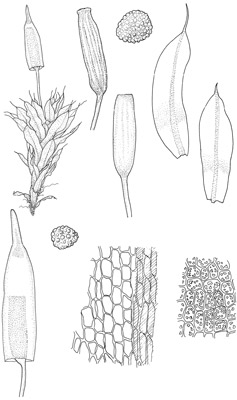
Plants dull, red-brown. Stems to c.8 mm, mostly branched. Leaves oblong-lanceolate, rather abruptly narrowed above to an acute apex, with a short or long hair point, mostly spiralled around the stem when dry, not markedly involute, erect-spreading when moist, entire, c.2.0–3.5 × 1 mm, in cross-section U-shaped or weakly-keeled and with margins plane; upper laminal cells short-oblong or subquadrate, bulging, with several (mostly 4–6) c-shaped papillae, mostly 12–21 × 12–15 µm, grading into the cells of the lower lamina; cells of lower lamina elongate-oblong, smooth, with thin longitudinal walls and strongly thickened yellow-orange transverse walls (especially near base of costa); cells of the lower margin lacking thickened transverse walls, forming a border c.5–6 cells wide which fades at the junction with the papillose laminal cells. Costa stout and prominent, red-brown or less commonly yellow-brown, mostly short- to long-excurrent to form a concolourous or apically pale hair-point, lustrous when dry, smooth below, in cross-section with a 1–2 layers of guide cells, 1 layer of papillose upper cells (not differing from adjacent laminal cells), and a large basal stereid band. Perichaetia often overtopped by innovations, the perichaetial leaves scarcely differentiated. Perigonia located immediately below perichaetia. Setae 3–5 mm, red-brown or orange, smooth, straight, not twisted; capsules exserted, erect, narrowly cylindric, with a weakly defined neck, smooth, weakly striate or furrowed, ± constricted at mouth, with a small and poorly defined neck, longitudinally furrowed when dry, gold-brown, red at mouth, 2.5-3.2 mm; annulus lacking; operculum narrowly long-rostrate from a conic base, straight, c.1.5 mm, often falling with the calyptra. Calyptra narrowly long-mitrate, completely enclosing the capsule, not lobed at base, weakly scabrose near tip, c.5 mm.
Distribution
Indigenous: North Island (Ruahine Ra.); South Island Nelson (Mt. Owen and Mt Arthur Ras.), Canterbury (Broken River basin) and Southland (Murchison Range.); Chatham Islands (Rangiauria (Pitt I.)).Also North and South America, northern Europe, Asia, Antarctica, Hawaii and the South Orkney Islands
Substrate details
Saxicolous and terricolous on base-rich (in New Zealand mostly limestone and marble) rocks where it grows in cracks, crevices and soil filled cavities
Threats
A Naturally Uncommon, mostly alpine species in New Zealand. Most populations are small but secure within national parks. The largest seem to be in Fiordland National Park. It is known in the North Island from one gathering made from the Ruahine Ranges in 1948. Further survey of that area is needed. on the Chatham islands it is known from one site on Rangiauria (Pitt I.) where it grew in a sinkhole on a trachytic peak.
Detailed taxonomy
Genus
Family
Synonyms
None
Endemic genus
No
Endemic family
No
Ecology
Fruiting
May be present throughout the year
Other information
NVS code
The National Vegetation Survey (NVS) Databank is a physical archive and electronic databank containing records of over 94,000 vegetation survey plots - including data from over 19,000 permanent plots. NVS maintains a standard set of species code abbreviations that correspond to standard scientific plant names from the Ngä Tipu o Aotearoa - New Zealand Plants database.
ENCRHA
Previous conservation statuses
This is the first complete assessment of all known species of mosses found in the wild in Aotearoa New Zealand with a total of 560 species being assessed. The conservation status of mosses, published in the NZTCS database, replaces all previous assessments of mosses. Data supporting the 2025 NZTCS assessment of mosses has been published on the NZTCS database at https://nztcs.org.nz/reports/1155.
Source: NZTCS and licensed by DOC for reuse under the Creative Commons Attribution 4.0 International licence.
2014 | At Risk – Naturally Uncommon | Qualifiers: RR, SO
2010 | At Risk – Naturally Uncommon | Qualifiers: RR, SO
2005 | Sparse | Qualifiers: DP